
How to Compost in a Flat With No Garden
A third of household rubbish is compostable — vegetable peelings, coffee grounds, eggshells, cardboard — and in a London flat it all goes to landfill, where it rots anaerobically and releases methane. Composting in a flat with no garden sounds impossible, but three proven indoor systems make it straightforward, odour-free and genuinely useful, even if your “garden” is a windowsill.
This guide compares the methods, gives step-by-step setup for each, solves the smell question honestly, and shows what to do with the finished compost when you have no soil to put it in.
Why compost when you have no garden
The environmental case is strong: composting diverts waste from landfill and, done right, produces no methane. But the personal benefits surprise most flat composters. You will halve your food waste bin’s volume and its smell (paradoxically, separating compostables makes the remaining rubbish less foul). You will produce free, superb fertiliser for houseplants and balcony pots. And you will join the satisfying loop of watching waste become resource — many flat composters describe it as the gateway habit that changed how they think about consumption.
London’s food waste collections help, but they are inconsistent across boroughs and do nothing for the satisfaction — or the free fertiliser — of doing it yourself. If you already work on reducing food waste at home, composting is the natural next step for the unavoidable scraps.
Method 1: wormery (vermicomposting)
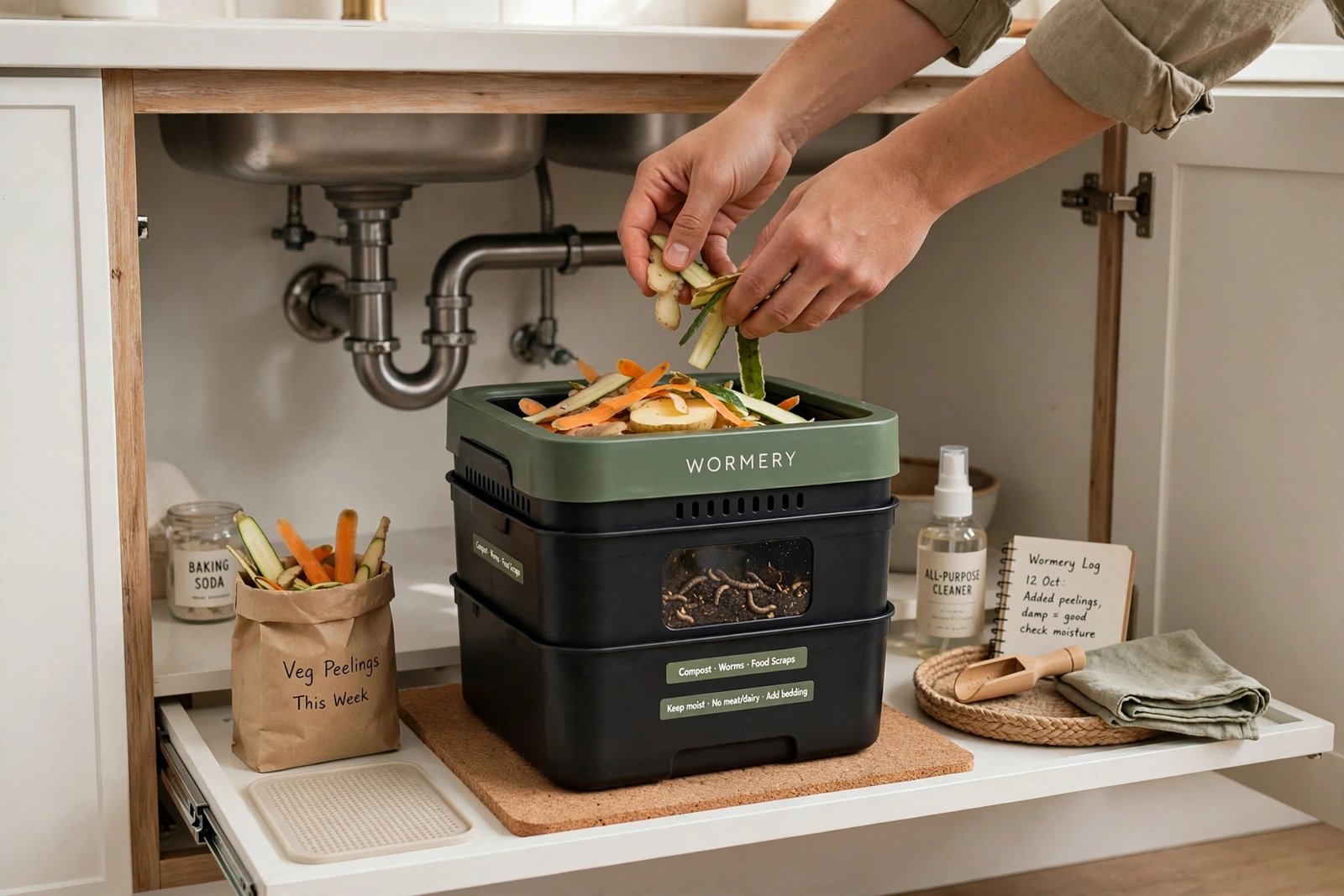
The classic flat solution. A wormery is a stacked tray system housing red wriggler worms that eat your scraps and produce rich compost (“worm castings”) plus liquid feed. A starter kit costs £60–£100, fits under a sink or on a balcony, and processes the scraps of 1–2 people once established.
Setup: layer damp coir or shredded cardboard bedding, add the worms, then feed small amounts of chopped veg scraps, coffee grounds, eggshells and plain cardboard. Avoid: onions, citrus, meat, dairy and oily foods in quantity. Harvest castings every few months from the lowest tray. Wormeries are odourless when balanced — smell means overfeeding or too-wet conditions, both fixable by adding dry cardboard and pausing feeding for a week.
Method 2: bokashi
Bokashi is fermentation, not composting: you layer scraps (including meat, dairy and cooked food — the big advantage) in an airtight bucket with bran inoculated with effective microorganisms. A £40–£60 kit with two buckets handles a household’s scraps continuously. Each layer gets a sprinkle of bran and a firm press to exclude air; the sealed bucket pickles the waste over 2–4 weeks with a mild sweet-sour smell only when opened.
The fermented output is not finished compost — it needs burying in soil or a second stage. For flat dwellers, that means: a wormery as stage two (the perfect pairing), a community garden donation, or a “soil factory” — a large tub of compost layered with the bokashi output, which becomes superb potting mix in a few months. Bokashi’s ability to handle all food waste, including the stuff wormeries cannot, makes it the most complete flat solution.
Method 3: electric composters
Countertop electric composters dehydrate and grind scraps into dry fertiliser flakes in hours. They are fast, genuinely odour-free, and handle almost everything — but they cost £300–£500, use electricity, and produce a soil additive rather than true compost. For time-poor flat dwellers who want zero-fuss operation, they are the premium option; for the budget-conscious, worms and bokashi deliver better value.
The smell question, answered honestly
Done right, indoor composting smells of nothing. A balanced wormery smells faintly earthy; a sealed bokashi bucket smells of nothing until opened. Smells indicate imbalance: too much food, too wet, not enough browns (cardboard, paper). The fix is always the same — add dry carbon material, reduce feeding, ensure drainage. Keep a stash of shredded cardboard by the system and you will rarely have problems.
Fruit flies are the other common complaint: prevent them by burying fresh scraps under bedding or bran, keeping lids sealed, and freezing scraps for 24 hours before adding (kills eggs). A small vinegar trap catches strays. With these habits, flat composting is cleaner than the food waste caddy most people already tolerate.
What to do with finished compost (no garden needed)
This is the question that stops people starting — and it has great answers. Use it: top-dress houseplants (they will visibly thrive), mix into balcony containers, feed a windowsill herb garden. The liquid from wormeries dilutes 10:1 into superb plant feed. Surplus? London’s community gardens gratefully accept compost donations — organising a small flat teaches the same lesson composting does: in small spaces, every output needs a planned destination.
Some boroughs run compost collection points, and apps connecting composters with gardeners are growing. Many flat composters find their “waste problem” becomes a social asset — neighbours with allotments will trade vegetables for your castings. The RHS confirms that homemade compost, whatever its source, outperforms most bagged products for container growing, and Garden Organic offers detailed composting guides for every method.
Getting started this weekend
Pick your method based on temperament: wormery for the nurturing type who likes a living system, bokashi for the pragmatist who wants all food waste handled, electric for the time-poor. Order the kit, designate its spot (under-sink, utility corner, balcony), stock up on cardboard, and start small — a handful of scraps daily while the system establishes. Within a month it will be routine; within three, you will wonder why everyone does not do it.
Conclusion
Composting in a flat with no garden is not a compromise — wormeries, bokashi and electric composters all work brilliantly in small spaces, smell-free when managed, and produce genuinely valuable fertiliser. Start with one system, feed it correctly, and turn a third of your rubbish into something useful. Your plants, your bin men and the planet will all notice the difference — and you will never look at a potato peeling the same way again.
Frequently Asked Questions
Can I compost cooked food in a flat?
Yes with bokashi or an electric composter — both handle cooked food, meat and dairy. Wormeries should stick to raw fruit and veg scraps, coffee grounds, eggshells and cardboard. When in doubt, bokashi first is the safe rule.
Does indoor composting smell?
No — not when balanced. A healthy wormery smells faintly earthy; bokashi is sealed and odourless. Smells signal overfeeding or excess moisture, fixed by adding dry cardboard and pausing feeding.
How long does flat composting take?
Wormeries produce harvestable castings in 3–4 months once established; bokashi ferments in 2–4 weeks but needs a further 2–4 weeks buried or in a soil factory to finish. Electric composters deliver usable output in hours. Patience pays with the biological methods — the results are worth it.
Can I compost meat and dairy in a flat?
With bokashi, yes — fermentation handles meat, dairy, cooked food and bones. Wormeries should avoid them. Electric composters handle almost everything.
How much does it cost to start composting in a flat?
A wormery starter kit is £60–£100, bokashi £40–£60, electric composters £300–£500. Worms and bokashi bran need occasional cheap top-ups.
What do I do with the compost if I have no plants?
Donate to community gardens, trade with allotment neighbours, use borough collection points, or start with houseplants — compost makes a visible difference and often sparks the growing bug.
Will a wormery attract pests?
Not if managed: bury scraps under bedding, keep the lid sealed, freeze scraps before adding to kill fruit-fly eggs, and avoid overfeeding. Balanced wormeries are pest-free.