
Why Is London’s Air So Polluted? The Invisible Killers
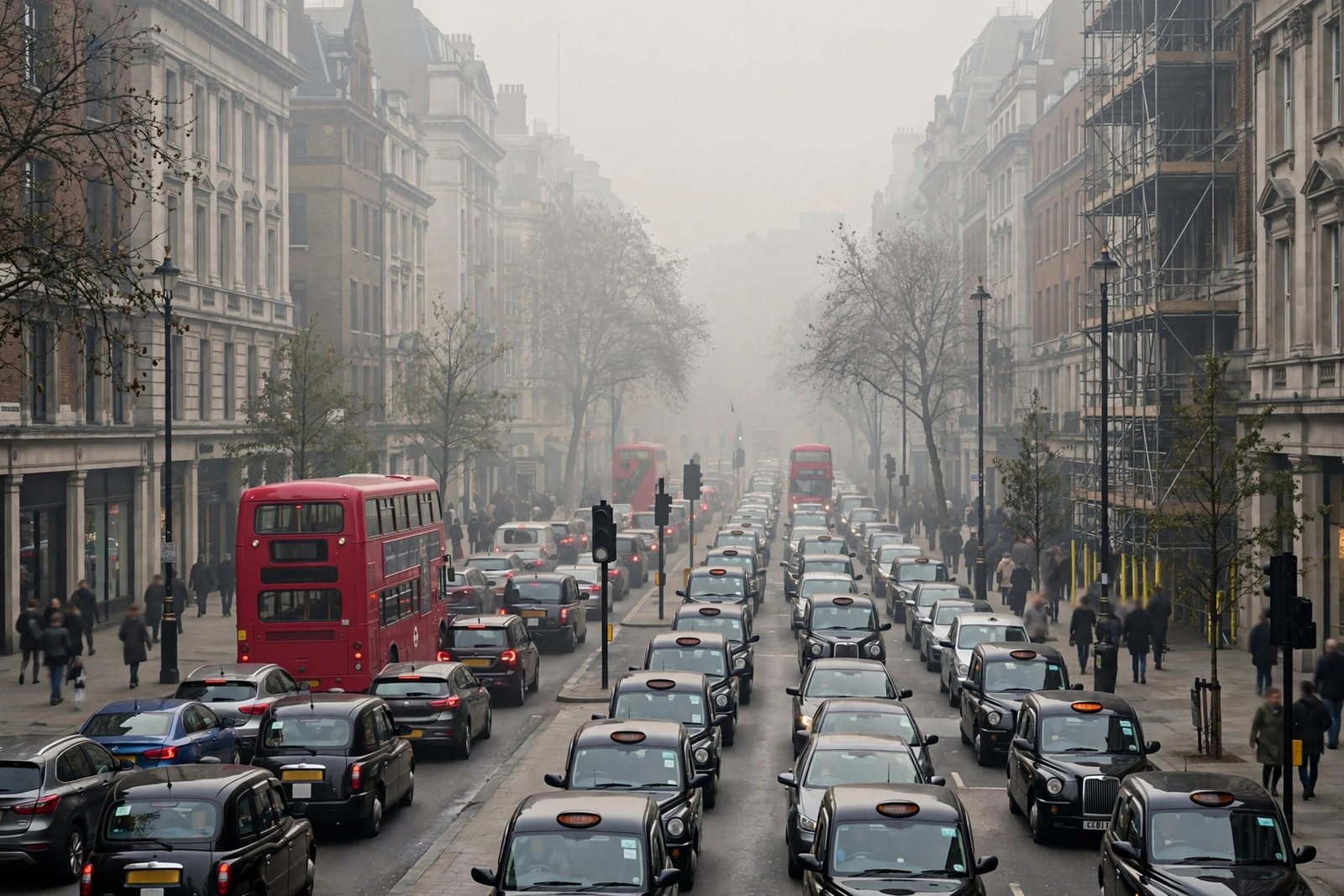
London’s air looks clean. There are no Victorian smogs, no pea-soupers rolling off the Thames — the sky over the Shard is usually a perfectly respectable blue. And yet the air you breathe on Oxford Street is, by the World Health Organization’s standards, unhealthy every single day. Air pollution in London still causes thousands of premature deaths a year, stunts children’s lung development, and costs the economy billions. The killer is invisible: nitrogen dioxide and microscopic particulates, not smoke. Here’s why London’s air is still so polluted, what’s actually being done about it, and what it means for you.
The invisible killers: NO₂ and PM2.5
London’s pollution problem has two main villains. Nitrogen dioxide (NO₂) — a toxic gas produced by combustion engines, especially diesels — irritates airways, triggers asthma attacks, and is linked to heart disease and dementia. Under UK law the annual average must not exceed 40 micrograms per cubic metre; in 2025, four London boroughs still breached it, with Westminster the worst at 49 µg/m³, followed by the City, Lambeth and Camden. And the WHO’s guideline — the level considered actually safe — is 10 µg/m³. Nowhere in London met it.
PM2.5 — fine particulates under 2.5 microns, small enough to cross from lungs into blood — is considered the most damaging pollutant of all, with no recognised safe level. It comes from vehicle exhausts, tyre and brake wear (which electric cars still produce), wood burning, cooking, and construction dust. These particles don’t just affect lungs; they’re implicated in strokes, heart attacks, diabetes, and cognitive decline. The 2025 borough-by-borough pollution data makes sobering reading: legal compliance is improving, but health-based safety remains distant.
Why London specifically?
Several factors conspire. Density: 9 million people, millions of vehicles, and constant construction in a compact area — emissions per square kilometre are inherently high. Diesel’s legacy: two decades of tax policy that pushed drivers toward diesel (lower CO₂, far higher NO₂) left London with a filthy fleet whose effects linger. Street canyons: tall buildings along busy roads trap pollution at breathing height — the same traffic in an open suburb disperses; on Oxford Street it marinates. Wood burning: the fashionable wood-burning stove is now one of London’s biggest PM2.5 sources; a single stove can emit more particulates than a modern diesel car, and domestic burning has surged. The background: pollution drifts in from continental Europe and from surrounding regions, so even car-free central London breathes its neighbours’ emissions.
Children are the most affected and the least responsible: their lungs are developing, they breathe faster relative to body size, and many London schools sit on polluted roads. Studies have found London children’s lung capacity measurably reduced by pollution exposure — damage that persists into adulthood.
What’s working: the ULEZ effect
Here’s the genuinely encouraging part. The Ultra Low Emission Zone — expanded London-wide in August 2023, the largest clean air zone in the world — is working. Independent analysis by Imperial College London’s Environmental Research Group found pollution-related premature deaths fell around 40% between 2019 and 2024, from roughly 6,400–8,000 to 3,800–5,100 a year. NO₂ levels dropped 41% and fine particulates 28% over the same period. London met legal NO₂ limits for the first time in 2024 — nearly two centuries earlier than projected without intervention, according to the Imperial College analysis of the ULEZ expansion.
That’s a staggering public health win — thousands of lives a year — from a policy that was ferociously controversial. It also shows the mechanism clearly: the fleet gets cleaner, the air gets cleaner, people stop dying. The remaining challenge is the last mile: brake and tyre particulates (which cleaner engines don’t fix), domestic wood burning, and construction dust — plus the uncomfortable truth that “legal” still isn’t “safe” by WHO standards.
What you can actually do
Individual action can’t fix a systemic problem, but it can protect you and nudge the system. Choose your routes: pollution varies enormously street by street — walking one block back from a main road can halve your exposure. Cycle and walking routes through parks and side streets aren’t just pleasanter, they’re measurably cleaner. Time it: pollution peaks with rush hour; exercising at midday rather than 8am meaningfully reduces intake. Speaking of which, the benefits of activity still outweigh the pollution costs for almost everyone — see whether morning or evening exercise is better, and consider parks over main roads.
At home: don’t idle the car, avoid wood burning (especially in smoke control areas — most of London), and ventilate with an eye on timing (midday air is cleaner than rush-hour air). If you’re cutting domestic emissions generally, reducing energy bills this winter overlaps neatly — insulation and heat pumps cut both carbon and local pollution. And for the trips you can shift: good walking shoes make the cleanest transport choice — your feet — the easy one.
The WHO gap: why “legal” still isn’t safe
Here’s the uncomfortable footnote to the ULEZ success story: UK legal limits are far weaker than the WHO guidelines, which reflect the actual health science. The UK allows 40 µg/m³ of NO₂ annually; the WHO says 10. For PM2.5, the UK limit is 20 µg/m³ against a WHO guideline of 5. London now passes its own laws while failing the health-based standards everywhere — which means “compliant” air still carries measurable risk. Campaigners argue the legal limits should be tightened to WHO levels; the government’s response has been cautious. The practical takeaway: don’t treat legal compliance as a clean bill of health. The direction of travel is excellent, but the destination — air that’s actually safe to breathe by the best available science — is still years and several more bold decisions away.
Frequently asked questions
Is London’s air actually dangerous, or is this exaggerated?
Genuinely dangerous by health standards, genuinely improved by legal ones. The 40% fall in pollution-related deaths since 2019 is real progress — but thousands still die prematurely each year, and no part of London meets WHO safety guidelines. Both facts are true simultaneously.
Which parts of London have the worst air?
Central boroughs with the heaviest traffic: Westminster, the City of London, Lambeth and Camden topped the 2025 NO₂ figures. Proximity to busy roads matters more than borough, though — a quiet street in Westminster can beat a main road in the suburbs.
Do electric cars solve air pollution?
Partially. They eliminate exhaust NO₂, which is huge — but tyre and brake wear still produce PM2.5, roughly comparable between EVs and conventional cars. The full solution needs fewer vehicle miles as well as cleaner vehicles.
Should I wear a mask on high-pollution days?
For most people, no — choosing cleaner routes and timing matters more. On rare very-high-pollution days, vulnerable people (asthmatics, heart conditions) should follow official guidance to reduce strenuous outdoor exertion. Check the daily air quality index if you’re sensitive.
Are wood-burning stoves really that bad?
Yes — domestic wood burning is now among London’s largest sources of PM2.5, with a single stove emitting more particulates than a modern diesel car. Most of London is a smoke control area with strict rules; the cosy aesthetic has a genuine public health cost.
The bottom line
London’s air is polluted because 9 million people, millions of vehicles, diesel’s toxic legacy, street-canyon trapping, and wood burning combine in one compact city — and the pollution is invisible, so it never provokes the outrage the old smogs did. But the ULEZ story proves the hopeful part: sustained policy cut pollution deaths 40% in five years. The air is getting cleaner, measurably, because of decisions — which means the remaining gap to genuinely safe air is also a matter of decisions. Breathe accordingly, choose the back streets, and keep the pressure on.