
What Is the Simplest Way to Track Habits? The 10-Second System
You’ve decided to build better habits. You’ve read the books, bought the journal, downloaded the app — and now you’re paralysed by the meta-question: what’s the simplest way to track all this? The habit-tracking world offers a bewildering menu: elaborate bullet journals, colour-coded spreadsheets, seven different apps with streaks and stats and social features. Here’s the liberating truth the productivity industry won’t tell you: the best tracking system is the simplest one you’ll actually use, and for most people, that’s embarrassingly low-tech. This is a guide to tracking habits with the minimum effective dose — and why simpler beats sophisticated every time.
Why tracking works (it’s not what you think)
Habit tracking works through three mechanisms, and understanding them tells you exactly how much system you need. Awareness: you can’t change what you don’t notice, and a daily check-in forces a moment of honest accounting. Consistency feedback: seeing a chain of successes motivates continuation — the famous “don’t break the chain” effect, which works because loss aversion makes an unbroken streak feel valuable. Data: over weeks, the log reveals patterns — which habits stick, which contexts derail you, what your real (not imagined) consistency looks like.
Notice what isn’t on the list: optimisation, analytics, gamification, or sharing. The research on self-monitoring — one of the most replicated findings in behaviour science — shows that the act of recording is the active ingredient. Fancy features are mostly decoration. A 2019 review found that simple daily self-monitoring outperformed complex systems for adherence, largely because complexity creates friction, and friction kills the very consistency you’re trying to build.
The paperclip method: tracking in 10 seconds a day
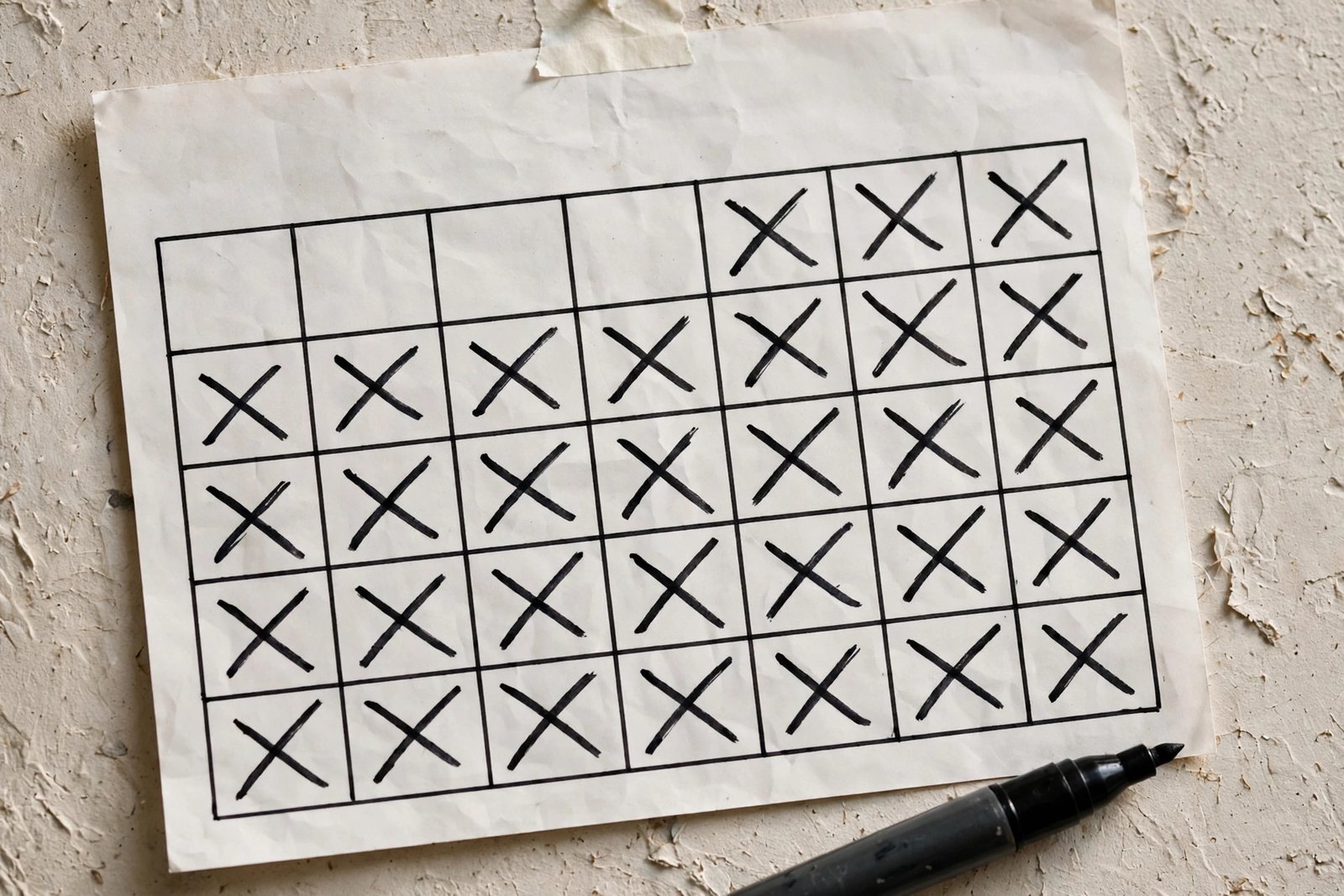
The simplest effective system ever devised: one habit, one binary question, one mark. Get a wall calendar (paper, large) and a marker. Each day you do the habit, draw a big X through the day. That’s it. The growing chain of X’s becomes its own motivation, the calendar on the wall is impossible to ignore, and the whole system takes ten seconds daily with zero learning curve.
For multiple habits, use a single index card per week: habits as rows, days as columns, ticks in the boxes. One card, one week, everything visible at a glance. Keep it where you’ll see it — fridge, bathroom mirror, desk. The physical visibility matters: out of sight is out of mind, and apps buried on screen three don’t get opened. If you want the digital equivalent, a single notes-app checklist (ticked daily) beats any dedicated habit app for most people. Complexity is the enemy; the calendar on the fridge has outperformed every app in the history of personal trials.
What to track (and what to skip)
Track behaviours, not outcomes. “Went for a walk” is trackable; “lost weight” is a lagging outcome you can’t directly control. Track the input and let the output follow. Track binary, not graded: did you do it, yes or no? Rating quality (“meditated: 6/10”) adds judgement without information and makes the log feel like school. One exception: for habits like exercise, noting the amount (minutes, distance) is useful data — see how much exercise you actually need per week for realistic targets worth tracking toward.
Track few, not many. The magic number is 1–3 habits at a time. Every additional habit divides attention and multiplies the chance of total abandonment. Master the first set until they’re automatic (2–3 months), then add more. And track streaks loosely: the “never miss twice” rule beats “never miss once” because perfectionism is the leading cause of tracking-system death. Miss Monday? Fine. The rule is: never miss Monday and Tuesday. A broken streak you resume beats a perfect streak you abandoned in week three.
Level up only when simple stops working
Start with paper. Only add sophistication when you hit a specific limit: if you want pattern analysis (which days derail you?), a spreadsheet’s worth of data helps. If you want reminders, phone alarms tied to existing routines work. If you’re tracking something with numbers (spending, pages, minutes), a simple spreadsheet row per day is plenty — the NHS Every Mind Matters approach to behaviour change emphasises exactly this: small, concrete, recorded actions over elaborate systems.
What about apps? They’re fine if — and only if — you already open the app daily for another reason, the input takes under ten seconds, and you don’t need an account, a subscription, or a tutorial. The moment a habit tracker needs its own habit to maintain, it’s failed. Be honest about which category yours falls into. And for habits tied to routines like meals, piggyback the tracking onto the routine itself: tick the meal-prep boxes while the food cools. Speaking of which, meal prepping for the week on a budget is a perfect candidate for the index-card method — five boxes, five days, visible on the fridge.
Review monthly, not daily
Daily tracking is for doing; monthly review is for learning. Once a month, spend ten minutes looking at the log: which habits stuck and why? Which died, and what was the context — travel, illness, stress, or just fading novelty? What will you change? This review is where the data pays off, and it’s the step almost everyone skips. Put it in the calendar now: last Sunday of the month, ten minutes, cup of tea.
And reframe what the log is for. It’s not a report card — it’s a scientist’s notebook. A week of missed ticks isn’t failure; it’s data about your life (you were ill, work exploded, the habit was wrong-sized). Adjust the habit, not your self-worth. The people who track successfully for years aren’t the disciplined ones — they’re the ones who kept the system so simple it survived their worst weeks. The NHS five steps to wellbeing include “take notice” — and a one-line daily tick is taking notice in its most minimal form.
Frequently asked questions
Paper or app for habit tracking?
Paper for most people: zero friction, always visible, no battery, no subscription. Apps only if you’d genuinely open them daily anyway and input takes seconds. The best system is the one with the lowest barrier between you and the tick.
How many habits can I track at once?
One to three. More than that divides focus and the whole system tends to collapse. Build the first set to automaticity (a couple of months), then add the next. Slow stacking beats ambitious collapsing.
What if I break my streak?
Resume immediately — the “never miss twice” rule. A broken streak is only fatal if you decide it is. Research shows self-compassion after lapses predicts better long-term adherence than self-criticism. Tick today’s box and move on.
Should I track outcomes like weight or just behaviours?
Behaviours primarily — they’re what you control. Outcomes lag, fluctuate, and demotivate when they don’t move. If outcomes matter to you, track them separately and infrequently (weekly, not daily), and judge the behaviours daily.
How long until I can stop tracking?
When the habit is genuinely automatic — you do it without deciding, usually 2–8 months depending on complexity. Many people keep the lightest possible tracking indefinitely because the awareness itself has value. There’s no prize for stopping; keep what serves you.
The bottom line
The simplest way to track habits is a wall calendar and a marker: one X per day per habit, visible, ten seconds, done. Track behaviours not outcomes, keep it to one to three habits, never miss twice, and review monthly. Everything fancier is optional — and most of it is just friction wearing a productivity costume. Start stupidly simple. Simple is what survives.