
The Best Way to Learn to Cook as a Beginner
The Best Way to Learn to Cook as a Beginner
I learned to cook at 26 out of pure financial necessity — my takeaway habit was costing more than my rent increase, and something had to give. Five years later I cook most nights, genuinely enjoy it, and spend a fraction of what I used to on food. The transformation didn’t come from a fancy course or a celebrity chef’s book. It came from learning a small set of skills in the right order and cooking the same forgiving dishes until they became automatic. Here’s the path I’d recommend to any beginner. This guide covers the best way to learn to cook as a beginner — the 8 skills that matter, the kit worth buying, and the meals to start with.
Start With the Right Mindset (Seriously)
Beginner cooks fail for psychological reasons, not technical ones. The three mindset shifts that matter:
- Aim for “good enough”, not impressive. Your goal is tasty food on the table in 30 minutes, not a dinner party showpiece. A decent pasta beats an ambitious failed soufflé.
- Repeat dishes. Cook the same 8–10 meals until they’re effortless, then expand. Variety comes later; competence comes from repetition.
- Embrace the failures. You will burn things, over-salt things, and serve at least one genuinely inedible meal. Every cook has. It’s tuition, not tragedy.
The 8 Skills That Change Everything
You don’t need 50 techniques. These eight cover 90% of home cooking:
- Knife skills: how to hold a knife, dice an onion, chop veg safely (claw grip!). Everything gets faster and safer. Plenty of free YouTube tutorials.
- Seasoning: salt early, taste often. Most beginner food is under-salted, not under-spiced.
- Heat control: when to go fierce (searing meat) vs gentle (sweating onions). If it’s burning, the heat’s too high — turn it down, it’s not cheating.
- Cooking pasta/rice properly: salted boiling water, don’t overcook, save pasta water for sauces.
- Frying an egg / cooking chicken safely: the weeknight proteins. Learn internal temps (75°C for chicken) or just cut it open — no shame.
- Making a basic sauce: tinned tomatoes + garlic + onion = pasta sauce, curry base, chilli base. One technique, endless meals.
- Roasting veg: hot oven, oil, salt, 25 minutes. Impossible to mess up, delicious every time.
- Reading a recipe properly: read it twice before starting, prep everything first (mise en place). Half of kitchen disasters are “oh, I needed that now?”
The Only Kit You Actually Need
Don’t buy a 15-piece knife set. You need:
- One good chef’s knife (8 inch, £20–£40 — Victorinox is the value king)
- A large chopping board
- A big saucepan, a frying pan, and a baking tray
- A wooden spoon, a spatula, tongs
- A colander and a couple of mixing bowls
That’s genuinely it to start. Add a slow cooker (£30) later if you want set-and-forget stews — brilliant for beginners. Buy decent, buy once; cheap non-stick pans that warp in six months are false economy.
Your First 10 Meals (In Order)
Learn these in sequence — each builds on the last:
- Pasta with tomato sauce (knife skills, boiling, sauce)
- Stir-fry (heat control, chopping, timing)
- Omelette or frittata (eggs, pan control)
- Chicken curry (spices, simmering, rice)
- Chilli con carne (browning meat, one-pot)
- Roast chicken traybake (oven, timing a full meal)
- Spaghetti bolognese (building flavour, longer simmer)
- Lentil dahl (cheap, forgiving, nutritious)
- Fajitas (quick, fun, assembly)
- A simple soup (using up veg, blending)
Master these and you can feed yourself well forever. Pair this with our meal planning guide and your grocery bill will drop while your eating improves — the rare win-win.
Best Free Ways to Learn
- YouTube: channels like Basics with Babish, Joshua Weissman (his “but cheaper” series), and Ethan Chlebowski teach technique brilliantly and free.
- BBC Good Food: the UK’s best free recipe site — reliable, tested, with videos for techniques.
- Library cookbooks: free, and librarians will order anything. Start with a general beginner book before buying.
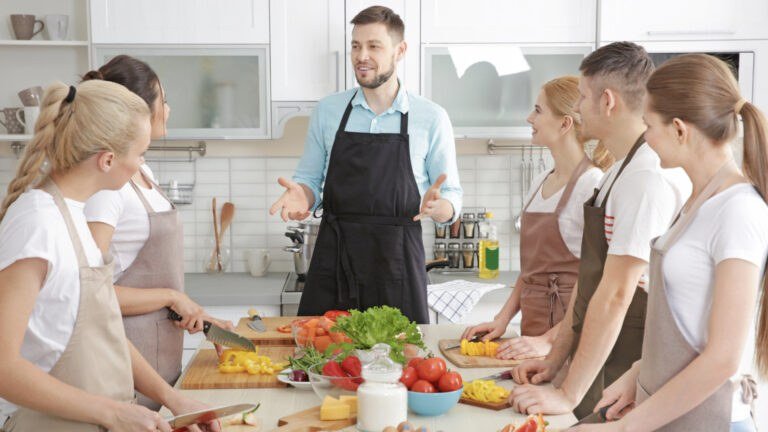
- Cook alongside someone: the fastest way to learn. Offer to be the sous-chef for a friend who cooks.
The 4-Week Beginner Plan
Week 1: Cook meals 1–3 twice each. Focus on knife safety and seasoning.
Week 2: Meals 4–6. Practice heat control and timing.
Week 3: Meals 7–8. Try cooking for a friend — accountability accelerates learning.
Week 4: Meals 9–10, plus repeat your favourites. Start meal planning for the month ahead.
By week four you’ll be cooking confidently most nights. That’s faster than most people expect — cooking has a steep initial curve that flattens quickly.
Cooking on a Budget: The Economics
Learning to cook isn’t just a life skill — it’s one of the highest-ROI skills you can acquire. The numbers: a home-cooked dinner costs £1.50–£3 per portion; the equivalent takeaway £10–£15; a restaurant £20+. Cook 5 nights a week instead of ordering 3 takeaways, and you save £150–£250/month — £1,800–£3,000 a year. That’s a holiday, funded by pasta.
The budget-cooking principles:
- Build meals around cheap staples: rice, pasta, lentils, oats, potatoes, eggs, tinned tomatoes, frozen veg. The world’s great cuisines are built on these — dal, pasta, stir-fry, chilli.
- Buy meat strategically: chicken thighs over breast (cheaper, tastier), cheaper cuts for slow cooking, and treat meat as a flavouring rather than the centrepiece sometimes.
- Waste nothing: stale bread becomes breadcrumbs/croutons, veg scraps become stock, leftovers become lunch. Our meal planning guide systematises this.
- Spices are an investment: £20 of basic spices (cumin, coriander, turmeric, paprika, oregano, chilli, cinnamon) transforms cheap ingredients for a year. Buy at world-food shops for half the supermarket price.
For the full financial picture, see our weekly shop costs and BBC Good Food’s budget recipes — hundreds of tested £1-a-portion meals.
Level 2: Once the Basics Are Solid
After 2–3 months of the 10-meal rotation, expand deliberately:
- Learn one cuisine properly: pick the food you love most (Italian, Indian, Thai, Mexican) and learn its 5–6 core dishes. Depth beats breadth — you’ll cook better food faster.
- Master eggs: omelettes, frittatas, shakshuka, eggs Benedict — the difference between a cook and someone who heats things up.
- Bread: a simple no-knead loaf is 5 minutes of effort and life-changingly good. It also makes you insufferable at dinner parties (worth it).
- Knife skills 2.0: speed comes with practice; focus on consistency (even pieces cook evenly).
- Cook for others regularly: nothing accelerates learning like the mild terror of feeding friends. Start with forgiving crowd-pleasers (curry, chilli, pasta bake) and build up to dinner parties.
Common Beginner Mistakes (and Fixes)
- Overcrowding the pan: food steams instead of sears. Cook in batches — patience, not a bigger pan.
- Not preheating: pans, ovens, oil. Hot pan, then oil, then food — in that order.
- Under-seasoning: salt in layers (during cooking, not just at the end). Taste constantly.
- Following recipes too rigidly: recipes are guides, not contracts. Learn the why and you’ll improvise confidently.
- Too many new recipes: the #1 beginner error. Master a few; variety follows competence.
The Practical Takeaway
The best way to learn to cook is: get minimal decent kit, learn 8 core skills, cook the same 10 forgiving meals on repeat, and use free YouTube/BBC Good Food resources. Don’t buy gadgets, don’t start with soufflés, and don’t compare yourself to Instagram. In a month you’ll be self-sufficient; in six months you’ll be the friend people ask for recipes. And if the cat’s been watching you cook with interest, our piece on keeping a cat in a London flat covers the other resident of your kitchen.