
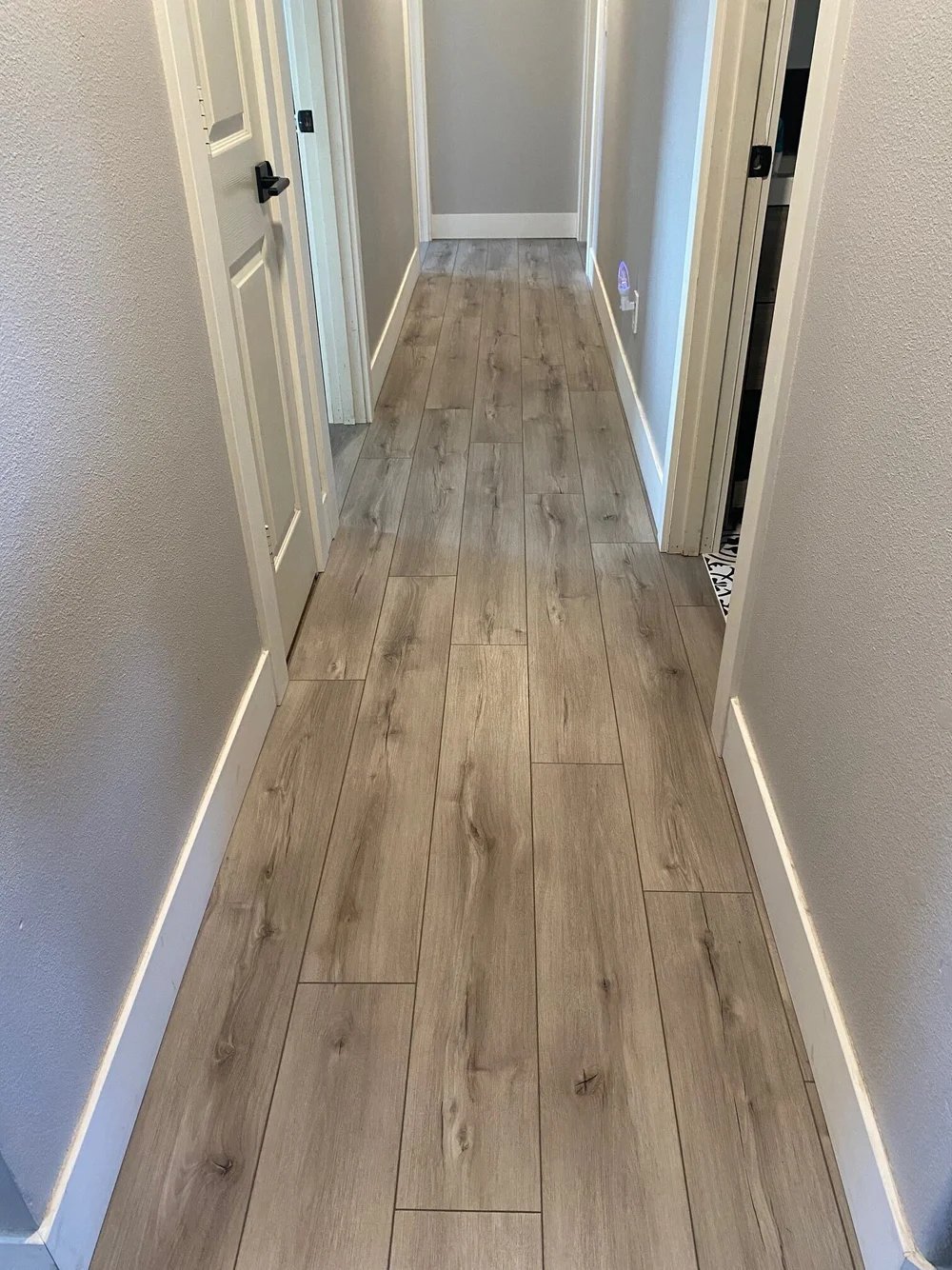
Laminate vs Vinyl Flooring: Which Is Better for a Busy Family Home?
Laminate vs Vinyl Flooring: Which Is Better for a Busy Family Home?
Kids, dogs, muddy boots, spilled juice — family floors take a beating. The two contenders for most UK family homes are laminate and luxury vinyl (LVT). So is laminate or vinyl flooring better for a busy family home? Here’s the honest head-to-head.
Quick verdict
Vinyl (LVT) wins for most busy family homes — it’s waterproof, quieter, softer underfoot and more forgiving. Laminate wins on price and wood-look realism in dry areas. Many families do both: vinyl in kitchen/hallway, laminate in living rooms/bedrooms. But let’s break it down properly.
Round 1: Water resistance — vinyl wins decisively
Standard laminate swells and ruins if water sits on it — a leaking dishwasher or an overflowing bath can destroy a laminate floor. LVT is fully waterproof: spills, pet accidents, wet boots — wipe and forget. For kitchens, bathrooms, utility rooms and hallways, vinyl isn’t just better, it’s the only sensible choice. (Water-resistant laminate exists but costs more and still isn’t truly waterproof.)
Round 2: Durability and wear — close, slight edge to vinyl
- Laminate: excellent scratch resistance (the AC wear layer is tough) — great against toy cars and chair legs. But chips on edges show, and it can’t be repaired — damaged planks must be replaced.
- Vinyl: slightly softer surface can dent under heavy furniture (use felt pads), but individual tiles/planks are easier to replace, and it doesn’t chip.
- With kids and pets: vinyl’s repairabability gives it the edge over time.
Round 3: Comfort and noise — vinyl wins
Laminate is hard and can sound clicky/hollow underfoot (good underlay helps but doesn’t eliminate it). Vinyl is softer, warmer and much quieter — a big deal in family homes where someone’s always running across the floor, and essential in flats with neighbours below. If you’ve ever lived under laminate, you know.
Round 4: Looks — laminate edges it
Modern laminate’s wood-effect printing and textured grain are remarkably convincing — at a glance, good laminate passes for engineered wood. LVT has improved enormously (and offers stone/tile effects laminate can’t), but the very best wood-look realism still belongs to premium laminate. That said, most visitors can’t tell either from real wood anymore.
Round 5: Price — laminate wins
- Laminate fitted: £18–£45/sqm (see laminate costs per sqm)
- LVT fitted: £25–£60/sqm — typically £5–£15/sqm more than equivalent laminate
For a 50 sqm downstairs, that’s a £250–£750 difference — real money, but spread over 15+ years of family life, the vinyl premium is modest.
Round 6: Installation — both DIY-friendly
Both come in click-lock floating formats a competent DIYer can install. LVT also comes in glue-down (pro job, flattest finish) and loose-lay options. Laminate needs an expansion gap and underlay; LVT needs a flatter subfloor (it shows bumps). Honestly, both are weekend-DIY-able — see our guide to laying vinyl flooring as a beginner.
The family-home recommendation
- Kitchen, bathroom, utility, hallway: vinyl, no contest (waterproof)
- Living room, dining room: either — vinyl for comfort/quiet, laminate for budget
- Bedrooms: laminate is fine (dry, low-traffic); carpet is warmer if you prefer
- With dogs: vinyl — claws, muddy paws, the occasional accident
- Flats: vinyl — your downstairs neighbours will thank you
- Tight budget, dry rooms: laminate — unbeatable value
The bottom line
For a busy family home, vinyl (LVT) is the better all-rounder: waterproof, quiet, comfortable and repairable. Laminate remains the value champion for dry living areas. The smartest family flooring strategy isn’t either/or — it’s vinyl where water and noise matter, laminate (or carpet) where they don’t. Your future self, mopping up the third spilled drink of the day, will be glad you chose waterproof where it counts.
What about real wood or carpet? (The wider context)
Laminate vs vinyl dominates the debate, but the full picture includes: Engineered wood (£40–£80/sqm fitted) — real wood, beautiful, can be refinished 1–2 times, but scratches, dents and water-marks with family life. Worth it in low-traffic adult spaces (dining room, study); brave in a playroom. Carpet (£15–£35/sqm) — warm, quiet, soft for babies — but stains permanently and harbours allergens. Many families do carpet upstairs, hard flooring downstairs — the classic UK compromise.
Solid wood: gorgeous, lasts generations, but £60–£100+/sqm and hates water — a luxury choice, not a family-practical one. Tiles (porcelain): indestructible and waterproof, but cold, hard and unforgiving on dropped things (and toddler heads). Underfloor heating transforms tiles — without it, they’re brutal in British winters. For most busy families, the vinyl-downstairs/carpet-upstairs combination remains the pragmatic champion.
Flooring FAQs
Which is better for pets — laminate or vinyl? Vinyl — waterproof against accidents, quieter for nervous dogs, warmer for old joints, and individual planks are replaceable when claws win. Laminate’s hardness is actually good for claw wear, but one water bowl spill in the wrong place ruins it. Dog owners: vinyl, no contest.
Which is better for allergies? Both beat carpet — hard floors don’t harbour dust mites. Vinyl has a slight edge (fewer joints for dust, damp-moppable). Either way, hard flooring + a good vacuum with HEPA filter transforms allergy sufferers’ lives versus carpet.
Can I mix laminate and vinyl in one house? Absolutely — it’s the smartest approach: vinyl in kitchen/bathroom/hallway (wet zones), laminate in living/bedrooms (dry zones). Use threshold strips at transitions. The height difference is minimal (both 8–12mm typically) — plan the underlay to match levels.
Which is easier to replace if damaged? Click vinyl and click laminate are equally replaceable — unclick the damaged plank (working back from the nearest wall) and click in a new one. Glue-down vinyl is harder (heat gun, scraping). Keep spare planks from the original batch — dye lots vary and matching later is difficult.
Does underfloor heating work with both? Yes — both are compatible with water-based UFH (check the manufacturer’s max temperature, usually 27°C surface). Vinyl conducts heat slightly better (thinner, denser). With electric UFH mats, check compatibility — some laminates restrict it. Neither likes rapid temperature cycling — warm up gradually.
Related reading
See laminate costs per square metre and Checkatrade’s flooring cost guides for fitted prices.