
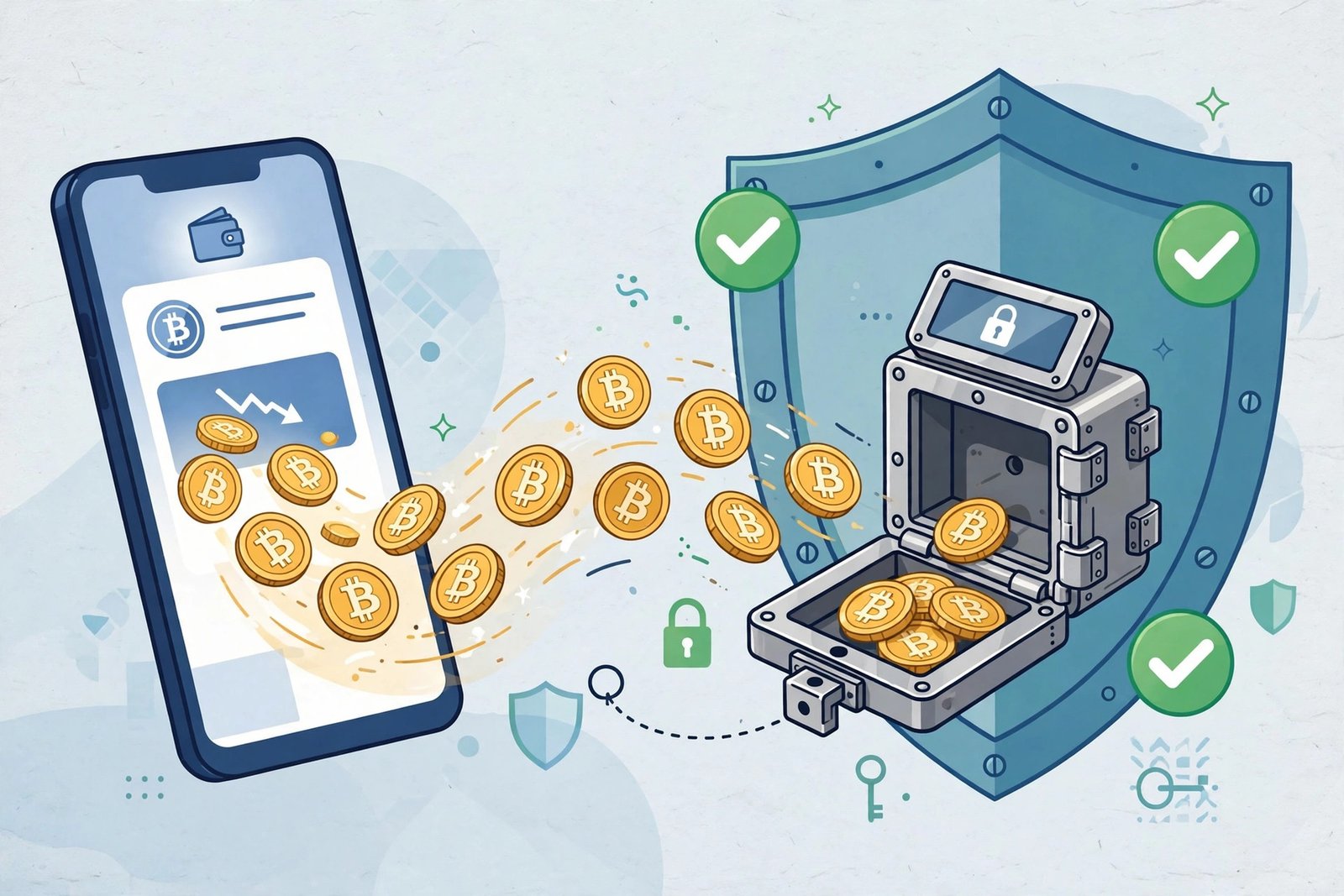
How to Transfer Crypto Off an Exchange Safely (2026)
There’s a moment in every crypto investor’s journey when the balance on the exchange stops feeling like “play money” and starts feeling like real money — and the thought arrives: what if the exchange gets hacked, freezes withdrawals, or simply disappears? That instinct is correct. “Not your keys, not your coins” isn’t tribal posturing; it’s the lived lesson of every exchange collapse in crypto history. Moving your crypto off the exchange and into a wallet you control is the single biggest security upgrade you can make. Done carefully, it takes twenty minutes. Done carelessly, it’s how coins get lost forever.
This guide walks you through the entire process safely: preparation, the transfer itself, verification, and the mistakes that lose people money.
Before you move anything: the preparation checklist
Rushing this process is how funds get lost. Work through this list first. 1. Set up your destination wallet properly. Whether it’s a hardware wallet or a reputable software wallet, complete the full setup — including writing down your seed phrase on paper and storing it securely — before any crypto moves. 2. Verify your wallet address. Copy it from the wallet app itself (never from an email, message or screenshot), and double-check the first and last six characters. 3. Match the network. If you’re moving Ethereum, make sure you’re withdrawing via the Ethereum network to an Ethereum address. Withdrawing on the wrong network is the #1 irreversible error. 4. Check fees. Look at current network fees and the exchange’s withdrawal fee — moving £30 with a £8 fee is a 25%+ haircut, so consolidate small balances first.
5. Secure your environment. Do this on your own device, on your own network — not on public Wi-Fi, not on a borrowed laptop. Malware that swaps copied addresses (clipboard hijackers) is a real and common threat. If you haven’t already, read our guide to spotting phishing attempts, since fake “withdrawal confirmation” emails are a classic attack timed to this exact moment.
The transfer: step by step
With preparation done, the actual move is straightforward. Step 1: On the exchange, go to Withdraw (not Sell — you’re moving crypto, not cashing out). Select the asset and the correct network. Step 2: Paste your wallet address. Triple-check it — character by character at the start and end. Many exchanges show a warning if the address format doesn’t match the network; heed it. Step 3: Enter a small test amount first. This is non-negotiable. Send £20–£50 worth, wait for it to arrive in your wallet, and only then send the remainder. The test costs one extra network fee and has saved countless investors from catastrophic address errors.
Step 4: Complete any exchange security checks — email confirmations, authenticator codes, and the waiting period some exchanges impose on new withdrawal addresses (often 24–48 hours; whitelist your address in advance to avoid this delay next time). Step 5: Send the main amount. Step 6: Verify arrival. Don’t trust the exchange’s “completed” status alone — check the receiving wallet and, for large amounts, the transaction on a block explorer using the TXID.
How long should it take?
Expect two phases. The exchange phase (security reviews, batching) can take minutes to several hours — occasionally longer for large or first-time withdrawals. The blockchain phase depends on the network: Bitcoin typically 10–60 minutes for standard confirmations, Ethereum a few minutes, though congestion extends both. If hours pass with no movement, check the exchange’s status page first (withdrawals are sometimes paused during volatility), then paste the transaction ID into a block explorer. Patience plus verification resolves nearly every “stuck” transfer; the funds are either still with the exchange or visible on-chain.
The mistakes that lose people money
Learn from others’ expensive errors. Wrong network: sending tokens via BSC to an Ethereum-only wallet address strands them — sometimes recoverable, sometimes not. Skipping the test amount: the one time you skip it will be the time the address was wrong. Clipboard malware: always visually verify the pasted address. Withdrawing to an exchange deposit address that’s expired: some exchanges rotate deposit addresses; for withdrawals from an exchange this doesn’t apply, but never send to an old address without checking. Panic resending: if a transfer is slow, don’t send a duplicate — you’ll pay twice when both arrive.
And the meta-mistake: moving crypto you can’t afford to experiment with before you understand wallets. If the amount would devastate you to lose, practise the full process with a trivial sum first — set up the wallet, send £20, restore the wallet from seed phrase on a spare device, then proceed. Competence first, size second. Throughout the process, remember that no legitimate support agent will ever contact you first — and with AI phone scams now impersonating exchange staff, verify any “help” through official channels only.
After the move: what good self-custody looks like
Arrival isn’t the finish line. Confirm the full balance in your wallet, then secure the seed phrase: paper (or steel for large sums), two separate physical locations, never photographed or cloud-stored. Consider whether this wallet is your long-term home or a staging post — many investors keep a small “hot” amount accessible and the bulk in cold storage. Update your records for HMRC: moving between your own wallets isn’t a taxable event, but document it anyway so the trail is clean. And if this transfer represents meaningful wealth, think about inheritance: ensure a trusted person could access your crypto if something happened to you, without giving them access now. A sealed envelope held by a solicitor is the standard solution.
The FCA’s consumer guidance and the NCSC’s online safety tips both reinforce the same fundamentals: verify addresses, secure your devices, and trust no unsolicited “help”.
Conclusion
Transferring crypto off an exchange safely comes down to a disciplined sequence: prepare the destination wallet first, verify address and network meticulously, always send a small test amount, complete security checks patiently, and verify arrival on-chain. It takes twenty careful minutes and protects you against the single biggest risk in crypto — trusting someone else with your keys. Do it once, do it right, and the anxiety of “what if the exchange…” disappears for good.
Frequently Asked Questions
Is it safe to keep crypto on a big exchange?
For small trading amounts, acceptably — but exchanges have been hacked and collapsed before, and UK holdings lack FSCS protection. As your balance grows, self-custody becomes increasingly sensible.
How much does it cost to withdraw crypto?
Two fees: the exchange’s withdrawal fee (often flat, e.g. £1–£5 equivalent) plus the blockchain network fee (varies with congestion). Check both before withdrawing small amounts.
Can I reverse a crypto withdrawal sent to the wrong address?
No — blockchain transactions are irreversible. This is why test amounts and address verification are essential. If you sent to an address you control on another platform, contact their support immediately.
Do I pay tax when moving crypto to my own wallet?
No. Transfers between wallets you own aren’t disposals for CGT purposes. But keep records proving both wallets are yours, in case HMRC ever asks.
Should I move all my crypto off the exchange at once?
If you’re moving a large amount, consider splitting it into two or three transfers rather than one — it limits the damage from any single error. The extra network fees are cheap insurance.