
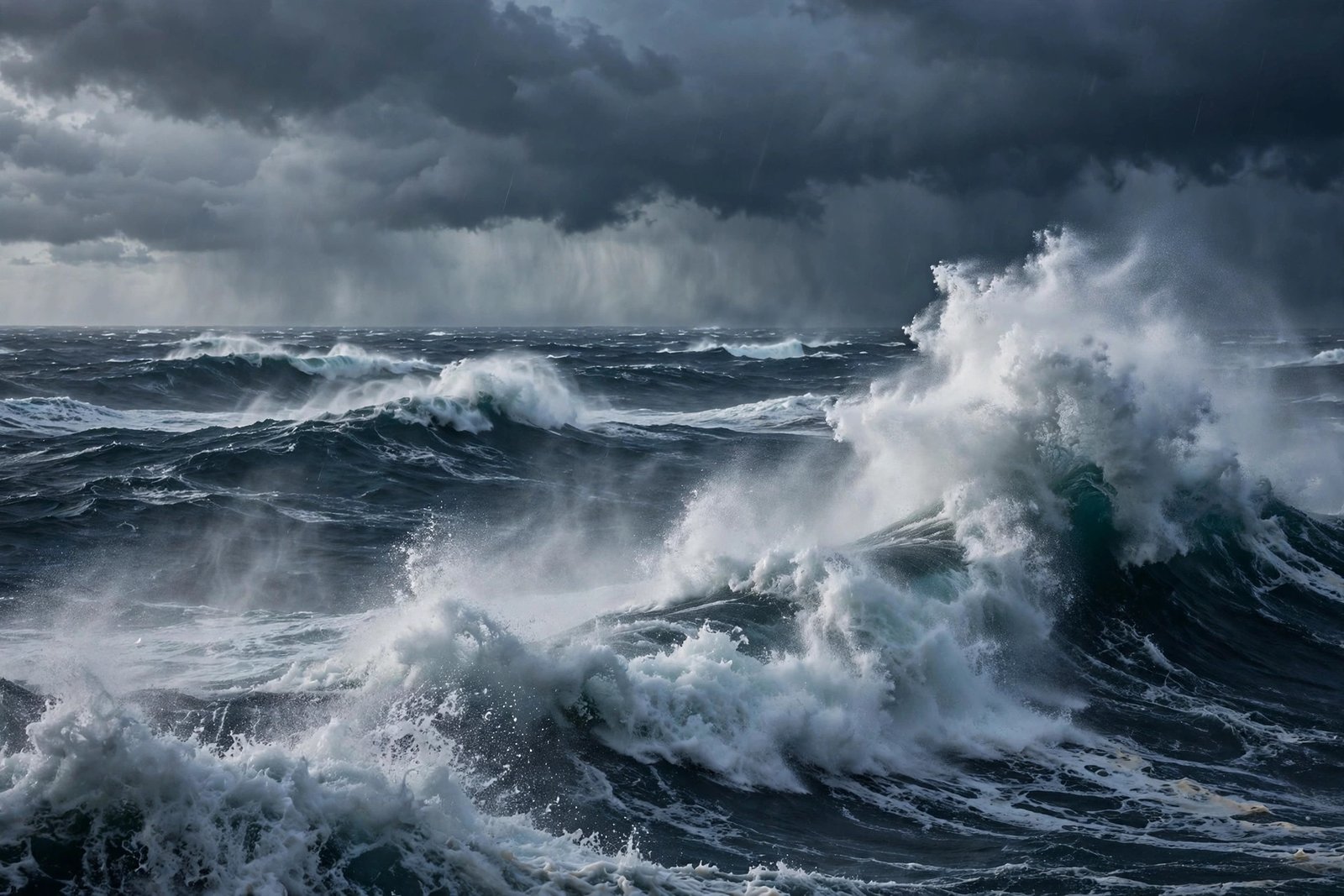
Why Is Seawater Salty When Rain Is Not? The Billion-Year Answer
It is a question that seems almost too simple to be interesting — until you think about it for thirty seconds. Rain falls from the same sky over land and sea. Rivers flow into the ocean constantly. So why is seawater mouth-puckeringly salty while rain is essentially pure water? The answer spans billions of years, involves the slow grinding of continents, and reveals an elegant planetary balancing act that keeps the oceans’ saltiness remarkably stable.
Rain is nature’s distilled water
Start with rain. Rain begins as evaporation: the Sun heats the ocean surface, water molecules escape as vapour — and crucially, salt does not evaporate with them. The phase change from liquid to gas acts as a perfect filter, leaving every dissolved mineral behind. The vapour rises, cools, condenses around tiny particles, and falls as rain that is, chemically speaking, distilled water with only trace dissolved gases picked up in the atmosphere.
This is why rain tastes of nothing (or faintly of whatever it washed out of the air). The salt never left the sea — it cannot, because evaporation only carries the water. Every raindrop that has ever fallen began as pure H₂O lifted from a salty ocean, which already hints at the answer: the ocean is salty partly because the water cycle keeps removing pure water and leaving the salt behind.
Rivers: the great salt delivery system
If evaporation only removes pure water, where does the salt come from in the first place? The answer is rock. Rainwater is slightly acidic — it absorbs carbon dioxide from the air, forming weak carbonic acid — and as it falls on land, it weathers rock, dissolving tiny amounts of minerals: sodium, chloride, magnesium, calcium, potassium, and dozens more. Rivers collect this mineral-laden runoff from entire continents and carry it to the sea.
Each litre of river water contains only milligrams of dissolved salts — far too little to taste. But rivers have been flowing for billions of years, delivering an estimated four billion tonnes of dissolved minerals to the oceans every year. The ocean is the end of the line: water evaporates out (pure), but the minerals stay. Over geological time, this one-way delivery built the ocean’s saltiness to its current average of about 35 grams per litre — roughly a heaped tablespoon of salt in every litre of seawater.
The ocean floor contributes too
Rivers are the main source, but not the only one. Hydrothermal vents along mid-ocean ridges — superheated water gushing through cracks in the crust — dissolve minerals directly from hot rock and inject them into the deep ocean. Undersea volcanoes and the slow chemical alteration of the oceanic crust add further dissolved material. The sea’s salt is thus a blend of continental weathering and deep-Earth chemistry, accumulated over 4 billion years.
Why the ocean is not getting saltier forever
Here is the puzzle within the puzzle: if rivers deliver four billion tonnes of salt annually and evaporation removes only pure water, why is the ocean not becoming saltier every century? Early geologists actually tried to date the Earth this way — and got it wrong, because the premise was flawed. The ocean has stayed at roughly the same salinity for over a billion years, which means salt must be leaving as well as arriving.
And it is. Sea spray carries salt back onto land, where rain washes it into soils. Marine organisms build shells and skeletons from dissolved calcium carbonate, locking minerals into sediments. Salt gets buried in seafloor sediments and, on geological timescales, subducted back into the Earth’s mantle at tectonic plate boundaries. Mineral deposits like the vast salt beds under Cheshire are ancient seabeds lifted onto land. The ocean is not a bathtub filling with salt — it is a dynamic system in equilibrium, with inputs and outputs balanced over millions of years.
This stability matters enormously for life: marine organisms evolved in 35-parts-per-thousand salinity, and their cells depend on it. It is also why the seasides we love look the way they do — if you are planning to experience the ocean firsthand, our guide to cheap seaside breaks in the UK covers the best of the British coast. And on the subject of water, you might be surprised by how much water you actually need to drink a day in the UK climate — considerably less than the myths suggest.
The Met Office explains the water cycle mechanics behind all of this, and the BBC‘s ocean science coverage explores how salinity shapes marine ecosystems and even global climate through ocean currents.
The bottom line
Seawater is salty because slightly acidic rain weathers minerals from rock, rivers deliver them to the sea, and evaporation removes only pure water — concentrating the minerals over billions of years, with hydrothermal vents adding more from below. Rain is fresh because evaporation is nature’s distillation, leaving all salt behind. And the ocean stays at stable salinity because salt continuously leaves too — buried in sediments, locked in shells, and recycled into the Earth itself.
The saltiest and freshest seas on Earth
Not all seawater is equally salty, and the variations prove the mechanisms. The Red Sea, with high evaporation and almost no river inflow, reaches 40+ parts per thousand — noticeably saltier than the open ocean. The Dead Sea, a landlocked lake with no outlet, has concentrated to around 340 parts per thousand — nearly ten times ocean salinity — because water leaves only by evaporation while minerals accumulate endlessly. It’s the end-state of the process, a preview of what the ocean would become without its salt-removal systems.
At the other extreme, the Baltic Sea drops to as low as 10 parts per thousand near its northern reaches, where massive river inflow and limited exchange with the Atlantic dilute it — so fresh that some freshwater species survive there. These gradients drive real ecology: marine life sorts itself by salinity tolerance, and the mixing zones where fresh river water meets the sea are among the most biologically productive habitats on Earth. Salinity isn’t just a curiosity — it’s a master variable of ocean life, shaping everything from plankton distributions to global current systems like the Atlantic’s overturning circulation, which is partly driven by salty water sinking.
Frequently Asked Questions
Why is the sea salty but rivers are not?
Rivers do carry dissolved minerals — just in tiny, tasteless amounts. The sea accumulates those minerals over billions of years because evaporation removes only pure water, concentrating what rivers deliver.
How salty is seawater exactly?
Average ocean salinity is about 35 grams of dissolved salts per litre (35 parts per thousand) — roughly a heaped tablespoon per litre. Enclosed seas vary: the Baltic is much fresher, the Red Sea saltier.
Is the ocean getting saltier over time?
No — ocean salinity has been roughly stable for over a billion years. Salt leaves the ocean via sea spray, shell-building organisms, sediment burial, and tectonic subduction, balancing the constant input from rivers.
Can you drink seawater if you remove the salt?
Yes — desalination (reverse osmosis or distillation) produces drinkable water, and it supplies drinking water in many arid countries. It is energy-intensive, which is why it remains expensive compared with conventional water sources.
Why does sea air taste salty?
Breaking waves fling tiny droplets of seawater into the air as sea spray, which evaporates and leaves microscopic salt crystals floating — you taste them on your lips near the shore. It is also one of the ways salt cycles back onto land.