
Why Do Gigs Sound Better Than Studio Versions? The Live Magic
You know the feeling: the band launches into your favourite song live, and it hits harder than the studio version you have played a thousand times — even though, objectively, the studio version is “better” played, better mixed, and in tune. This is not nostalgia or crowd hype. Scientists have now shown, with brain scanners, that live music genuinely moves us more than recordings of the same notes. Here is why gigs sound better than studio versions — and it starts in your amygdala.
The landmark evidence comes from the University of Zurich, where researcher Sascha Frühholz and colleagues had 27 people listen to piano pieces — some performed live by a pianist adapting in real time, some recorded — while lying in an MRI scanner. The listeners did not know which was which. The result: live performances consistently triggered greater activity in the amygdala, the brain’s emotional processing centre, for both pleasant and unpleasant pieces. New Scientist’s report on the live music study captures the key quote: recorded music cannot adapt to the listener, but live musicians constantly adjust to get the best response — and the brain notices.
Your brain locks onto live rhythm
A follow-up line of research found something even more specific. EEG studies showed that listeners’ brain waves synchronise with the rhythm of live music significantly more strongly than with recordings — about 31% stronger phase-locking at the note rate of fast pieces, even when loudness and listening conditions were matched. Your brain literally falls into step with a live performance in a way it does not with a recording. PsyPost’s coverage of the brain-wave synchronisation research details how robust the effect is: it is the liveness itself, not volume or visuals, driving the difference.
This neural coupling may be the mechanism behind the whole phenomenon. When your brainwaves align with the music’s rhythmic structure, the experience feels more immersive, more “inside” the sound. A studio recording, however perfect, is a fixed object; a live performance is a conversation your nervous system joins.
The chemistry of the crowd
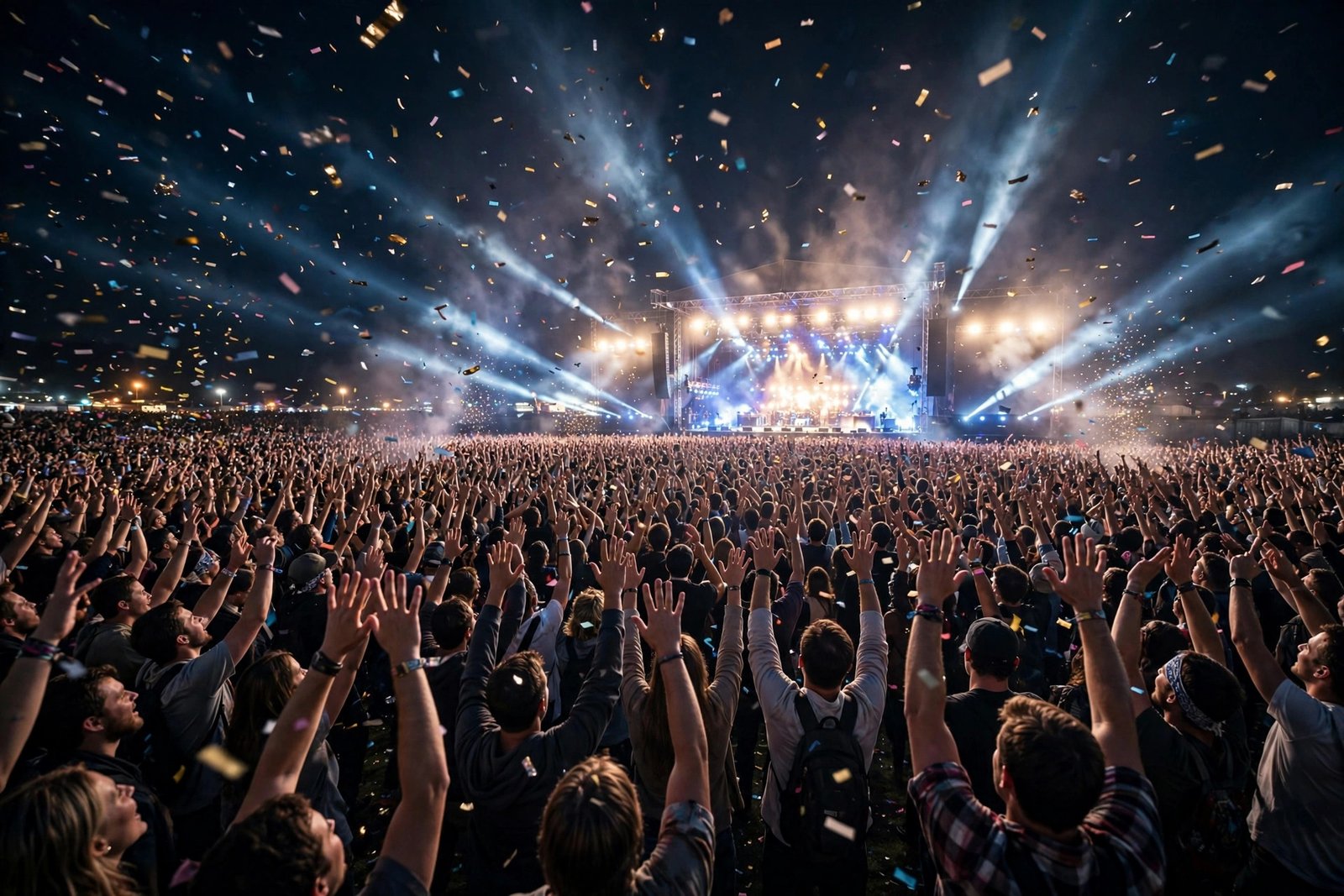
Brains do not experience gigs alone. Concerts trigger a neurochemical cocktail recordings cannot replicate: dopamine during the anticipation of favourite moments (your brain rewards prediction, and live shows are full of delicious uncertainty), oxytocin from social bonding and synchronised movement with thousands of strangers, and endorphins from the whole euphoric package. Researchers call the collective version “collective effervescence” — the measurable high of shared experience.
Synchrony amplifies everything. When a crowd moves, sings, and breathes together, individual brains align — studies of interpersonal neural synchrony show cooperation and trust rising with shared rhythmic experience. That is why the chorus sung by 20,000 people feels transcendent and the same chorus alone in your kitchen feels merely pleasant. The gig is not just the band; it is the temporary tribe. No wonder fans pay the prices they do — if you are planning a night out, average concert ticket costs in the UK help you budget for the experience your brain is clearly willing to pay for.
Volume, imperfection, and the physicality of sound
Some of it is gloriously physical. Live music is loud in a way home listening rarely is, and loudness itself is pleasurable — bass frequencies you feel in your chest activate the body, not just the ears. Clubs and venues are tuned for impact; your living room is tuned for neighbours.
Then there is imperfection. Studio versions are comped, tuned, quantised, and polished until every edge is smooth — which can also sand off the humanity. Live, you hear the strain in the vocal, the slightly rushed fill, the ad-libbed lyric change. Paradoxically, these flaws increase emotional authenticity: your brain reads effort and risk as sincerity. A voice cracking slightly on the high note moves you precisely because the studio version never would. The unrepeatable moment — the extended intro, the surprise cover, the mistake turned into a joke — makes this gig yours in a way no recording can be.
And the visual-spatial dimension matters: sound arriving from a real stage, in a real room, with real air moving, gives your auditory system the spatial richness that even the best headphones flatten. Your brain evolved for sound-in-space; the gig is the native format.
Why studio versions still matter
This is not a hierarchy with a winner. Studio recordings do things live cannot: the perfect take, the impossible arrangement, the intimate headphone moment at 1am. The album is the definitive text; the gig is the living interpretation. Fans who love both get the complete experience — the studio version teaches you the song, the live version teaches you what the song means when humans risk it in real time.
London’s venue ecology understands this perfectly, from 200-cap rooms to the biggest stages — check what is on at the O2 arena this month if you want the full-scale version of everything described here. The small gig and the arena gig trigger the same machinery at different scales.
The crowd is an instrument too
There’s a final ingredient no studio can bottle: the people around you. Psychologists call it collective effervescence — the shared emotional charge of thousands of people experiencing the same moment — and it measurably changes how music feels. Your heart rate syncs with the crowd’s, the singalong physically vibrates in your chest, and the band feeds off the energy in real time, playing harder and looser than they ever would under studio lights. Recordings capture the notes; they can’t capture the feeling of 5,000 strangers becoming, briefly, one organism. That’s not a flaw in recording technology. It’s the whole point of going out.
The bottom line
Gigs sound better than studio versions because your brain says so, measurably: stronger amygdala activity, tighter neural synchronisation with the rhythm, and a neurochemical cocktail of dopamine, oxytocin, and endorphins that no recording can trigger. Add real volume you feel in your chest, the electricity of imperfection, and 20,000 people becoming a temporary tribe, and the studio version — perfect as it is — never stood a chance. It was never a fair fight; it was never meant to be.
Frequently Asked Questions
Is there scientific proof live music feels better?
Yes. MRI research from the University of Zurich found live performances trigger significantly greater amygdala (emotional brain) activity than recordings of the same music, and EEG studies show brain waves synchronise about 31% more strongly with live rhythm.
Why do I get goosebumps at concerts but not listening at home?
Live music combines anticipation-driven dopamine, social bonding oxytocin, physical bass impact, and neural synchronisation with the performance — a cocktail that home listening, however good the system, does not replicate.
Do musicians play better live or in the studio?
Technically, studio — multiple takes, editing, and perfect conditions. Emotionally, live often wins because of risk, spontaneity, and imperfection, which the brain reads as authenticity. They are different excellences, not ranked ones.
Why does the crowd make such a difference?
Shared rhythmic experience synchronises brains and raises oxytocin, creating “collective effervescence” — the euphoria of feeling like one body. Singing with thousands of strangers is neurologically distinct from singing alone.
Are expensive concert tickets worth it?
Neuroscience suggests the experience genuinely cannot be replicated at home, which is the core of its value. Whether a specific price is worth it depends on the artist, the venue, and your budget — but the emotional premium of live music is real, not marketing.