
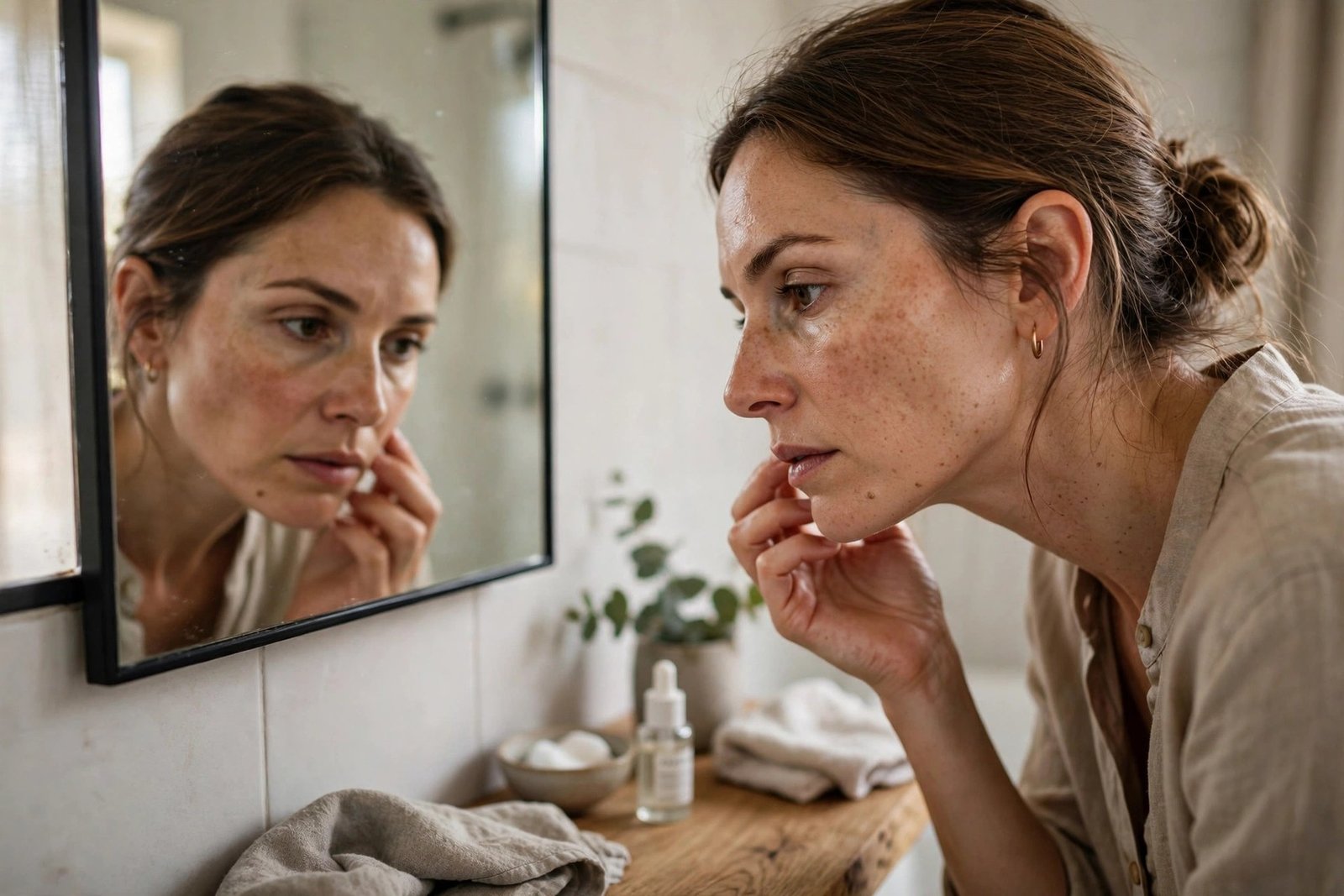
Why Am I Suddenly Breaking Out at 30? Adult Acne Explained
You survived teenage acne, enjoyed a decade of clear skin, and now — at 30 — your chin looks like a battlefield. It feels like a cruel regression, but adult-onset acne is startlingly common, particularly in women: studies suggest up to 40% of adult women experience it. It is not the same condition as teenage acne, and treating it like teenage acne is why most approaches fail.
Here is why you are suddenly breaking out at 30 — the distinct adult triggers — and the treatment ladder that actually works for grown-up skin.
Hormones: The Primary Suspect
Adult acne is overwhelmingly hormonal, and 30 is prime time for hormonal shifts. Coming off hormonal contraception is the classic trigger — the pill suppresses androgen-driven oil production, and stopping it can unleash rebound breakouts months later. Pregnancy, post-pregnancy, perimenopause's early stages (which can begin in the late 30s), and conditions like PCOS all shift the androgen-oestrogen balance toward oil production and clogged pores.
The signature is location: adult hormonal acne concentrates on the lower face — jawline, chin, around the mouth — often as deep, painful, cystic spots rather than teenage surface whiteheads. Stress amplifies the hormonal route: cortisol stimulates oil glands and inflammation, so the 'big presentation breakout' is endocrinology, not coincidence. If breakouts are cyclical with your menstrual cycle, jawline-concentrated, or coincided with contraception changes, hormones are driving — and hormonal treatments (including certain contraceptives or spironolactone, via your GP/dermatologist) target the cause rather than the symptom.
The Modern Triggers: Products, Diet, Lifestyle
Skincare overload
Beyond hormones, adult life introduces new acne drivers. Skincare overload is the fashionable culprit: the 10-step routine layers comedogenic ingredients, and 'purging' from new actives is often just breakouts. Heavy moisturisers, facial oils, and hair products migrating to skin (pomade acne along the hairline) clog adult pores that teenage skin tolerated. Simplify before you add: strip back to cleanser, moisturiser, SPF, then reintroduce actives one at a time.
Diet, lifestyle and the full audit
Diet's role is modest but real: high-glycaemic diets and (in some people) dairy correlate with acne in studies — the evidence is associative, not prescriptive, but a trial reduction is reasonable. Mask-wearing, phone screens pressed to cheeks, dirty pillowcases, and chronic sleep deprivation all contribute at the margins. None of these alone explains sudden onset at 30, but stacked on hormonal shifts they push skin over the edge. Audit the full picture: what changed in the months before the breakouts began?
Further reading: the Office for Product Safety and Standards.
The Treatment Ladder
Treat adult acne in ascending order of strength. Step one: simplify the routine and give it six weeks — many cases resolve when the trigger (new product, stress peak) passes. Step two: over-the-counter actives — benzoyl peroxide (antibacterial, start at 2.5-5% to limit irritation), salicylic acid (unclogs pores, good for blackheads), adapalene (the retinoid now available OTC, the single most effective OTC option — start twice weekly, expect initial dryness).
Step three: GP or dermatologist — prescription retinoids (tretinoin), topical antibiotics, hormonal treatments (co-cyprindiol or spironolactone for women with hormonal patterns), or oral antibiotics for widespread cases. Step four: for severe, scarring, or treatment-resistant acne, isotretinoin (Roaccutane) — highly effective, strictly monitored, life-changing for the right patients. Do not pick or squeeze cystic spots — it drives inflammation deeper and scars. And use hydrocolloid patches on surface spots; they are the rare TikTok trend with genuine merit.
What Not to Do
Adult skin punishes the teenage playbook. Harsh scrubs, alcohol toners, and aggressive 'drying out' damage the skin barrier, triggering rebound oiliness and more breakouts — the stripping cycle. Over-exfoliating with multiple acids simultaneously is the modern version of the same error. Toothpaste, lemon juice and other DIY 'hacks' irritate without treating.
Do not layer every active at once: retinoids, vitamin C, AHAs and benzoyl peroxide in one routine is a recipe for a compromised barrier and months of recovery. Introduce one active at a time, weeks apart. Do not expect overnight results — every effective treatment needs 8-12 weeks for full judgment; switching products weekly guarantees nothing works. And do not suffer silently with scarring or severe acne: dermatology waiting lists are long, so get the GP referral early — adult acne is a medical condition, not a cosmetic inconvenience.
Makeup for Acne-Prone Adult Skin
Breakouts do not pause life — and the right makeup approach conceals without worsening. Choose non-comedogenic, oil-free foundations; mineral formulas suit many acne-prone skins. Colour-correct strategically: green neutralises redness, peach counteracts dark marks — applied thinly under foundation, not instead of it. Less is more: heavy full-coverage over active breakouts looks worse and traps irritation; spot-conceal after a light base instead.
The removal routine matters more than the application: double-cleanse every evening (oil or balm first to dissolve makeup and SPF, then a gentle water-based cleanser) — sleeping in makeup is a top breakout trigger. Clean brushes weekly; replace sponges regularly; check expiry dates (old mascara and liquid foundation harbour bacteria). And give skin makeup-free days when possible — not as punishment but as recovery. The goal is confidence during treatment, not camouflage as lifestyle: makeup that supports the healing process while the treatment ladder does its work underneath.
Learn more from the NHS.
The Long View
The reassuring truth: adult acne usually has an identifiable trigger and responds well to targeted treatment — it is more solvable than teenage acne, not less. Most cases improve dramatically within three to six months of the right approach. Maintenance is then simple: the effective routine continued, triggers managed, hormones monitored.
Reframe the experience: your skin is reporting something — hormonal shifts, stress load, product overload — and the report is useful. The 30-year-old breakout is not regression but information, and acting on it (GP visit, routine simplification, stress management) benefits more than your skin. Clear skin at 30 is absolutely achievable; it just requires the adult approach — diagnosis before treatment, patience over panic, and professional help when the ladder's lower rungs do not suffice.
If you found this useful, keep reading: what are the best comedy clubs in london for a night out and how much does a family day out in london cost.
Breaking out at 30 is usually hormonal — contraception changes, perimenopause's early shifts, PCOS, or stress-driven cortisol — with the signature jawline and chin pattern of deep, painful spots. Audit modern triggers too: overloaded skincare routines, hair products, diet, phones and pillowcases. Treat up the ladder: simplify first, then OTC adapalene/benzoyl peroxide/salicylic acid, then GP-prescribed retinoids or hormonal treatments, with isotretinoin for severe cases. Give each step 8-12 weeks, never pick cystic spots, and get the dermatology referral early if scarring threatens.
Frequently Asked Questions
Why am I getting acne in my 30s when I never had it as a teen?
Adult-onset acne is usually hormonal — contraception changes, early perimenopause, PCOS, or stress — rather than the puberty-driven acne of teenagers. Up to 40% of adult women experience it.
Where does hormonal acne appear?
Characteristically the lower face: jawline, chin and around the mouth, often as deep, painful cystic spots. Cyclical flares with the menstrual cycle confirm the hormonal pattern.
What is the best treatment for adult acne?
Climb the ladder: simplify the routine, try OTC adapalene/benzoyl peroxide/salicylic acid for 8-12 weeks, then see a GP for prescription retinoids, hormonal treatments or antibiotics. Isotretinoin for severe cases.
Should I see a doctor for adult acne?
Yes if it is severe, scarring, cystic, persistent beyond 3 months of OTC treatment, or accompanied by other hormonal symptoms (irregular periods, excess hair growth) suggesting PCOS.