
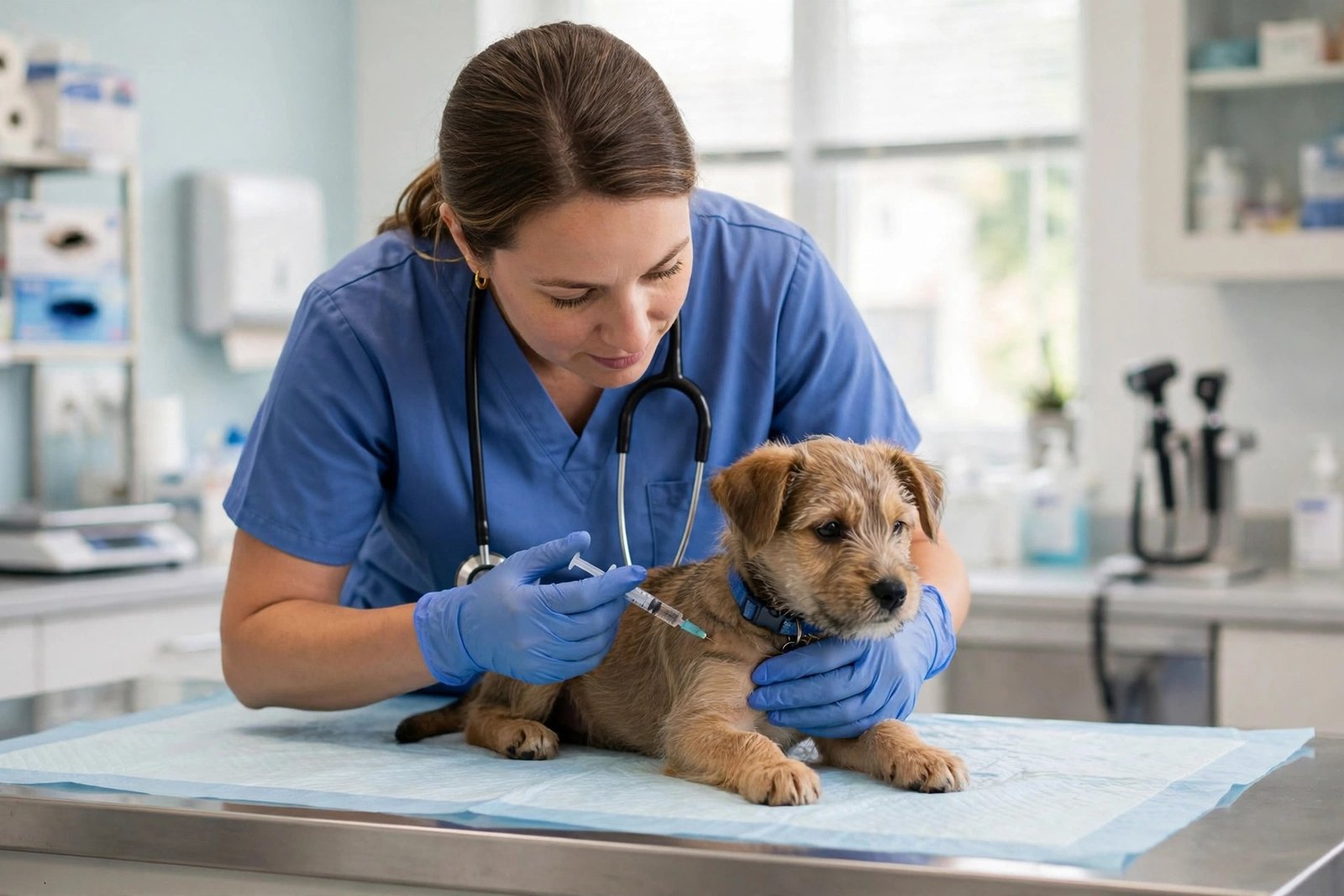
Which Jabs Does a Puppy Really Need in the UK?
New puppy owners face a blizzard of advice — the breeder says one thing, the internet says another, and the vet's vaccination quote raises eyebrows. Beneath the noise, the UK puppy vaccination schedule is well-established, evidence-based, and simpler than it appears. The confusion mostly concerns the optional extras and the anti-vax fringes, not the core programme.
Here is which jabs your puppy really needs in the UK — the core schedule, the sensible optionals, the costs, and the straight facts on risks.
The Core Vaccines: Non-Negotiable
UK vets universally recommend the core combination vaccine, typically given as two doses: the first at 6-8 weeks, the second at 10-12 weeks (protocols vary slightly by product — follow your vet's schedule). The core covers four diseases. Canine distemper: often fatal, causing respiratory, gastrointestinal and neurological disease. Canine parvovirus: the puppy killer — severe vomiting and diarrhoea, frequently fatal in unvaccinated pups, with treatment costing thousands. Canine adenovirus (hepatitis): liver disease, potentially fatal. Parainfluenza: a kennel cough component.
These diseases are not historical curiosities — parvo outbreaks still occur in the UK, particularly where vaccination lapses, and distemper persists in wildlife reservoirs. The core vaccines are genuinely lifesaving with an excellent safety profile; serious reactions are rare (roughly 1 in 10,000 doses). Puppies can venture out one to two weeks after the second dose (your vet will advise) — before that, carry them outside for socialisation without ground contact. This is the non-negotiable foundation; everything else is situational.
The Sensible Optionals
Kennel cough: for social dogs
Kennel cough (Bordetella bronchiseptica, often with parainfluenza): recommended for puppies attending training classes, daycare, boarding kennels (many require it), or mixing with other dogs — given as an annual intranasal or oral dose. It is not usually fatal but is miserable and highly contagious; the intranasal version can cause a few days of snorting.
Leptospirosis and rabies
Leptospirosis: increasingly considered core-adjacent in the UK — a bacterial disease from rat urine in water, causing liver/kidney failure, and zoonotic (transmissible to humans). Most UK core protocols now include it (the 'L4' vaccine) given the genuine and growing risk, especially for rural or water-loving dogs. Rabies: required only for travel abroad under the pet travel scheme — not needed for UK-only dogs. Discuss your puppy's lifestyle with your vet; the optionals should match actual exposure, not anxiety.
The full background is available at PDSA.
Costs and the Annual Question
Puppy vaccination courses in the UK typically cost £60-100 for the full primary course at independent vets (corporate chains vary; some offer puppy plans bundling vaccines, flea/worming and neutering that work out well). Annual boosters thereafter run £40-70. This is among the cheapest interventions in dog ownership — compare with parvo treatment at £1,500-5,000+ or the cost of a dead puppy, which is incalculable.
The booster debate deserves honesty: modern evidence supports triennial (three-yearly) boosters for the core viral components after the first annual booster, with leptospirosis and kennel cough remaining annual (shorter immunity). Many UK vets now offer titre testing (blood tests measuring immunity) as an alternative to automatic revaccination. Discuss protocol with your vet rather than accepting or refusing boosters blindly — the science supports tailored schedules, not one-size ideology in either direction.
Risks, Side Effects and the Anti-Vax Question
Be straight about risks: mild side effects (lethargy, soreness, small lump at the injection site, slight temperature) affect a minority of puppies for 24-48 hours — normal immune responses, not illness. Serious allergic reactions are rare and vets manage them routinely; the risk of the diseases dwarfs the risk of the vaccines by orders of magnitude.
The anti-vaccine fringe borrows human anti-vax rhetoric with even less evidence: claims linking vaccines to autism-like conditions in dogs, or that 'natural immunity' suffices, collapse against parvovirus wards full of unvaccinated dying puppies. Vets see the consequences directly — ask any practising vet about their stance and you will get an unambiguous answer born of dead puppies. Reasonable questions about schedules, titre testing and individual risk are welcome; refusing core vaccines is not a reasonable position but a gamble with your puppy's life.
Socialisation During the Waiting Weeks
The vaccination waiting period collides with the critical socialisation window (closing around 14 weeks) — manage both, not one. The rule: avoid ground contact in risky areas (dog parks, pavements with unknown dogs) until a week or two after the second jab, but maximise safe exposure: carry the puppy everywhere — streets, cafés, stations — so sights, sounds and people become normal. Invite calm, vaccinated adult dogs to your home or garden for supervised interaction.
Puppy classes are the structured answer: good classes accept puppies after their first vaccination, with hygiene protocols managing the small risk — the behavioural benefit vastly outweighs it. Expose deliberately: traffic, crowds, children (supervised), household noises, car rides, handling of paws/ears/mouth (future vet visits depend on it). Keep sessions short and positive; fear learned now lasts years. The vaccinated-at-12-weeks puppy with 100 positive exposures is set for life; the isolated-until-16-weeks puppy faces behavioural debts no vaccine covers. Socialise safely, but socialise relentlessly.
Worth a look: GOV.UK pet guidance.
The Practical Timeline
Weeks 6-8: first core dose (often with the breeder — confirm and get records). Weeks 10-12: second core dose plus leptospirosis; discuss kennel cough if lifestyle warrants. One to two weeks after: safe to walk on the ground; before that, carry for socialisation (the socialisation window closes at ~14 weeks, so do not isolate the puppy entirely — balance disease risk against behavioural risk with your vet's guidance).
At 12 months: first annual booster, then onto the tailored schedule (triennial cores, annual lepto/kennel cough) or titre testing. Register with a vet before the puppy arrives; book the second vaccination when collecting the puppy. Keep the vaccination card safe — boarding, training, travel and insurance may all require it. The whole programme is a handful of appointments in the first year for a lifetime of protection: the best value in puppy care.
Keep exploring with what documents do i need to travel with a pet from the UK and do i need a tv licence to watch netflix in the UK.
UK puppies need the core combination vaccine — distemper, parvovirus, adenovirus, parainfluenza — in two doses at 6-8 and 10-12 weeks, plus leptospirosis (now standard in most protocols) given the genuine UK risk. Add kennel cough for social dogs and rabies only for travel abroad. Expect £60-100 for the primary course, then tailored boosters (triennial cores, annual lepto) or titre testing. The diseases kill; the vaccines rarely cause more than a day's lethargy. It is the clearest decision in puppy ownership.
Frequently Asked Questions
When should puppies get vaccinated in the UK?
First core dose at 6-8 weeks, second at 10-12 weeks. Puppies can usually walk on the ground one to two weeks after the second dose — confirm timing with your vet.
How much do puppy vaccinations cost in the UK?
Typically £60-100 for the full primary course; annual boosters £40-70 thereafter. Puppy health plans bundling vaccines with flea/worming and neutering often work out well.
Does my puppy need kennel cough vaccine?
Recommended if your puppy mixes with other dogs — training classes, daycare, boarding (many kennels require it). It is an annual intranasal/oral dose, not usually part of the core injections.
Are puppy vaccines safe?
Yes — serious reactions occur in roughly 1 in 10,000 doses. Mild lethargy or soreness for a day is normal. The diseases prevented (especially parvovirus) are frequently fatal in unvaccinated puppies.