
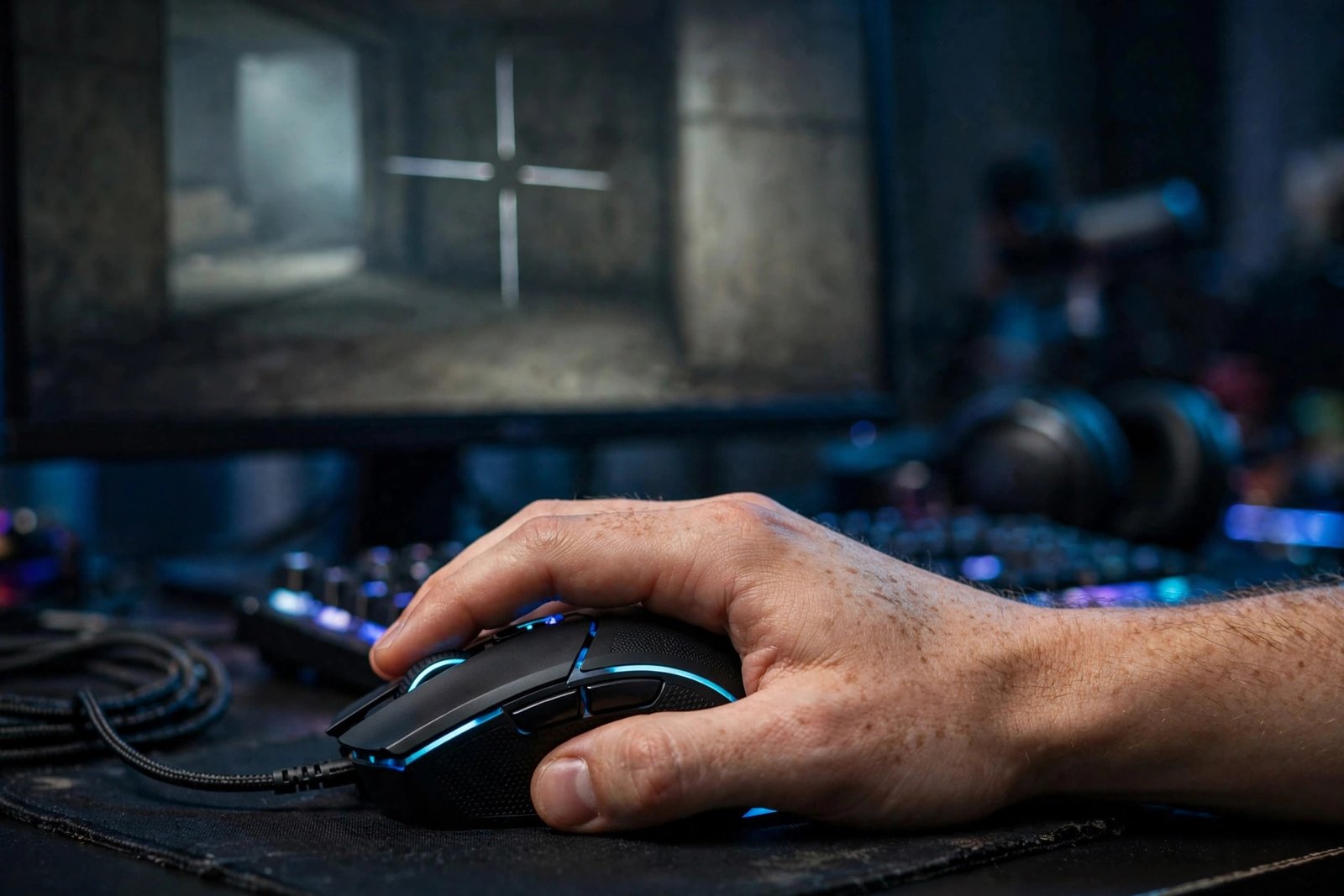
How to Get Better Aim in FPS Games: The Trainable Skill Stack
You lose the duel. Again. The enemy’s crosshair seems magnetically attached to your head while yours wanders like a lost tourist. Aim is the fundamental skill of first-person shooters — the thing that separates frustrating sessions from clutch plays — and the good news is that it is far more trainable than most players believe. Aim is not talent; it is a bundle of specific, practicable sub-skills. Here is how to build each one.
Fix your settings before anything else
Most players sabotage their aim with bad settings before firing a shot. The critical number is eDPI (effective dots per inch): your mouse DPI multiplied by in-game sensitivity. Professional FPS players overwhelmingly use low eDPI — typically 200–400 eDPI in games like Counter-Strike and Valorant — because lower sensitivity means larger, more precise mouse movements and less jitter from hand tremor. If your sensitivity is so high that a wrist flick does a 360, your fine aim control is effectively random.
Find your baseline: set a sensitivity where you can comfortably do a 180-degree turn with one comfortable arm sweep across your mousepad. Then fine-tune over days, not minutes — changing sensitivity constantly prevents muscle memory forming. Disable mouse acceleration everywhere (Windows “enhance pointer precision” and any in-game acceleration): acceleration makes the same physical movement produce different cursor travel depending on speed, which destroys consistency. Use a large mousepad, a comfortable grip (palm, claw, or fingertip — all viable at pro level), and a stable frame rate: aiming on 60Hz versus 144Hz+ is measurably different, because higher refresh rates show enemy movement sooner and smoother.
Crosshair placement: the skill that matters most
Ask coaches what separates good aimers from great ones and most will say crosshair placement, not flick speed. Crosshair placement means keeping your crosshair at head height, aimed at the angle where enemies are likely to appear, before you see them. Every duel then becomes a micro-adjustment instead of a frantic 90-degree flick. Watch professional demos: their crosshairs glide along head-level lines, pre-aiming corners, while amateurs stare at the floor and flick upward in panic.
Train it deliberately: in deathmatch, focus exclusively on keeping the crosshair at head height for entire sessions, ignoring your score. Learn the common angles on each map — where heads appear — and pre-aim them as you move. This single habit improves duel win rates more than any aim trainer, because most lost duels are lost before the first shot: the player with better placement needs a smaller, faster correction.
Counter-strafing and movement
In tactical shooters (Counter-Strike, Valorant), accuracy collapses while moving — so professionals counter-strafe: tapping the opposite movement key to stop instantly before shooting. The rhythm is strafe-stop-shoot-strafe, and it must become automatic. Practise it in isolation until the stop-shoot feels like one motion. In arena shooters (Apex, Call of Duty), the equivalent skill is strafing while tracking — keeping your crosshair glued to a strafing target — which aim trainers drill specifically.
Structured practice: aim trainers and routines
Free tools like Aim Lab and the in-game training ranges of most shooters let you drill specific mechanics: flicking (fast large corrections), tracking (smooth following), target switching, and precision clicking. A focused 15–20 minute routine before playing — not instead of playing — builds mechanics efficiently. Structure it: 5 minutes of smooth tracking scenarios, 5 minutes of flicking, 5 minutes of target switching, then play.
The key principle is deliberate practice, not volume. Mindlessly grinding deathmatch for hours ingrains bad habits; 20 focused minutes on your weakest mechanic outperforms two hours of autopilot. Record your scores weekly — aim trainers quantify progress, and visible improvement sustains motivation through plateaus. And warm up before competitive matches, not during them: your ranked games should be performance, not practice.
The mental game and hardware reality
Aim degrades under tilt, fatigue, and tension. Gripping the mouse harder when stressed — the classic death grip — destroys fine motor control; consciously relaxing your hand between rounds helps. Take breaks: aim performance drops measurably in long sessions, and a tilted player aiming worse plays worse, compounding the spiral. Sleep and general alertness affect reaction time significantly — the unglamorous fundamentals apply to gaming as much as to sport.
On hardware: a decent gaming mouse (accurate sensor, comfortable shape) and a 144Hz+ monitor are the two upgrades with genuine, measurable aim impact. Beyond that, diminishing returns set in fast — a £150 mouse does not aim for you. Before spending on gear, consider whether the money is better directed at the platform itself: our analysis of whether it’s worth buying a PS5 in 2026 and how much a Nintendo Switch costs in the UK helps frame the hardware decision sensibly.
The UK games industry body Ukie tracks the competitive gaming scene’s growth, and the BBC has covered esports’ rise including the training regimens of professional players — whose practice discipline mirrors traditional sports more than most realise.
The bottom line
Better FPS aim comes from: low, consistent sensitivity with acceleration disabled; crosshair placement at head height as the primary skill; counter-strafing drilled to automaticity; 15–20 minutes of deliberate aim-trainer practice on your weakest mechanic; and managing tilt, fatigue, and grip tension. It is a trainable bundle of sub-skills, not a gift — and the players out-aiming you simply trained the bundle first.
Frequently Asked Questions
What is the best sensitivity for FPS games?
Most professionals use 200–400 eDPI (mouse DPI × in-game sensitivity) — low enough for precise control, high enough for a 180° turn in one arm sweep. Disable all mouse acceleration for consistency.
Do aim trainers actually improve aim?
Yes, for mechanics — flicking, tracking, and target switching all improve with deliberate practice. But they don’t teach game sense or crosshair placement, so combine trainer time with in-game practice focused on positioning.
What is crosshair placement and why does it matter?
Keeping your crosshair at head height aimed where enemies will appear, before you see them. It turns duels into micro-adjustments instead of large flicks, and coaches rate it the highest-impact aim skill.
Does a 144Hz monitor really help aim?
Measurably, yes — higher refresh rates display enemy movement sooner and smoother, improving tracking and reaction. It’s the most impactful hardware upgrade for aiming after a decent mouse.
How long does it take to get good aim?
Noticeable improvement typically comes within 4–8 weeks of consistent deliberate practice (15–20 minutes daily plus regular play). Plateaus are normal; changing the practiced mechanic usually restarts progress.
Is claw grip better than palm grip for aiming?
Neither is objectively superior — professional players succeed with palm, claw, and fingertip grips. What matters is comfort and consistency: use the grip that lets you make smooth micro-adjustments without tension, on a mouse shape that suits your hand size. Switching grips constantly is worse than any single grip choice.
Should I use aim assist or turn it off?
On controller, keep aim assist on — it is designed into the game’s balance and turning it off handicaps you against other controller players. On PC with a mouse, aim assist is usually unavailable or minimal by design. Do not let platform purists shame your settings; use what the game gives you.
How important is a good mousepad for aim?
More than most players think: a large, consistent-surface pad enables the low-sensitivity arm aiming that precision requires, and a worn or tiny pad forces compromises in sensitivity and movement. It is one of the cheapest meaningful upgrades — a quality large pad costs less than most games.