
Painting vs Replacing Kitchen Cabinets: Is It Worth It?
Painting vs Replacing Kitchen Cabinets: Is It Worth It?
New kitchen cabinets cost £3,000–£12,000. Painting them costs £150–£400. So is it worth painting kitchen cabinets instead of replacing them? For most kitchens with sound carcasses: absolutely yes — with a few honest caveats.
The case for painting
- Cost: £150–£400 in paint and materials vs £5,000+ for new units. The saving is enormous.
- Time: a long weekend vs 3–5 weeks of kitchen chaos.
- Waste: keeping functional cabinets out of landfill.
- Result: done properly, painted cabinets look genuinely professional — most visitors won’t know.
- Flexibility: hate the colour in 5 years? Repaint for £150. Try that with new units.
When painting is the right call
- Carcasses are structurally sound — solid, not swollen or delaminating
- The layout works — painting doesn’t fix a bad kitchen design
- Doors are flat or simple shaker style — easiest to paint well
- You want a colour change, not a style revolution
- Budget is tight but standards are high
When to replace instead
- Water damage: swollen, peeling or soft chipboard carcasses won’t paint well and will keep deteriorating
- Broken hinges/fixings: if the carcass won’t hold screws anymore, it’s done
- Bad layout: painting doesn’t fix a kitchen that’s fundamentally wrong
- Thermofoil/vinyl wrap peeling: peeling vinyl doors are very hard to paint successfully — replacement doors (£30–£80 each) on existing carcasses are the smart middle ground
- You want a different configuration (island, taller units, integrated appliances)
The middle ground: replacement doors
Often overlooked: keep the carcasses, replace just the doors and drawer fronts. Companies like IKEA (for IKEA carcasses) and specialist door suppliers sell replacements at £30–£80 per door. New doors + new handles + painted carcasses = a kitchen that looks entirely new for £800–£1,500. This is the sweet spot many renovators miss.
What does professional cabinet painting cost?
- DIY: £150–£400 (paint, primer, brushes/rollers, sandpaper)
- Professional spray finish: £1,500–£3,500 for an average kitchen — a factory-smooth finish that’s very hard to achieve with a brush
A pro spray job at £2,000 vs new units at £7,000+ is still a massive saving — and the finish genuinely rivals new. If your budget stretches, this is the upgrade that makes painted cabinets indistinguishable from new.
Durability: will it last?
Done properly (degrease → sand → prime → 2–3 topcoats of proper cabinet paint), painted cabinets last 5–10 years in a family kitchen. The weak points are around handles and the bin cupboard — areas of heavy contact. Use proper cabinet/furniture paint (not wall emulsion): brands like Frenchic, Farrow & Ball Modern Eggshell, or Dulux Cupboard Paint. For the full method, see how to paint kitchen cabinets for a professional finish.
The bottom line
Paint when the bones are good; replace when they’re not. Sound carcasses + tired doors = paint (or new doors). Damaged carcasses or a bad layout = replace. For most 10–20 year old kitchens with solid units, painting delivers 80% of the transformation for 5% of the cost — and that maths is very hard to argue with. See full kitchen renovation costs for the replacement side of the equation.
Colour choices that work (and ones to avoid)
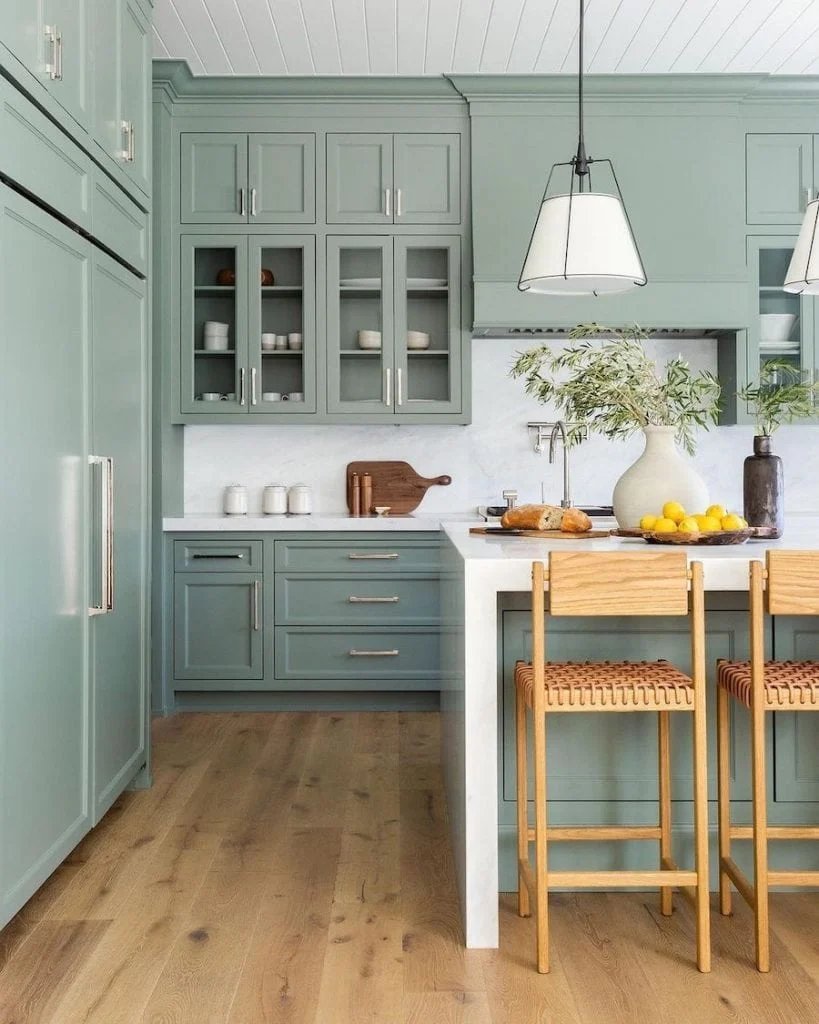
Painting lets you choose any colour — which is both the joy and the danger. Safe, enduring choices: warm white (not brilliant white — it looks clinical), soft grey-green (sage — the current classic for good reason), deep navy (dramatic, timeless on lower units), charcoal (sophisticated, hides wear). Risky: very dark colours in small kitchens (shrinks the space), bright primaries (tire quickly), ultra-trendy shades (remember avocado?).
The designer trick: two-tone — darker colour on lower units/island, lighter on uppers. It adds depth, hides lower-unit wear, and looks intentional rather than indecisive. And whatever colour you choose, test it on a door in your kitchen’s actual light for 48 hours — paint chips lie, and north-facing kitchens murder warm colours. Farrow & Ball, Little Greene and Frenchic all do sample pots (£4–£6).
Cabinet painting FAQs
How long does it take? 3–5 days for an average kitchen DIY: day 1 remove/clean/sand/prime, day 2 first topcoat, day 3 second topcoat + light sand, day 4 final coat, day 5 rehang. Plus 2–3 weeks curing before heavy use. Professionals: 3–4 days on site.
Can I paint laminate/flat-pack cabinets? Yes — with the right primer. Laminate needs shellac primer (Zinsser BIN) — standard primer peels off laminate within months. Degrease thoroughly (laminate shows grease as fisheyes in the paint), light sand to key, BIN prime, then topcoat. IKEA Metod doors paint beautifully with this method.
What about the inside of cupboards? Don’t bother — nobody sees them, and paint inside cupboards wears fast from stored items. Clean them, maybe line shelves with wipeable liner (£5 a roll), and spend the paint on visible surfaces.
Spray or brush — which is better for DIY? Brush/roller for DIY — spraying needs equipment, masking, ventilation and practice; a bad spray job looks worse than a good brush job. Use a mini foam roller for flat areas and a quality synthetic brush for edges, sand between coats, and the finish will be excellent. Pros spray because they’re set up for it — you’re not.
Will painted cabinets hurt resale value? No — a well-painted kitchen in a neutral colour helps saleability versus tired original units. What hurts: garish colours, visible brush marks, chipping paint. If selling soon, choose neutral (greige, soft white, sage) and do the prep properly — buyers see “updated kitchen”, not “painted kitchen”.
The full kitchen refresh: what painting pairs with
Painted cabinets alone transform a kitchen — but paired with two or three cheap companions, the effect multiplies. New worktop (£500–£1,000 for laminate, fitted): the second-biggest visual element after the cabinets; a new light worktop with freshly painted dark cabinets is the classic high-contrast transformation. New handles (£2–£5 each, £40–£100 total): the jewellery — brushed brass or matt black on painted cabinets reads instantly modern. Splashback (£100–£300 for tiles, or £50–£100 for a painted/stick-on panel): fresh colour or texture behind the hob.
Total for the full refresh: cabinets (£200 paint) + worktop (£700) + handles (£60) + splashback (£150) = ~£1,100 and two weekends — versus £12,000–£20,000 for a full renovation (see kitchen renovation costs). You get 80% of the visual transformation for 7% of the cost. The carcasses, layout and appliances stay — but nobody looking at the finished kitchen thinks “painted old kitchen.” They think “lovely kitchen.” That’s the whole point.