
Is It Safe to Do Your Own Electrical Work at Home? (UK Rules)
Is It Safe to Do Your Own Electrical Work at Home? (UK Rules)
The UK has some of the strictest DIY electrical rules in the world — and for good reason. Here’s whether it’s safe (and legal) to do your own electrical work at home, what’s allowed, and where the line is.
The short answer
Some electrical work: yes, legally and safely — if you’re competent. Other work: illegal without notifying building control, and genuinely dangerous without training. The distinction matters enormously.
What you CAN do (non-notifiable work)
Under Part P of the Building Regulations, you can legally DIY:
- Replacing existing sockets, switches and light fittings (like-for-like)
- Replacing a damaged cable for a single circuit (same route, same spec)
- Replacing consumer unit components (with care — and honestly, get a pro)
- Installing extra low-voltage garden lighting
- Minor repairs to existing installations
“Competent” is doing heavy lifting here — you must work to BS 7671 (the Wiring Regulations) standards. “I watched a YouTube video” is not competence; understanding isolation, earthing, circuit protection and testing is.
What you CANNOT do without notification
Notifiable work must be done by (or inspected by) a registered electrician, with building control notified:
- New circuits (new ring main, new shower circuit, new cooker circuit)
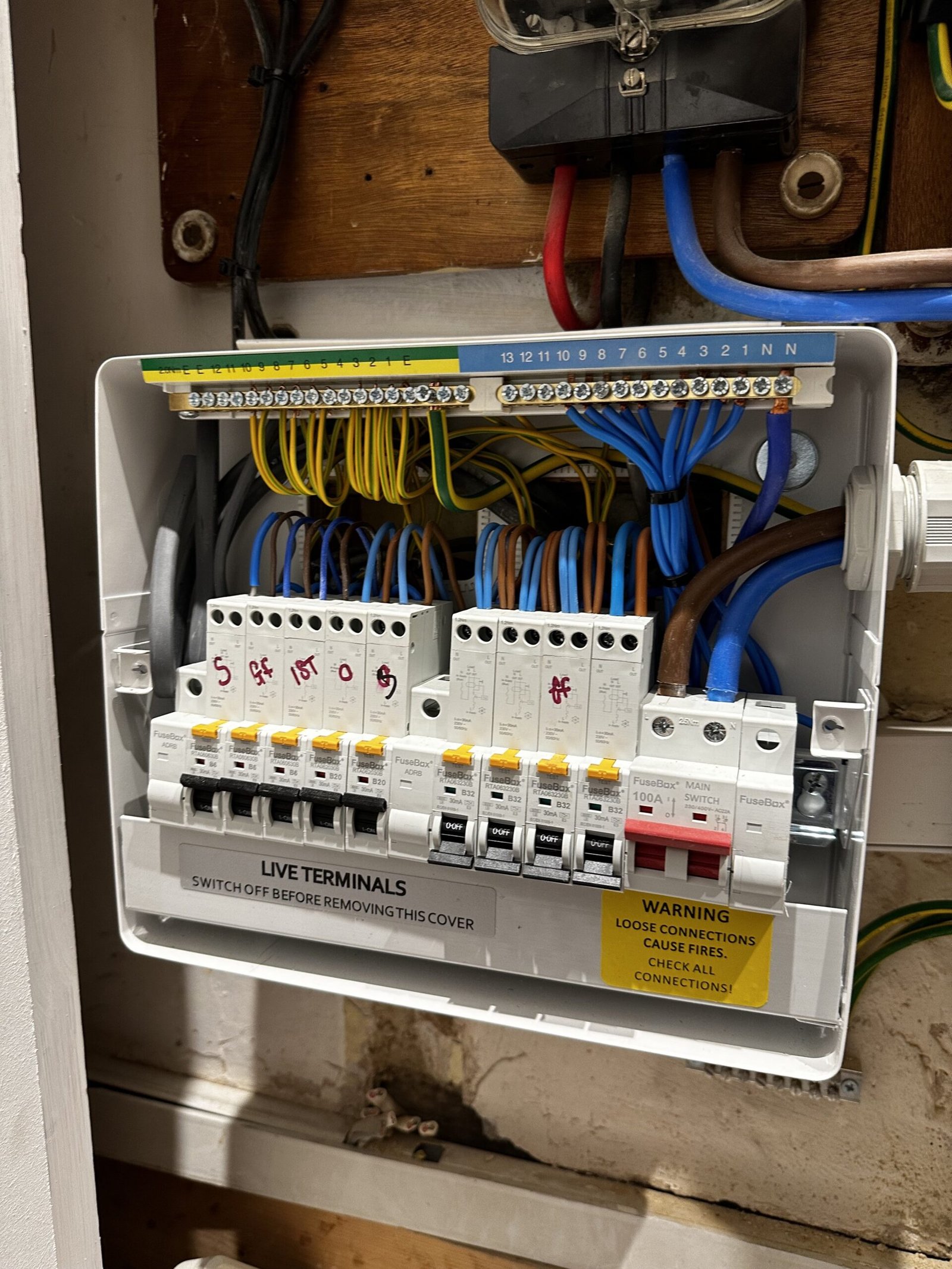
- Consumer unit (fuse box) replacement
- Any electrical work in bathrooms (special location — stricter rules)
- Work in kitchens (no longer notifiable since 2013, but still high-risk — strongly recommend a pro)
- Outdoor electrics connected to the house supply
- Any work in special locations (swimming pools, saunas)
Doing notifiable work without compliance is illegal — and it’ll surface when you sell (solicitors ask for certificates) or claim on insurance.
The safety reality
- Electricity causes around 70 deaths and 350,000+ injuries a year in UK homes (Electrical Safety First data)
- Faulty electrics cause ~20,000 house fires annually in the UK
- The dangers aren’t just shock — loose connections cause fires months or years later, long after the DIYer has forgotten the job
- Old wiring (pre-1970s, no earth, rubber insulation) makes every job riskier — if your wiring is old, get an EICR (Electrical Installation Condition Report, £150–£300) before touching anything
Source: Electrical Safety First — the UK’s electrical safety charity, worth reading before any DIY electrical work.
If you DIY: the non-negotiable rules
- Isolate at the consumer unit — switch off the circuit and verify dead with a voltage tester (£15). Wall switches alone are not isolation.
- Understand what you’re touching — live, neutral, earth; ring vs radial; why the earth matters. If any of that is unfamiliar, stop.
- Use the right cable, the right terminations, tight connections — loose connections are the #1 DIY fire cause.
- Test afterwards — continuity, insulation resistance, polarity. A multimeter (£20) is the minimum.
- Never work on live circuits. Ever. No exceptions, no “I’ll be careful”.
- Know when to stop — aluminium wiring, no earth, confusing old colours (pre-2004 red/black), anything that doesn’t make sense: call a pro.
When to definitely call an electrician
- Anything notifiable (above) — legal requirement
- Consumer unit work — high fault currents, no forgiveness for errors
- Bathrooms and outdoors — water + electricity + special regulations
- Frequent tripping, burning smells, scorch marks, buzzing — fault-finding needs expertise and test equipment
- Old wiring — get an EICR first; a rewire (£3,000–£7,000 for a 3-bed) may be the real answer
- If you’re not 100% confident — that doubt is your brain telling you something
Find a registered electrician via the official competent persons register. For typical costs, see electrician charges for fitting a light.
The bottom line
Like-for-like replacements (sockets, switches, light fittings): fine to DIY if you’re genuinely competent — isolate properly, test afterwards. Everything else: use a registered electrician. The £80–£150 call-out is trivial against the cost of a house fire or a fatal shock. Electricity is the one DIY area where overconfidence kills — and it doesn’t give second chances. When in doubt, call someone qualified. That’s not weakness; that’s wisdom.
The EICR: your home’s electrical MOT
If you’re unsure about your home’s wiring, the answer isn’t guessing — it’s an EICR (Electrical Installation Condition Report). A registered electrician inspects your consumer unit, wiring, sockets and fittings, and grades issues C1 (danger present — immediate action), C2 (potentially dangerous — urgent), C3 (improvement recommended), or FI (further investigation needed). Cost: £150–£300 for a typical 3-bed house. Landlords must have one every 5 years by law; homeowners should have one every 10 years (or when buying a house).
When buying: get an EICR before exchange — “the electrics look old” from a surveyor is vague; an EICR tells you exactly what needs doing and what it’ll cost (£500 for a consumer unit upgrade vs £6,000 for a rewire is rather important to know). Red flags in a home you’re buying: old fuse wire boxes, no RCD protection, rubber-insulated cable (pre-1960s), DIY additions (extra sockets spurred incorrectly). An EICR turns electrical unknowns into a priced list — the best £200 in the buying process.
DIY electrical FAQs
What is Part P? Part P of the Building Regulations — the law governing domestic electrical work in England and Wales. It requires electrical work to be designed and installed to BS 7671 (the Wiring Regulations) and makes certain work notifiable to building control. Registered electricians (NICEIC, NAPIT, ELECSA) can self-certify; DIYers doing notifiable work must notify building control in advance (£200–£400) and have it inspected. Scotland and NI have equivalent (slightly different) regimes.
Can I change a plug socket myself? Yes — like-for-like socket replacement is non-notifiable. Isolate at the consumer unit, verify dead with a voltage tester, photograph the wiring before disconnecting, replicate exactly. Don’t: spur new sockets off existing circuits (that’s new circuit work — notifiable), install sockets in bathrooms (special location rules), or work on anything you’re unsure about.
What should I do in an electrical emergency? Burning smell / smoke / sparks: switch off at the consumer unit if safe, call 999 if fire, evacuate. Electric shock: don’t touch the person until the power is off — switch off at the mains, call 999, start CPR if trained and needed. Power cut: check neighbours (if they’re out too, it’s the network — call 105, the free power-cut helpline). Water + electrics (flood): don’t enter the water — call an electrician once it’s safe.
Are DIY electrical kits safe? The kits are fine; the knowledge gap isn’t. A £15 “fuse box wiring kit” doesn’t teach you about earth fault loop impedance, RCD coordination, or cable derating — the things that actually prevent fires and shocks. Electrical work is one area where Dunning-Kruger kills: the confident beginner is more dangerous than the cautious one. If a sentence in the wiring regulations doesn’t make sense to you, you’re not ready — and that’s fine. Call a pro.
How do I verify an electrician’s registration? electricalcompetentperson.co.uk — the official register. Search by name/company. Check: registration is current, and covers the work type. Ask to see the ID card on arrival — registered electricians carry them. No card, no registration, no work — it’s that simple.
Related reading
For typical costs, see what electricians charge to fit a light.