
How to Practise Drums Quietly in a Flat (Without Eviction)
Drums are the loudest acoustic instrument you can put in a flat, and your neighbours know it. A snare drum cracks at around 120 decibels — louder than a chainsaw — and unlike a guitar, you cannot just turn it down. But “drummer in a flat” is not the contradiction it seems. Between mesh heads, low-volume cymbals, electronic kits, and some clever room treatment, you can practise properly without becoming the villain of your building. Here is the full toolkit, from cheapest to most committed.
First, understand what you are fighting. Drum noise has two components: airborne sound (what travels through walls) and impact/transmission noise (vibrations travelling through the floor into the flat below — the kick drum pedal is the worst offender). Most “quiet drum” solutions address the first; the floor is the part people forget, and it is what actually gets you evicted.
Level 1: quiet down your acoustic kit
If you already own an acoustic kit, you do not necessarily need to replace it. Mesh heads replace your batter heads with woven mesh — Evans’ dB One heads cut volume by around 80% while keeping realistic rebound, and dB Zero mesh cuts up to 90% for near-silent practice. Pair them with low-volume cymbals (perforated designs from Zildjian’s L80, Sabian’s Quiet Tone, or Evans dB One lines), which drop cymbal volume by up to 80% while keeping recognisable tone and feel.
This guide to building a silent drum kit reckons the mesh-head-plus-low-volume-cymbal combination cuts total kit volume by roughly 80% — taking a 120dB snare crack down to something closer to a loud conversation. Add drum rods (bundles of thin dowels instead of sticks) for another 30–50% reduction on top. The trade-off: it does not sound like a real kit, and your dynamics will need recalibrating when you play a real kit at rehearsal. But for technique practice — rudiments, coordination, reading — it is superb.
Do not forget the floor
The kick pedal thumping through the floorboards is the number one neighbour complaint about e-kits and muted acoustics alike. Solutions: a tennis-ball riser (a plywood platform sitting on tennis balls — the DIY classic that genuinely works), commercial isolation platforms, or thick interlocking gym mats layered under the kit. If you are in a converted Victorian flat with original floorboards, take this seriously — impact noise travels through those like a drumhead, because structurally, that is what they are. A friendly word with the downstairs neighbour about your practice schedule buys more goodwill than any product; see dealing with noisy neighbours in a flat for the diplomacy side.
Level 2: the electronic kit
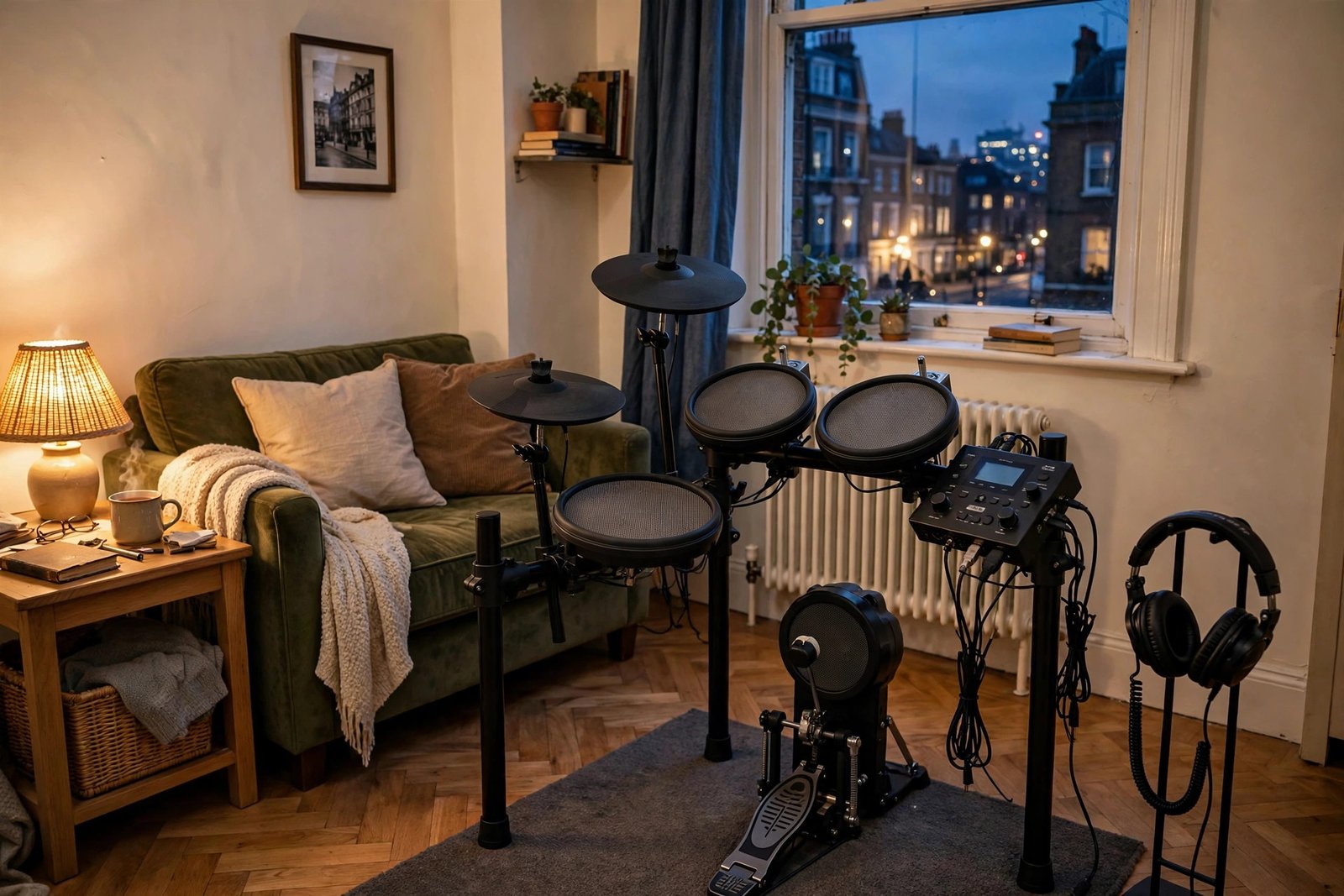
For most flat drummers, an electronic kit is the real answer. Modern budget e-kits (£300–£600 for mesh-pad kits from Roland, Alesis, or Donner) are dramatically better than the rubber-pad toys of a decade ago: mesh heads with real rebound, chokeable cymbals, and modules with coaching modes. Plug in headphones and the only sound in the room is the soft thud-thud of sticks on mesh — around 60–65dB, roughly normal conversation level.
What to look for: mesh pads on all drums (not just the snare), a kick tower or pedal rather than a pedal-only trigger (quieter through the floor), and USB/MIDI for connecting to learning apps. Budget for the tennis-ball riser regardless — e-kits solve airborne noise, not floor transmission. This electronic vs acoustic comparison is honest about the trade-offs: e-kits win on volume and recording convenience, acoustic wins on feel and dynamics. For flat practice, volume wins.
Space is the other London constraint. Most e-kits fold or pack down to about a square metre; some (like Roland’s compact models) are designed for exactly this. If your flat is genuinely tiny, organising a small London flat around a kit means choosing the corner once and building the habit of a five-minute setup — friction kills practice.
Level 3: technique for quiet playing
Whatever kit you use, learning to play quietly is a skill in itself — and one that makes you a better drummer everywhere. Practise rudiments on a practice pad (£20–£40): silent, portable, and brutally honest about your technique. Work on the Moeller stroke and finger control, which produce volume through whipping motion rather than arm force — quiet playing done right sounds better, not just softer.
Set volume rules for yourself: practise pad work and technique anytime; full-kit practice only in agreed hours (say, 6–8pm, never after 9pm — and check your tenancy agreement, which may specify quiet hours). Record yourself on your phone regularly: quiet practice reveals sloppy timing that volume used to hide.
The neighbour diplomacy playbook
Gear solves physics; diplomacy solves people. Introduce yourself before there is a problem, explain you are a drummer who practises with an electronic/quiet kit, give them your number, and agree practice hours. Most neighbour wars start not with noise but with surprise. A box of biscuits after the first month of peaceful coexistence is the best £3 you will spend on your drumming career.
Know your legal position too: most UK tenancies include nuisance clauses, and persistent noise complaints can ultimately threaten your tenancy. Councils can investigate statutory noise nuisance. This is not meant to scare you — it is meant to motivate the tennis-ball riser and the agreed hours, which make complaints vanishingly unlikely.
Make peace with the neighbours first
All the mesh heads and low-volume cymbals in the world won’t help if your downstairs neighbour believes you’re doing it on purpose. Knock on doors before you start, explain what you’re doing to keep the noise down, and agree practice hours — then stick to them religiously. Most noise complaints aren’t really about decibels; they’re about feeling powerless. A drummer who asked first and stops at 8pm gets far more goodwill than one who didn’t. And keep a practice log for a fortnight: if a complaint ever escalates, being able to show reasonable hours and mitigation measures puts you on solid ground.
The bottom line
Practise drums quietly in a flat with mesh heads and low-volume cymbals (or an electronic kit with headphones), isolate the floor with a riser or thick mats, learn genuine quiet-playing technique on a practice pad, and agree hours with your neighbours before they have to ask. Do all four and you can play daily in a one-bed flat without a single complaint — thousands of London drummers prove it every evening.
Frequently Asked Questions
Can you play drums in a flat without annoying neighbours?
Yes, with the right setup: an electronic kit or mesh-head acoustic kit with headphones keeps airborne noise at conversation level, and a riser or mats handle floor vibration. Agreeing practice hours with neighbours completes the picture.
Are electronic drums quiet enough for flats?
The pads themselves are (around 60–65dB), but the kick pedal’s impact travels through floors — that is the part neighbours hear. A tennis-ball riser or isolation platform under the kit solves most of it.
What are mesh drum heads?
Woven mesh replacements for standard drum heads that cut volume by 80–90% while keeping realistic stick rebound. Brands like Evans (dB One/dB Zero) make them for most drum sizes, and they can be swapped back for normal heads before gigs.
How much does a quiet drum setup cost?
A practice pad costs £20–£40; mesh heads plus low-volume cymbals for an existing kit run £150–£300; a decent beginner electronic kit with mesh pads costs £300–£600. A DIY tennis-ball riser costs under £30.
What hours can I practise drums in a UK flat?
There is no universal legal time, but 8am–9pm-ish practice within agreed hours is the social norm, and many tenancy agreements specify quiet hours (often 11pm–7am). Always check your tenancy agreement and agree hours with neighbours directly.