
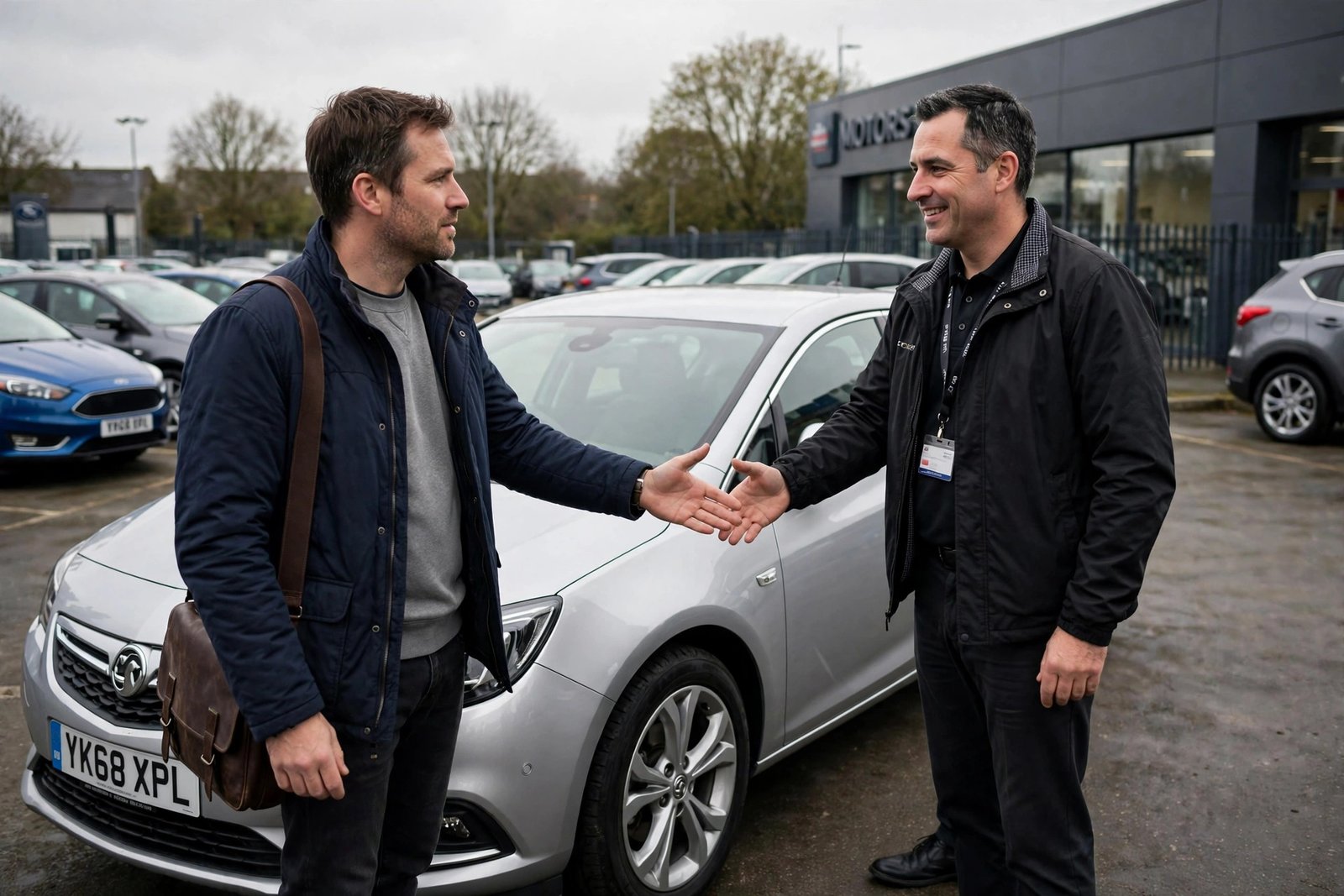
How to Haggle at a UK Car Dealership: Pro Tactics (2026)
The sticker price on a car at a UK dealership is not the price — it is the opening bid. Dealers expect negotiation: margins, bonuses and monthly targets all create room to move, and the buyers who haggle routinely save £500–£2,000. But haggling badly is worse than not haggling at all. Here is how to negotiate at a UK car dealership like someone who does it for a living.
Before you walk in: the homework
Negotiation is won before it starts. Research the car’s market value across at least three sources — Auto Trader price ratings, Parkers and What Car? valuations — and know what similar cars actually sell for, not just what dealers ask. Check how long the specific car has been in stock (listings show this); 60+ days means a motivated seller. Identify two or three alternative cars you would genuinely buy — your best leverage is the credible ability to walk away.
Sort your finance in advance. A pre-approved bank loan or finance quote transforms you from a “monthly payment” buyer (whom dealers love — they hide margin in the finance) into a cash-equivalent buyer negotiating on the car’s price alone. And know your part-exchange value separately — Which?’s car valuation tools plus a couple of online buying quotes (Motorway, Carwow) give you the floor price no dealer should go below.
The golden rules of the negotiation
1. Negotiate the car price, not the monthly payment
Dealers adore monthly-payment buyers because they can extend terms, inflate the balloon payment or load extras while keeping the monthly figure palatable. Always negotiate the on-the-road cash price first, get it in writing, and only then discuss how you will pay. “What monthly budget are you looking at?” is a trap question — answer with the total price you will pay.
2. Make your first offer count
Open at 8–12% below asking on a used car (less on new — 3–7%), backed by your research: “Similar cars are advertised at £X, this one has been in stock Y weeks, I am ready to buy today at £Z.” A serious, evidenced offer gets a serious response; a silly one gets dismissed. Silence after your offer is a tactic — wait it out.
3. Be prepared to walk away — and mean it
The walk-away is the nuclear weapon, and it only works if genuine. “Thanks, I will think about it” followed by leaving has closed more deals than any clever line — dealers routinely call within 48 hours with a better offer rather than lose a ready buyer. Never bluff a walk-away you will reverse in the car park; it destroys all credibility.
4. Negotiate extras, not just price
When the price stalls, pivot to value: 12 months’ MOT, a full service, new tyres, warranty extension, mats, or a tank of fuel. These cost the dealer less than their retail value and can be worth £300–£800 to you. A dealer who will not move £200 on price will often throw in £500 of extras — take the win.
New cars: a different game
New-car margins are thinner but the levers are different: pre-registered cars (technically “used” with delivery miles, discounted 15–25%), end-of-quarter targets (the last week of March, June, September and December is when sales managers authorise deals they would refuse mid-month), and competing dealers (get a written quote from one dealer and take it to another — the oldest trick because it works).
Manufacturer deposit contributions (£1,000–£3,000 on many models) are often available but not advertised — ask directly. And time model cycles: when a facelift or new model is announced, outgoing stock gets discounted heavily. Buying last year’s model in October is one of the cheapest ways to buy new.
The traps to avoid
Paint protection, GAP insurance, tyre insurance and extended warranties sold in the showroom carry enormous markups — often 200–400%. You can buy GAP insurance independently for a third of the dealer price; paint protection is largely profit. The finance office is where deals go to die: every add-on is negotiable, and “it is only £15 a month” over four years is £720.
Never sign under time pressure (“this price is only valid today” — it is not), never negotiate against yourself (make an offer, then stop talking), and never fall in love with the car before the deal is done — emotional buyers pay emotional prices. Gov.uk’s consumer rights guidance covers your protections, including the 14-day cooling-off period for finance arranged away from the dealership.
Part-exchange: the second negotiation
Treat the part-exchange as a separate deal: agree the new car’s price first, then introduce the trade-in. Dealers profit by giving with one hand and taking with the other — a generous discount on the new car funded by undervaluing your old one. Get independent valuations first (online buyers give instant quotes), clean and prep your car (a valet costing £50 can add £300 to the offer), and be ready to sell privately if the dealer’s number insults you — private sales typically beat part-exchange by 10–15%.
Understand the total cost picture too: the yearly cost of running a car often matters more than the purchase haggle — a £1,000 discount means little if insurance and servicing eat the saving. And if the numbers do not work at all, car clubs versus ownership is worth a serious look.
The London factor
London dealerships carry higher overheads and often higher prices — but also more competition and more stock turnover. Use this: get quotes from dealers outside London (the M25 corridor, Home Counties) and use them as leverage — “Kent is offering £1,200 less for the same car.” Many buyers save the difference with a train ticket and a drive home. Also check insurance costs before committing — London postcodes can make an affordable car unaffordable.
Conclusion
Haggling at a UK dealership works when you do the homework (market values, stock age, alternatives), negotiate the cash price not the monthly payment, open with an evidenced 8–12% under on used cars, use timing (month-end, quarter-end, model cycles), pivot to extras when price stalls, and walk away genuinely when needed. The sticker price is the start of the conversation — and the prepared buyer always pays less than the impulsive one.
Frequently Asked Questions
How much can you negotiate off a used car in the UK?
Typically 5–10% off the asking price on used cars, more on stock that has sat 60+ days. New cars: 3–7% plus deposit contributions and extras. The discount depends on demand, stock age and timing.
When is the best time to buy a car from a dealer?
The last week of the month (sales targets), end of quarter (March, June, September, December), and when new models launch (outgoing stock discounted). Winter months are generally quieter and more negotiable.
Should I tell the dealer my budget?
No — or rather, frame it as total price, never monthly payment. Dealers use monthly budgets to hide margin in extended terms and add-ons. Negotiate the on-the-road price first.
Is it better to part-exchange or sell privately?
Private sales typically achieve 10–15% more than part-exchange offers, but cost time and hassle. Get independent valuations first, negotiate the new car’s price separately, and only accept part-exchange if the convenience justifies the gap.