
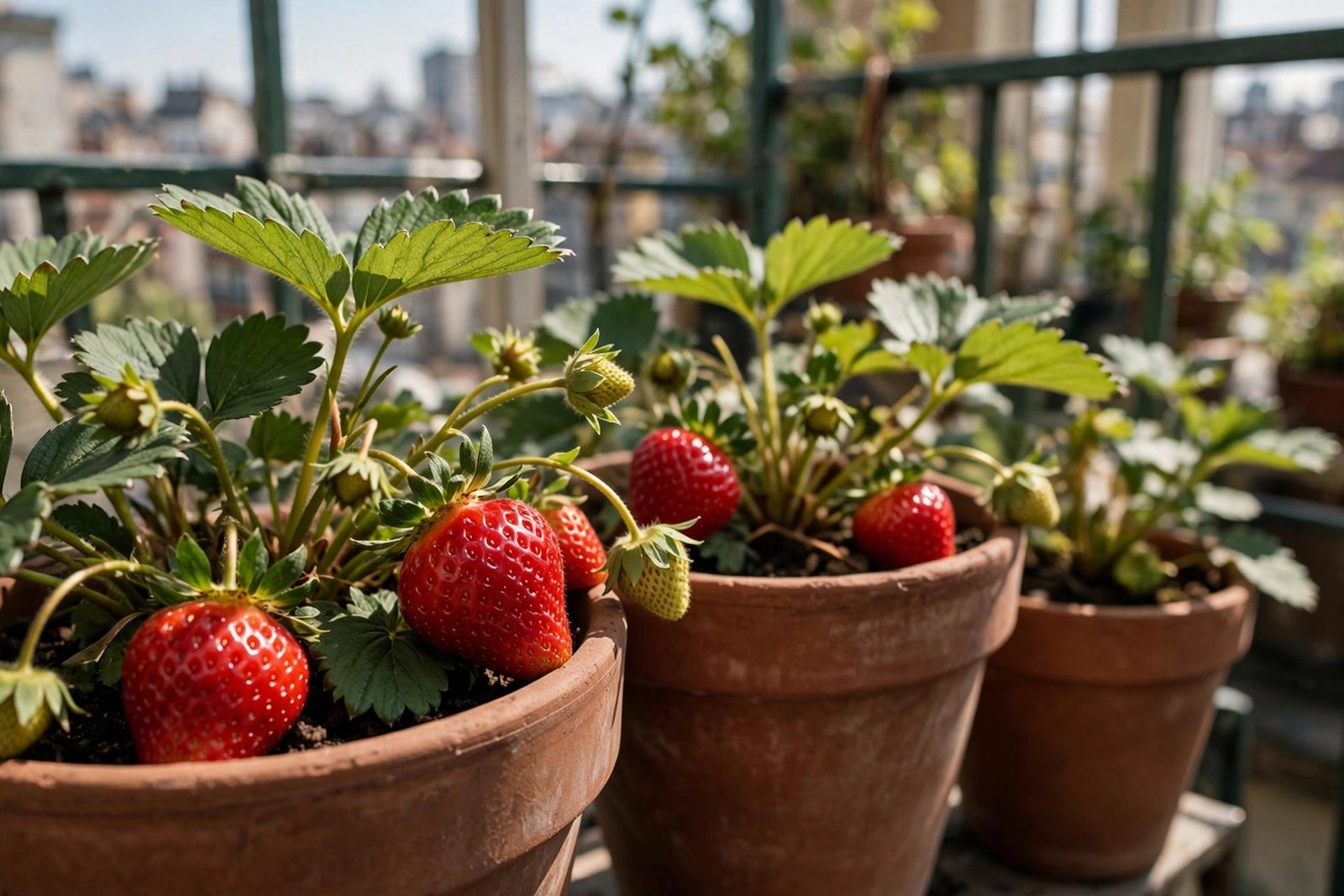
How to Grow Strawberries on a Balcony: The Complete Guide
Few harvests beat the first warm strawberry picked seconds from the plant — and you do not need a garden to experience it. Strawberries are among the most balcony-friendly crops in existence: shallow-rooted, compact, ornamental enough to double as decoration, and dramatically better fresh than anything from a supermarket punnet, because commercial berries are bred for shipping, not flavour.
Here is how to grow strawberries on a balcony successfully — the right varieties, the containers that work, and the simple routine that keeps berries coming from June to October.
Choosing Varieties Bred for Pots
Variety choice decides everything in containers. For balconies, everbearing (also called day-neutral) varieties outperform traditional June-bearers: instead of one heavy crop, they fruit continuously from early summer into autumn. Excellent container choices include 'Mara des Bois' for intense, almost wild-strawberry flavour, 'Albion' for large, sweet, reliable berries, and alpine varieties like 'Mignonette' for tiny, perfumed fruits that thrive in the smallest pots.
Buy runners or young plants rather than seed — seed-grown strawberries take a full season longer to fruit and many varieties do not come true from seed. One plant per 20cm pot is the rule; strawberries look sparse initially but fill out fast. For a household that snacks daily, six to eight plants across a couple of containers provides a satisfying trickle all season. Replace plants every three years as vigour declines — or propagate the runners they send out for free replacements.
Containers, Compost and Position
Strawberries need surprisingly little root space but demand excellent drainage — waterlogged crowns rot fast. Any container 20cm deep or more works: terracotta pots, trough planters, hanging baskets, or vertical strawberry planters with planting pockets that turn a square metre of balcony into twenty plants. Ensure drainage holes and raise pots on feet so water escapes freely.
Fill with good peat-free multi-purpose compost mixed with a little grit for drainage; strawberries prefer slightly acidic to neutral soil. Position is critical: six or more hours of direct sun daily for sweet berries — a south or west-facing balcony is ideal. Windy high-rise balconies need shelter; a simple windbreak or positioning pots against the wall prevents desiccation and physical damage. Mulch the surface with straw or bark to keep fruits clean and deter slugs.
Worth a look: Defra.
The Watering and Feeding Routine
The daily watering routine
Container strawberries are thirstier than their garden cousins — pots dry fast, especially terracotta in sun. Water daily in warm weather, ideally mornings, aiming to keep compost consistently moist but never soggy; the classic test is a finger pushed 3cm into the compost. Hanging baskets may need twice-daily watering in heatwaves. Inconsistent watering causes misshapen berries, so routine matters more than volume.
Feeding for fruit, not leaves
Feed fortnightly from first flowers with a high-potassium liquid feed — tomato fertiliser is perfect and cheap. Too much nitrogen grows leaves at the expense of fruit, so avoid general-purpose feeds heavy in nitrogen. Remove the first flush of flowers on newly planted everbearers to let roots establish; the delayed harvest will be heavier. Pinch off runners unless you want new plants — each runner drains energy from fruiting. This routine takes five minutes a day and is the entire difference between sad berries and superb ones.
Pests, Birds and Balcony Advantages
Balconies confer a genuine pest advantage: fewer slugs, less soil-borne disease, and easier monitoring than ground-level growing. Birds remain the arch-enemy — a ripening strawberry is irresistible, and pigeons learn fast. Netting draped over canes is the reliable defence; the ultra-fine mesh sold for fruit cages works on balconies too. Aphids occasionally colonise; a sharp jet of water or insecticidal soap handles them.
Watch for grey mould (botrytis) in damp spells — improve air circulation, avoid wetting fruits when watering, and remove affected berries immediately. Vine weevils can trouble containers; check for notched leaf edges and consider nematode treatment if confirmed. The balcony's controlled environment makes organic management genuinely practical — most problems are visible early and solvable without chemicals.
Troubleshooting Poor Harvests
When berries disappoint, diagnose systematically. Lots of leaves, few flowers: excess nitrogen or overfeeding — switch to high-potassium feed and check you are not using nitrogen-heavy fertiliser. Flowers but no fruit: poor pollination — bees do the work, so avoid spraying during flowering, plant bee-friendly companions nearby, and in still balcony corners, hand-pollinate with a soft brush. Small, misshapen berries: inconsistent watering or poor pollination — mulch and water evenly.
Plants declining in year three: normal — vigour fades, so propagate runners each summer into fresh compost and rotate container soil. White powdery leaves: powdery mildew from poor air circulation — space plants, water at the base, remove affected leaves. Reddish leaves in autumn: natural dormancy, not disease. Keep a simple log — variety, planting date, feed schedule — and each season's mysteries become next season's knowledge. Balcony strawberry growing rewards the observant; the plants tell you everything if you learn to read them.
The full background is available at the Royal Horticultural Society.
Harvest, Overwinter and Renew
Pick berries fully ripe — strawberries do not ripen after picking, and the supermarket habit of eating under-ripe fruit is why homegrown tastes revelatory. Harvest every day or two in peak season, twisting gently to avoid damaging the plant. Morning picking gives the best flavour and coolest fruit. Eat fresh, obviously — but glut moments suit jam, freezing (hull, freeze spread on trays, then bag), or a genuinely superior Eton mess.
Overwintering is simple: after fruiting ends, tidy dead leaves, and either leave hardy containers in place (cluster pots together against the wall and mulch crowns) or move to a sheltered corner. Plants fruit best in years one and two, adequately in year three, then decline — propagate runners each summer into fresh compost for a perpetual free supply. A balcony strawberry patch, once established, is a self-renewing source of the summer's best flavour.
Want to go deeper? Our article on do i need planning permission for a garden shed and how do i build a raised garden bed cheaply is worth a look next.
Grow strawberries on a balcony by choosing everbearing varieties like Mara des Bois or Albion, planting one per 20cm pot in free-draining peat-free compost, and giving six-plus hours of sun. Water daily, feed fortnightly with tomato fertiliser from first flowers, net against birds, and pick fully ripe. Overwinter the pots, renew plants every three years from free runners, and enjoy berries from June to October that make supermarket fruit taste like a rumour.
Frequently Asked Questions
What is the best strawberry variety for containers?
Everbearing types like Mara des Bois (superb flavour), Albion (large and reliable) or alpine strawberries for tiny pots. They fruit continuously from early summer to autumn rather than in one flush.
How many strawberry plants do I need for a balcony?
Six to eight plants across a couple of containers gives a household a satisfying daily trickle. Plant one per 20cm pot — they fill out faster than they look.
Why are my balcony strawberries small and tasteless?
Usually insufficient sun (under six hours), inconsistent watering, or too much nitrogen feed growing leaves instead of fruit. Ripe-picked homegrown berries should taste dramatically better than shop-bought.
Do strawberries come back every year in pots?
Yes — they are perennial. Overwinter containers in a sheltered spot, and plants fruit best in years one and two. Propagate the runners each summer for free replacement plants.