
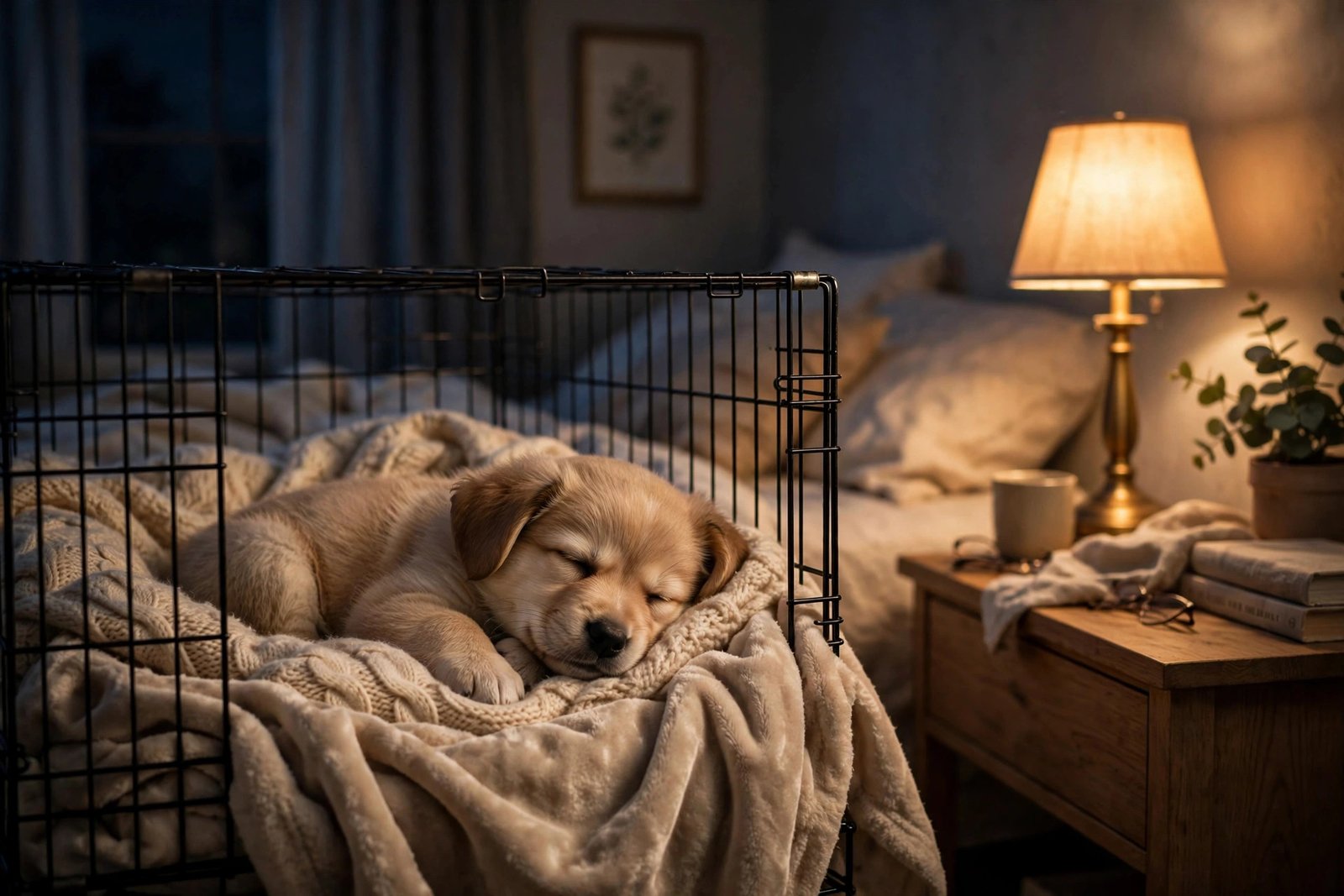
How to Crate Train Without the All-Night Whining
The first nights with a crate-trained puppy are notorious: you put a tired little dog in the crate, turn off the light, and the whining starts — then the barking, then the howling that has the neighbours banging on the wall. Most owners crack within an hour, and the puppy learns a lasting lesson: scream, and the door opens. It does not have to be this way.
Crate training without the all-night whining is about preparation, not willpower. Done right, the crate becomes the puppy’s favourite den within days, and nights are quiet from the start. Here is the method trainers actually recommend.
Why puppies whine at night (and why punishment backfires)
A young puppy whining in a crate is not being naughty — it is a baby animal separated from everything it knows, possibly for the first time. Whining signals genuine distress, loneliness, or a full bladder. Scolding or banging the crate teaches the puppy that the crate is a scary place, which makes the whining worse, not better.
The goal is to change the puppy’s emotional response: crate equals safe, cosy den — not prison. Every technique below serves that single goal. Patience in week one buys you years of a dog that settles happily. And remember that your own rest matters too; sleep deprivation makes everything harder, so protect your sleep with the same seriousness you would apply to improving your sleep without medication — earplugs for the first nights are no failure.
Set the crate up for success before night one
Location matters enormously. For the first week, put the crate in your bedroom, right beside your bed. This single decision prevents most night-time drama: the puppy can smell and hear you, and you can dangle your fingers through the bars for reassurance without getting up. You can move the crate gradually to its permanent spot over the following weeks.
Make it den-like: cover three sides with a blanket (leaving the front ventilated), add vet bedding or a worn t-shirt that smells of you, and include a safe chew toy. A Snuggle Puppy-style toy with a heartbeat simulator genuinely helps many puppies. Size it right — just enough room to stand, turn and lie down. Too big, and the puppy will toilet in one corner and sleep in the other.
Feed all meals in the crate from day one with the door open, so the puppy builds positive associations before any door ever closes. In a flat, also think about sound: a whining puppy at 3am in a converted Victorian terrace is a neighbour dispute waiting to happen, so the bedroom-crate strategy doubles as diplomacy — see how to deal with noisy neighbours in a flat for keeping relations smooth while you train.
The first three nights: a survival plan
Night one
Exercise the puppy well in the evening — a tired puppy settles faster. Last toilet trip as late as possible, then into the crate with a stuffed Kong. Lie beside the crate until the puppy sleeps, then get into bed. If whining starts, shush gently and offer fingers through the bars, but do not open the door unless you suspect a genuine toilet need.
The 2am toilet run
Puppies under 12 weeks cannot hold it all night. Set an alarm for halfway through the night, carry the puppy out silently (no play, no lights, no fuss), let them toilet, then straight back in. Boring is the point — you are teaching that nights are for sleep, not parties.
Nights two and three
Gradually reduce your presence: move from beside the crate to your bed, then to sleeping normally. Most puppies who start in the bedroom settle within three nights. If whining persists beyond 10–15 minutes, check for genuine need (toilet, too hot, tangled blanket) rather than assuming manipulation — young puppies rarely “fake it”.
Daytime training that makes nights easy
Night success is built during the day. Practise short, happy crate sessions: toss treats in, let the puppy wander in and out freely, then briefly close the door while you sit nearby, building from seconds to minutes. Never use the crate as punishment — it must remain the good place.
Establish a rock-solid daytime routine of toilet breaks (after waking, eating, playing and every hour for young pups), and the nights take care of themselves. A puppy on a predictable schedule is a puppy whose body learns when to sleep. Crate training also simplifies flat life enormously — a defined dog zone keeps small spaces workable, as our guide to organising a small London flat with no storage explains.
Troubleshooting: when whining will not stop
If a puppy whines for more than a few nights despite the bedroom setup, run through the checklist: Is the crate too hot or cold? Is the bedding uncomfortable? Is the puppy getting enough daytime exercise and mental stimulation — an under-tired puppy cannot settle? Is there a medical issue such as a urinary infection causing night-time urgency?
For genuine separation distress (panting, drooling, frantic escape attempts rather than simple whining), slow down: you may be moving too fast, and a qualified behaviourist is worth the fee. The Blue Cross and Dogs Trust both offer free crate-training advice lines and factsheets.
Conclusion
Crate training without all-night whining is not about toughness — it is about setup. Crate in the bedroom, den-like comfort, meals in the crate, a boring 2am toilet run, and daytime practice sessions will have most puppies sleeping through within a week. Stay calm, stay consistent, and resist the urge to negotiate with a whining puppy at 3am: every time the door opens for noise, the noise gets louder tomorrow. Get week one right, and the crate becomes the place your dog chooses — door open, tail wagging, fast asleep.
Frequently Asked Questions
What size crate should I get?
Just big enough for the puppy to stand up, turn around and lie down comfortably. Too large defeats the house-training benefit, since puppies will soil one end. Buy a crate with a divider panel so it can grow with the puppy — cheaper than buying twice.
How long will my puppy whine in the crate at night?
With the crate in your bedroom and proper daytime preparation, most puppies settle within 2–4 nights. Persistent whining beyond a week suggests something needs adjusting — location, comfort, routine or a vet check.
Should I ignore whining or respond to it?
Respond to genuine need (toilet, distress) calmly and boringly; do not open the door for attention-seeking whining. Young puppies under 12 weeks usually need one night-time toilet trip regardless.
Is it cruel to crate a puppy at night?
No — dogs are den animals and most find a properly introduced crate comforting. Cruelty would be long daytime confinement without exercise, or using the crate as punishment.
When can the puppy sleep out of the crate?
Most owners transition between 6 and 12 months, once the dog is reliably house-trained and past the destructive chewing phase. Many dogs keep choosing the crate voluntarily.
What if my puppy toilets in the crate?
The crate is likely too big, or the puppy was left too long. Shrink the space with a divider, increase toilet breaks, and clean with enzymatic cleaner — never punish, as the puppy cannot connect punishment with the act.