
Loft Insulation Cost UK 2026: Prices, Grants and Payback
Loft Insulation Cost UK 2026: Prices, Grants and Payback
A quarter of your home’s heat escapes through the roof — and loft insulation is the cheapest big win in home energy efficiency. Here’s how much it costs to insulate a loft in the UK, what grants exist, and how fast it pays for itself.
Typical costs
- Top-up (existing 100mm → 270mm): £300–£500 for a typical 3-bed semi
- Full install from scratch (270mm mineral wool): £500–£900
- Detached / larger homes: £700–£1,200
- DIY (materials only): £200–£400 — rolls of mineral wool from Wickes, B&Q or Screwfix
- Spray foam: £1,500–£3,000 — effective but controversial (see below)
The recommended depth is 270mm of mineral wool (or equivalent). Most UK lofts installed before 2000 have far less — if you can see the joists clearly, you need a top-up.
Grants and free insulation
Check these before paying full price:
- ECO4 scheme: low-income households and those on certain benefits may get loft insulation free via energy suppliers. Check eligibility on gov.uk or ask your energy supplier directly.
- Great British Insulation Scheme: covers insulation for homes in lower council tax bands with poor EPC ratings — can fund partial or full costs.
- Local authority grants: some councils top up national schemes — worth a call.
Even without grants, the payback is fast (below) — don’t wait years hoping for free insulation while paying £250/year in wasted heat.
Payback: the maths
The Energy Saving Trust estimates that topping up loft insulation from 120mm to 270mm in a typical semi saves around £200–£300/year on heating bills. At a £400 install cost, that’s payback in under two years — then pure saving for decades. Few home improvements touch that return.
DIY or professional?
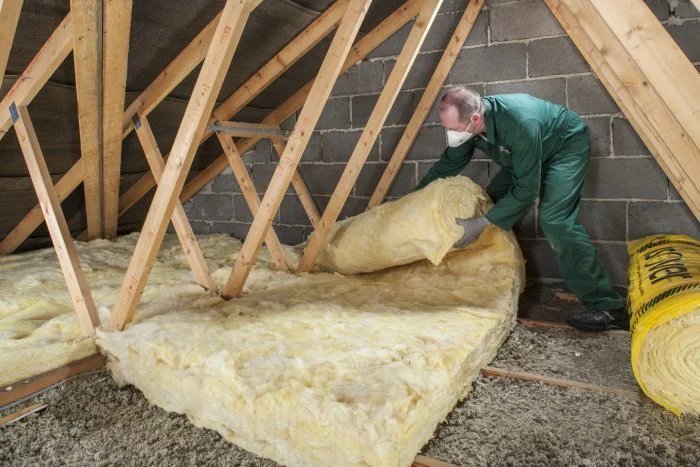
DIY is very doable if your loft is accessible and boarded (or boardable):
- Wear a mask, gloves, goggles and long sleeves — mineral wool is irritating
- Lay the first layer between joists, the second across them (to 270mm total)
- Don’t compress it — squashed insulation loses effectiveness
- Leave the eaves ventilated — don’t block airflow at the edges (causes condensation)
- Don’t insulate over downlights unless they’re fire-rated with proper covers
- Insulate and draught-proof the loft hatch too — it’s a notorious heat leak
Get a pro if: the loft is hard to access, there’s old wiring to work around, you need boarding for storage (requires raised platforms to avoid compressing insulation), or there’s damp up there.
A warning about spray foam
Spray foam insulation is effective but has become a mortgage problem: many lenders now refuse or restrict lending on homes with spray foam, because it can trap moisture against timbers and hide roof defects. The RICS has flagged concerns. If you’re considering it, check with your mortgage lender first — and know that removing it costs thousands. Mineral wool remains the safe default.
Don’t forget the rest of the package
Loft insulation works best alongside:
- Draught-proofing (£100–£200, saves £50–£100/year)
- Cavity wall insulation — see is cavity wall insulation worth it?
- A smart thermostat to control the heat you’re now keeping in — see smart thermostat savings
The bottom line
£300–£600 for a professional top-up, payback in 1–2 years, benefits for 40 years. Check ECO4/GBIS grant eligibility first — you might pay nothing. Avoid spray foam unless your lender approves. Of all the ways to cut energy bills, topping up loft insulation is the closest thing to free money in home improvement.
Loft boarding: insulation vs storage (the conflict)
The classic dilemma: you want insulation and loft storage, but boarding laid directly on joists compresses insulation — squashing 270mm to 100mm destroys its effectiveness. The solution: raised loft legs (LoftZone, £80–£150 for an average loft) — plastic stilts that lift boarding above the insulation, preserving its full depth. Or insulate between joists (100mm) plus a cross-layer (170mm) with boarding on legs above.
Never just lay boards on top of insulation and hope — you’ll halve its performance and create cold spots that cause condensation. If a builder suggests boarding straight onto insulation, they don’t understand insulation. The raised-leg system adds £100–£200 to the job and preserves both storage and performance — always worth it.
Loft insulation FAQs
Can I get it free? Possibly — ECO4 (via energy suppliers, for benefit recipients/low-income) and the Great British Insulation Scheme (lower council tax bands, poor EPC) can fund full or partial costs. Even if you’re not eligible, the 1–2 year payback makes it worth paying for.
How long does installation take? 2–4 hours for a professional top-up of a standard loft. DIY: a full day including the inevitable three trips to the DIY shop.
Will it cause condensation? Only if done wrong — never block eaves ventilation, don’t insulate over non-fire-rated downlights, and keep the loft hatch draught-proofed. Done correctly, insulation reduces condensation by warming ceiling surfaces.
What about flat roofs? Different job — flat roofs need warm-roof (insulation above the deck) or cold-roof (between joists with ventilation) construction. It’s specialist work (£1,500–£4,000) — not a DIY mineral-wool roll job.
Does it affect my EPC rating? Yes, positively — loft insulation to 270mm is one of the highest-impact EPC improvements per pound spent. If you’re selling or renting, it’s cheap EPC points.
A real example: what a top-up actually involves
To make this concrete: a typical 3-bed semi with 100mm of old insulation getting topped to 270mm. The installer arrives around 9am, lays dust sheets on the landing, and works from the loft hatch outward — rolling 100mm between the joists first, then 170mm across them. They’ll insulate the loft hatch itself (usually forgotten, always leaky), fit eaves vent trays to keep airflow at the edges, and box around the water tank and pipes (pipes get insulated too — lagging the cold water tank prevents freezing). Done by lunchtime. Cost: £350–£450. Disruption: minimal — you might hear thumping for a few hours. The first winter after, the upstairs bedrooms are noticeably warmer and the heating clicks off earlier in the evening. It’s the least glamorous home improvement and one of the most satisfying — you feel the difference within days, and the payback starts immediately.
One thought on “Loft Insulation Cost UK 2026: Prices, Grants and Payback”