
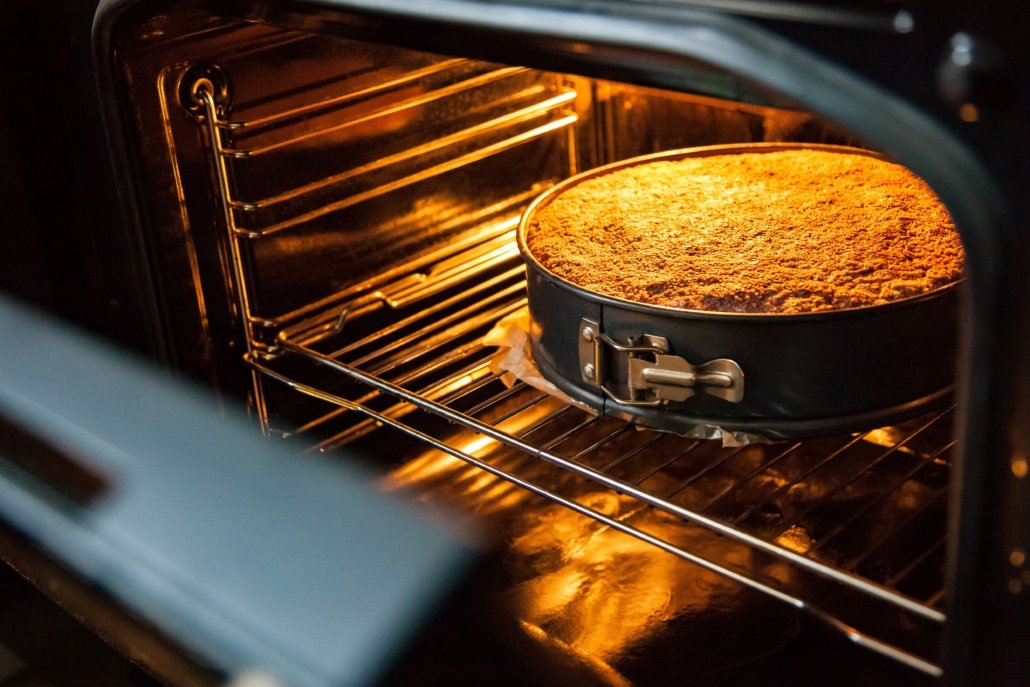
Why Your Cakes Sink in the Middle (and How to Stop It Happening)
There’s a special kind of heartbreak in pulling a beautiful, golden cake from the oven, only to watch the centre slowly collapse like a deflated soufflé. I’ve been there more times than I’d like to admit. The good news: cakes sink for specific, fixable reasons. Once you know what causes it, you’ll know exactly how to stop cakes from sinking in the middle — and it’ll rarely happen again.
Why cakes sink in the middle
A cake rises because gases expand in the heat and the batter’s structure sets around them. If the structure isn’t strong enough when the gases escape — or if the gases were never properly trapped in the first place — the middle caves in. Almost every sunken cake comes down to one of nine causes.
The 9 causes (and fixes)
1. Your oven is too cool
This is the biggest culprit. If the oven isn’t hot enough, the cake rises slowly, the structure never firms up properly, and the centre collapses under its own weight. Invest in an oven thermometer (£5-8) — most domestic ovens are off by 10-20°C, and the dial lies. Preheat fully, and don’t open the door for at least the first two-thirds of the baking time.
2. Too much raising agent
Counterintuitive, but more baking powder doesn’t mean more rise. Excess leavening creates big bubbles that rise fast and then burst, leaving nothing to hold the cake up. Measure carefully with proper measuring spoons, not a dinner spoon. If your recipe uses both soda and powder, don’t “round up” either.
3. Underbaking
A cake that looks done on top can still be raw in the middle. The skewer test is your friend: insert a skewer or cocktail stick into the centre — it should come out clean or with a few dry crumbs, never wet batter. Also try the spring-back test: gently press the centre; it should spring back, not leave a dent.
4. Overmixing the batter
Once flour meets liquid, gluten starts developing. Mix too long or too vigorously after adding flour and you get a tough, dense crumb — or paradoxically, a cake that rises then sinks because the overworked structure can’t hold. Mix until just combined, no more. A few small lumps are fine.
5. Wrong tin size
A batter meant for an 8-inch tin poured into a 9-inch tin spreads too thin and overbakes at the edges while the middle stays raw. Too small a tin and the middle can’t cook through before the outside burns. If you don’t have the right tin, scale the recipe rather than improvising.
6. Opening the oven door too early
Every peek drops the temperature and lets the rising gases escape before the structure sets. I know it’s tempting — resist. Use the oven light and wait until at least 75% of the baking time has passed before even thinking about checking.
7. Too much sugar or fat
Sugar and fat tenderise a cake, which is lovely — until there’s so much the structure can’t support itself. If you’ve “improved” a recipe by adding extra butter or sugar, that might be your problem. Rich cakes need longer, slower baking to set properly.
8. Cold ingredients
Eggs, butter and milk straight from the fridge don’t emulsify properly, giving you an uneven batter that rises unpredictably. Take refrigerated ingredients out 30-60 minutes before baking. Room-temperature butter creams properly with sugar, trapping the air bubbles your rise depends on.
9. Old raising agents
Baking powder loses its power within 6-12 months of opening. Test it: half a teaspoon in hot water should fizz vigorously. No fizz, no rise. This one is so common it’s almost embarrassing — check the date on your tub before you blame anything else.
How to rescue a sunken cake
So the damage is done — now what? Don’t bin it. A sunken middle is a cosmetic problem, not a flavour one:
- Fill the dip. Whipped cream, buttercream, custard, fruit compote or ice cream in the hollow turns a flaw into a feature. Nobody will know.
- Flip it. Turn the cake upside down so the flat bottom becomes the top, then ice it.
- Make trifle. Cube the cake, layer with custard, fruit and cream in a bowl. Sunken cake makes excellent trifle — genuinely, it’s ideal.
- Cut out the middle. Level the whole cake with a serrated knife and use the trimmings for cake pops.
And if you’re serving it alongside a proper spread, remember that presentation covers a multitude of sins — much like knowing where to find the best fish and chips in London covers you when you don’t fancy cooking at all.
Prevention checklist
Before your next bake, run through this:
- Oven thermometer in place, fully preheated
- Raising agents tested and in date
- Ingredients at room temperature
- Correct tin size, greased and lined
- Measured — not eyeballed — leavening, sugar and fat
- Mixed until just combined
- Oven door stays shut for the first 75% of baking
- Skewer-tested before removing
For more on the chemistry of raising agents, the BBC Good Food leavening guide is worth a bookmark. And once your sponges are rising reliably, you might enjoy building a proper spice collection — here’s what spices you need for a basic Indian kitchen to expand your repertoire beyond baking.
How to stop cakes from sinking in the middle: advanced tips
Beyond the big nine causes, a few finer points separate reliably good bakers from lucky ones. Oven position matters: bake on the middle shelf where heat circulates most evenly. Too high and the top sets before the middle cooks; too low and the base overcooks while the centre stays raw. If your oven has hot spots (most do — test with a tray of desiccated coconut or bread slices), rotate the tin once, gently, at the two-thirds mark.
Fan vs conventional: fan ovens bake faster and can set the outside before the inside is done — reduce the recipe temperature by 15-20°C for fan, and consider conventional mode for delicate sponges if your oven offers both. Tin preparation counts too: a properly greased and lined tin lets the batter climb evenly; a sticky tin drags the edges down as it cools, and the middle follows.
Finally, cool it right. A cake that was perfect in the oven can still sink if cooled badly: leave it in the tin for 10-15 minutes (the structure is still setting), then turn out onto a wire rack. Cooling a cake in the tin for an hour steams the base and weakens the crumb; turning it out too soon, while fragile, risks collapse. Ten to fifteen minutes is the sweet spot — set a timer, walk away, and let physics do its job.
The takeaway
Sunken cakes are almost always about temperature, timing or measurement — not talent. Calibrate your oven, respect the recipe’s ratios, keep the door shut, and test before you pull it out. Do that, and the dreaded dip in the middle becomes a distant memory.
One thought on “Why Your Cakes Sink in the Middle (and How to Stop It Happening)”