
How to Compost With No Outdoor Space: 4 Flat-Friendly Methods
You live in a flat. No garden, no balcony, maybe not even a windowsill to spare. And yet every week you throw away vegetable peelings, coffee grounds, and eggshells — perfectly good organic matter on its way to landfill, where it’ll rot anaerobically and release methane, a greenhouse gas far punchier than CO₂. Composting feels like something that requires a garden, a big bin, and a lifestyle you don’t have. It doesn’t. Urban composting has quietly become a solved problem, with methods designed for kitchens, cupboards, and even desks. Here’s how to turn your scraps into black gold without a single square foot of outdoor space.
Why bother? The methane argument
Food waste in landfill doesn’t just sit there — it decomposes without oxygen, producing methane, which traps roughly 80 times more heat than CO₂ over 20 years. The UK wastes around 9.5 million tonnes of food a year, and a shocking share of household food waste is avoidable. Composting doesn’t just avoid the methane; it creates a soil improver that sequesters carbon and replaces peat-based composts (peat extraction being its own environmental disaster). Even a flat-dweller’s modest scrap output, composted, is a genuine climate action — small, yes, but real, unlike most of what passes for green virtue.
There’s a second argument: the output is valuable. Finished compost is the best free soil improver in existence, and even without a garden you’ll find it has users — houseplants, window boxes, community gardens, allotment holders who’ll take it off your hands. Reducing food waste in the first place matters even more, of course — see how to reduce food waste at home — but the unavoidable scraps (peelings, cores, grounds) still need somewhere better than landfill.
Option 1: The wormery (vermicomposting)
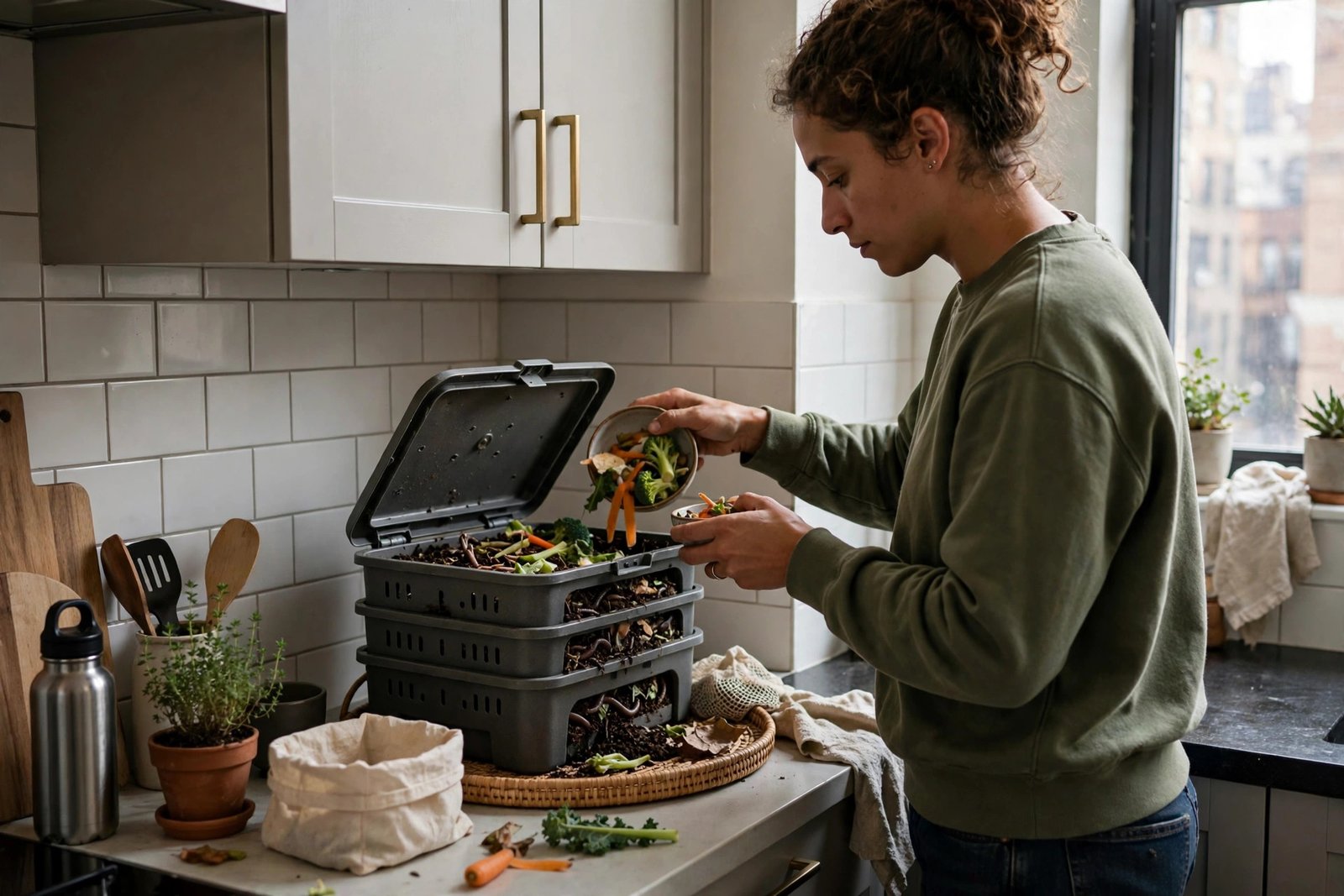
The classic flat solution: a stacked wormery — trays in a compact bin, usually about the size of a kitchen pedal bin — housing tiger worms that eat your scraps and produce two outputs: vermicompost (superb, nutrient-dense compost) and “worm tea” (liquid feed you dilute for houseplants). A wormery handles most fruit and vegetable scraps, coffee grounds and filters, tea bags (plastic-free ones), eggshells, and shredded cardboard.
The honest pros and cons: wormeries are odourless when managed right (they smell like forest floor, not bins), fascinating, and produce the best compost of any indoor method. They need a little learning — the right moisture, the right balance of “greens” (scraps) and “browns” (cardboard), and not overfeeding. They don’t handle meat, dairy, oils, or large volumes, and they sulk in very hot or cold spots (a hallway or kitchen corner is ideal). Tiger worms are available by post, multiply on their own, and a well-run wormery can process the scraps of a 1–2 person household indefinitely. The RHS notes that balanced composting needs both green and brown materials — the same principle applies in miniature: every handful of scraps wants a handful of shredded cardboard.
Option 2: Bokashi — fermentation in a bucket
Bokashi is the speed demon of flat composting: a sealed bucket where you layer food scraps with a bran inoculated with effective microorganisms, which ferments (pickles, essentially) the waste instead of rotting it. The killer feature: bokashi handles everything — meat, fish, dairy, cooked food, the stuff wormeries refuse. Two buckets alternate (one filling, one fermenting), each cycle takes about two weeks, and the process is anaerobic and sealed, so there’s no smell beyond a faint pickle tang when you open the lid.
The catch: bokashi’s output isn’t finished compost — it’s pre-compost, acidic fermented matter that needs a second stage. Without outdoor space, that means either a wormery (bokashi pre-compost is worm candy — the combination is the flat composter’s power move), a “soil factory” (a storage box of soil where the fermented matter breaks down over a few weeks), or donation to a community composting scheme. Many London community gardens and allotments accept bokashi output. Check what’s near you before investing — the second stage is the part people forget to plan.
Option 3: Electric countertop composters
The new kids on the block: countertop devices that heat, grind, and dehydrate scraps into a dry, soil-like output in hours. They’re fast, odourless, handle most foods, and genuinely effortless — scrape plate, close lid, done. The downsides: cost (£300–500), energy use (which undercuts some of the green benefit), noise, and output volume limits. The output is dehydrated matter rather than biologically active compost — better than landfill, less magical than worm castings. They’re best for time-poor flat-dwellers who’d otherwise compost nothing; think of them as the dishwasher of composting — not traditional, but effective.
Option 4: Don’t compost at home — compost collectively
Here’s the option nobody considers: you don’t have to process it yourself. London has a growing network of community composting schemes — estates, community gardens, and food-growing projects that accept kitchen scraps. Some boroughs run collection schemes; several social enterprises collect scraps by bike. And from March 2026, Simpler Recycling means councils must collect food waste weekly anyway — so your scraps will be composted or anaerobically digested even if you just use the council caddy. The Simpler Recycling rules make the council food waste bin the zero-effort baseline every Londoner now has.
If you have even a tiny growing space — window boxes, a shared courtyard — your compost has a direct use: top-dressing pots and planters. Building a raised bed cheaply is overkill for most flats, but even a few pots of herbs will drink up worm tea and thank you for it.
Frequently asked questions
Will a wormery smell up my flat?
No — a healthy wormery smells earthy, like a forest floor. Bad smells mean something’s wrong: overfeeding, too wet, or wrong foods. Fix the balance (more shredded cardboard, less food for a week) and the smell resolves. The only whiff most owners ever notice is when opening the lid.
Can I compost meat and dairy indoors?
Not in a wormery (it goes rancid and attracts problems), but yes in bokashi — fermentation handles all foods including meat, fish, and dairy. That’s bokashi’s main advantage for omnivorous households.
What do I do with the compost if I have no plants?
Worm tea dilutes into excellent houseplant feed (you’ll find takers among friends). Solid compost goes to community gardens, allotments, window boxes, or neighbours with gardens — post in local groups and it’ll vanish. Some councils accept home compost at recycling centres too.
Is bokashi or a wormery better for a flat?
They solve different problems: wormeries make finished compost but only take veg scraps; bokashi takes everything but needs a second stage. The gold standard is both — bokashi for all scraps, wormery to finish the fermented output. If you must pick one, pick the wormery for simplicity.
Do I even need to bother now councils collect food waste?
The council caddy is a fine baseline — your scraps avoid landfill either way. Home composting’s edge is the output: you get soil improver and plant feed back, closing the loop in your own home. It’s the difference between recycling and actually using the material. Both beat the black bin.
The bottom line
No outdoor space is no excuse anymore: wormeries turn veg scraps into premium compost in a kitchen corner, bokashi ferments everything including meat in a sealed bucket, electric composters do it at the touch of a button, and community schemes plus weekly council food waste collections catch everything else. Pick the method that fits your scraps, your space, and your patience — and stop sending methane to landfill from a flat that could be making black gold instead.