
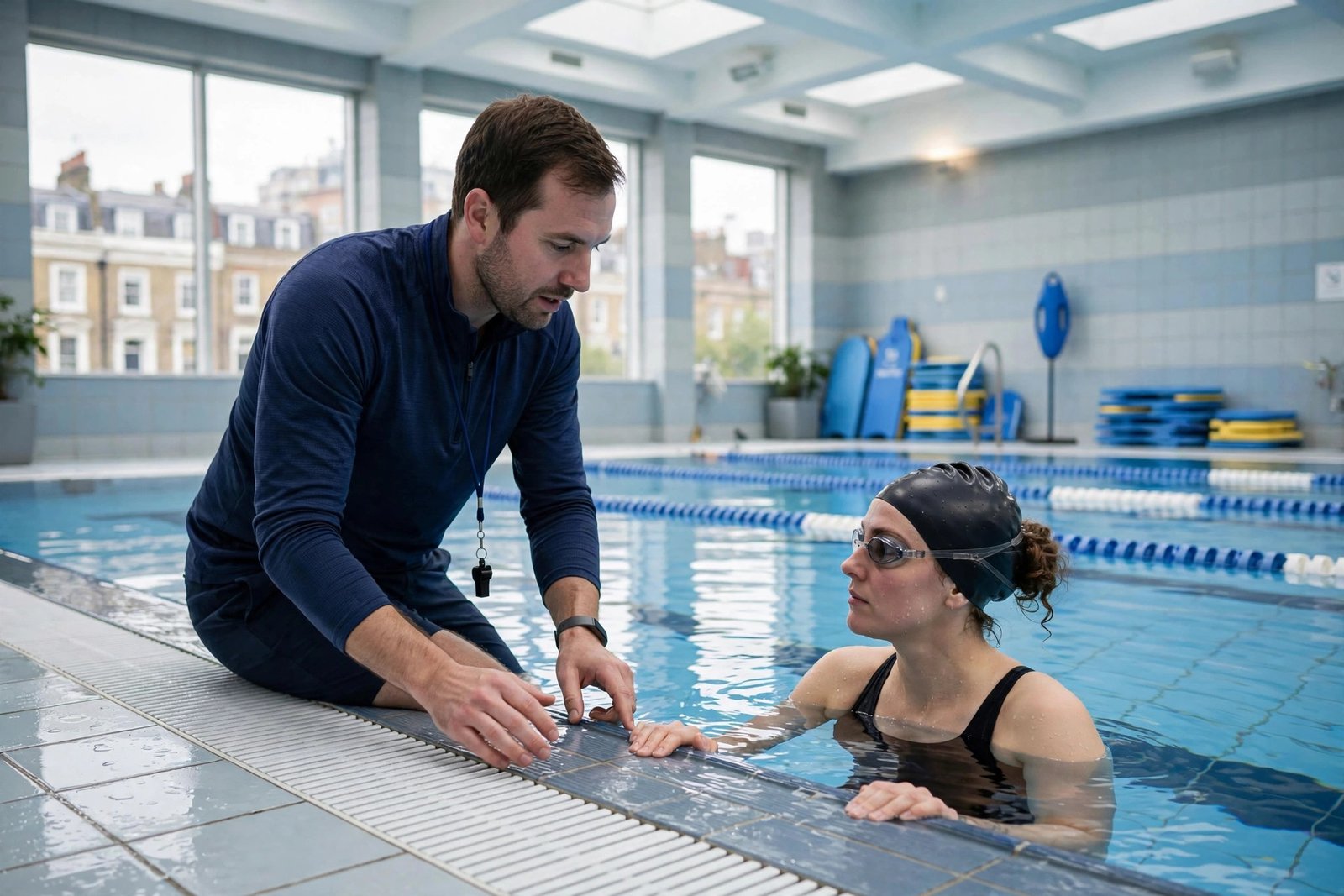
How to Learn Swimming as an Adult in London: Full Guide
Here is a secret London’s leisure centres know well: a huge proportion of adult swimming lessons are filled by people in their 30s, 40s and 50s who never properly learned. Maybe you grew up somewhere without a pool, maybe school lessons were a chaotic 20 minutes of shivering, or maybe life just got in the way. Whatever the reason, learning to swim as an adult in London is not only possible — it is one of the most common and best-supported adult learning journeys in the city.
Why adults struggle (and why it is not your fault)
Adult non-swimmers usually carry one of three barriers: fear (often from a bad childhood experience), embarrassment (the changing-room walk of shame), or the belief that it is too late. All three are myths. Adults actually learn faster than children in many ways — you understand instructions, you can practise deliberately, and your motivation is your own.
The fear is real and deserves respect: water anxiety affects a significant minority of adults. Good instructors are trained for exactly this and will never push you faster than you are comfortable with. If the thought of deep water spikes your heart rate, say so at booking — you will be placed accordingly, and many centres run dedicated nervous-beginner classes.
Where to learn in London
London is spoilt for choice. Council leisure centres (Better/GLL, Everyone Active and independent borough centres) run adult beginner courses at £8–£15 a session or £40–£80 for a 6–10 week course — the best value by far. Private swim schools offer smaller groups and faster progression at £20–£35 a session. One-to-one lessons (£35–£60 an hour) are the fastest route and worth considering if fear is your main barrier.
Swim England’s pool finder lists accredited lessons by postcode, and their adult Learn to Swim framework is the national standard most good instructors follow. Look for STA or Swim England qualified teachers and a maximum of 6–8 adults per class. Popular central London courses fill fast — book a full term rather than hoping for drop-in spaces.
What the learning journey looks like
A realistic timeline for a complete beginner attending weekly lessons:
Weeks 1–3: Water confidence
Getting comfortable with submersion, floating on front and back, and basic breathing. This phase feels slow and looks unimpressive; it is also the foundation everything else rests on. Rushing it creates the tense, sinky swimmers who struggle forever.
Weeks 4–8: The basics of movement
Push-and-glide, basic leg kick with a float, and introductory arm action. You will swim short widths with rests. Breathing rhythm — the thing that defeats most beginners — starts to click here. Practice between lessons if you can: even 20 minutes of floating and gliding accelerates everything.
Weeks 9–16: Building a stroke
Front crawl comes together: coordinated arms, legs and breathing over full lengths. Backstroke usually follows quickly. Most adults swim a continuous length by week 12 and multiple lengths by week 16. Breaststroke — technically trickier timing — often comes later.
After one term (10–12 weeks), most committed beginners can swim 4–8 lengths comfortably. That is genuinely swimming — enough for fitness, holidays and safety. Continuing to an improvers class builds stamina and refines technique, and many swimmers find the second term is when it all starts feeling natural rather than mechanical.
The kit you actually need
Almost nothing: a swimsuit you are comfortable in, goggles (essential — buy decent ones, £10–£20, and learn to fit them properly), a towel and a swim cap if you have long hair (many pools require them). Nose clips divide opinion; try without first. That is it. Do not buy training fins, pull buoys or fancy kit until an instructor suggests them.
The changing-room anxiety is universal and fades within two sessions. Everyone is focused on their own routine; nobody is watching you. Go at off-peak times initially if it helps — weekday daytime sessions are quieter and cheaper.
Why swimming is the perfect adult exercise
Swimming is about as good as exercise gets for adults: full-body, zero-impact, kind to joints and backs, and meditative in a way few workouts match. It is the best low-impact exercise for bad knees and brilliant for anyone returning to fitness after injury or years out. A 45-minute session burns 400–500 calories without a single aching joint the next day.
The NHS counts swimming toward the 150 weekly minutes of moderate activity, and the mental health benefits are well documented — the combination of rhythmic breathing, water and disconnection from phones is genuinely therapeutic. Many adult learners report the lessons becoming the calmest hour of their week, which keeps them coming long after they have “learned.”
Overcoming the specific fears
“I will sink”
Everyone floats with the right technique — sinking is a body-position problem, not a body-type problem. Instructors teach floating before swimming precisely because it proves this to your nervous system.
“I cannot breathe properly”
Breathing is the hardest skill and the last to feel natural — for everyone. Bilateral breathing drills, exhaling fully underwater and never holding your breath are the fixes. It clicks suddenly, usually around week 6–8, and then feels obvious.
“Everyone will judge me”
Adult beginner classes are full of people exactly like you — professionals, parents, retirees, all starting from zero. The atmosphere is supportive, not competitive. And within weeks, you will be the one reassuring the next nervous newcomer.
Making it stick: from lessons to lifestyle
The danger point is finishing the course and stopping. Bridge the gap deliberately: book an improvers course immediately, find a weekly lane-swim slot at your local pool (£4–£7), or join a masters/wild swimming group. Swimming with others — even loosely — is what converts a skill into a habit, and it is a fine way of meeting people in London too. Track lengths in a notes app; watching the numbers climb is quietly addictive.
Conclusion
Learning to swim as an adult in London is straightforward: book a beginner course at a council leisure centre or Swim England-accredited school, expect 10–16 weeks to swim lengths comfortably, and treat the water-confidence phase with patience. The embarrassment fades in two sessions; the skill, the fitness and the calm last decades. The water is fine — get in.
Frequently Asked Questions
How long does it take an adult to learn to swim?
Most complete beginners swim continuous lengths within 10–16 weeks of weekly lessons. Water confidence takes 2–4 weeks; a basic front crawl typically comes together by week 8–12.
How much do adult swimming lessons cost in London?
Council leisure centres charge £8–£15 per session or £40–£80 for a 6–10 week course. Private group lessons run £20–£35 a session; one-to-one lessons £35–£60 an hour.
Is it embarrassing to learn to swim as an adult?
It feels that way for about two sessions, then it vanishes. Adult beginner classes are full of people in exactly your position, and instructors specialise in nervous beginners. Nobody is judging you.
Can adults overcome a fear of water?
Yes — it is one of the most common reasons adults take lessons, and good instructors are specifically trained for it. Dedicated nervous-beginner classes progress at your pace with no pressure, and most fearful beginners are swimming confidently within a term.