
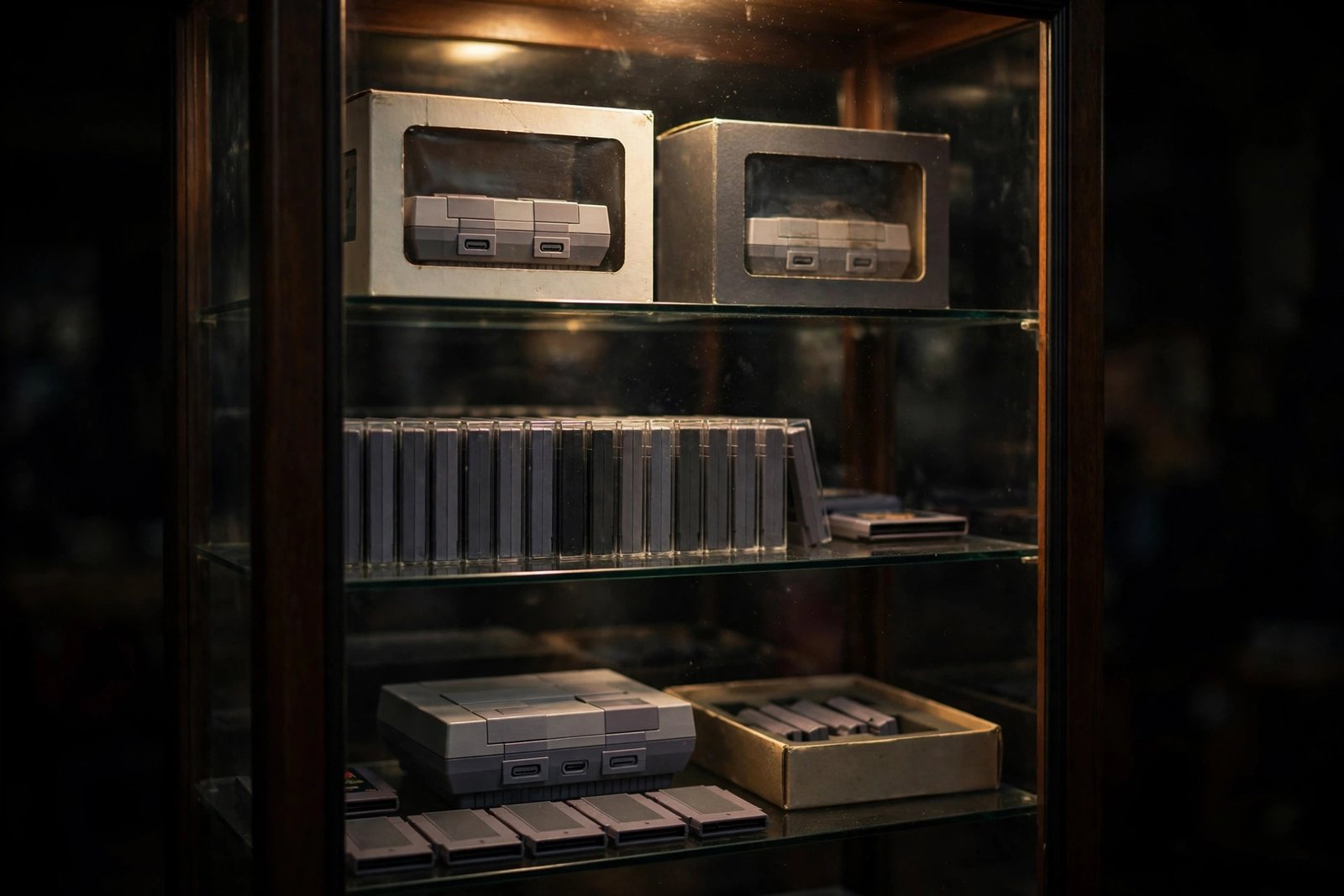
Why Are Old Games Worth a Fortune Now? Inside the Retro Boom
Somewhere in a loft in Croydon, a dusty grey cartridge sits in a shoebox. It cost £29.99 from Woolworths in 1992. Today, depending on which cartridge it is and what condition it is in, it could be worth more than the car parked outside. That is not an exaggeration: in July 2021, a sealed copy of Super Mario 64 sold at auction for $1.56 million, making it the first video game ever to break seven figures. The world of retro games went from car-boot curiosity to serious money in the space of about five years, and plenty of British attics are sitting on the evidence.
So why are old games worth a fortune now? The short answer is that nostalgia grew up, got a mortgage, and started bidding. The longer answer involves grading companies, pandemic boredom, investment hype, and a market correction that most sellers never heard about. If you have a box of old games, here is what is really going on.
The cartridges that broke the internet
The modern retro boom has a clear starting gun. In February 2019, a sealed copy of the original Super Mario Bros. sold privately for $100,150 — the first game ever to sell for six figures. Then came the famous July 2021 weekend at Heritage Auctions’ record-breaking $1.56 million sale: a sealed Legend of Zelda from 1987 fetched $870,000 on the Friday, and a sealed Super Mario 64 smashed it with $1.56 million on the Sunday — the first game ever to break seven figures.
Those headline numbers were for the absolute pinnacle — sealed, highest-graded, culturally iconic games. But the heat spread downwards. Complete-in-box Super Nintendo and Mega Drive games that sold for £20 in 2015 were suddenly £80. Rare titles like Stadium Events on the NES, an obscure fitness game with a tiny print run, had already shown the pattern years earlier. The message to anyone with an old games drawer was unmistakable: check before you chuck.
Why the money arrived when it did
The demographics tell most of the story. The kids who queued for the NES, Mega Drive, SNES and PlayStation in the late eighties and nineties are now in their late thirties and forties — peak earning years, with disposable income and a powerful urge to buy back their childhoods. Economists call it the nostalgia premium, and it hits hardest about 25 to 30 years after the original craze.
Then came 2020. Lockdowns left millions stuck at home with time and spare cash, and collecting anything — cards, trainers, watches, games — surged. Near-zero interest rates pushed investors towards “alternative assets”: anything scarce that might hold value. A sealed, graded game looked, to some buyers, like a tiny piece of art. When people ask whether buying a PS5 in 2026 is still sensible, part of what they are really asking is whether games still hold their magic — and the retro market suggests the emotional attachment to games has never been stronger.
Grading: the invention that created millionaires
The single biggest structural change was third-party grading. Companies like Wata Games and VGA began sealing games in tamper-proof cases with a numerical grade — 9.8 A++ being near perfection. This did two things. First, it gave buyers confidence: a graded 9.8 is a known quantity, not a gamble on a stranger’s description. Second, it created population reports. If only three copies of a game exist at 9.8, and hundreds of wealthy collectors want one, the price becomes whatever the richest bidder says it is.
Grading also split the market into tiers that barely speak to each other. A loose Super Mario 64 cartridge is worth perhaps £30. A complete boxed copy, a few hundred. A sealed 9.8 A++ — $1.56 million. Condition was always important in collecting, but grading turned it into a near-religion. One caveat: “sealed” only commands those prices when the seal is provably original — resealed games (opened, then re-wrapped to look new) are worth a fraction, and telling the difference takes expertise, which is exactly why buyers wanted an authority to certify it.
It was never just Nintendo
Mario and Zelda made the headlines, but the money spread wide. Sega’s rarest Mega Drive and Saturn titles, Sony’s black-label PlayStation 1 games in mint condition, and Neo Geo cartridges — always expensive — all climbed. In the UK specifically, regional variants became a hunting ground: PAL releases often had different box art, and some had tiny print runs. Mattel-distributed NES games in the UK, with their distinctive packaging, attract specialist collectors.
Britain’s own gaming history matters too. The ZX Spectrum and Commodore 64 era produced games that barely existed as physical “collectables” — cassettes in flimsy cases — so complete, good-condition examples of classics are genuinely scarce. If you are wondering what a Nintendo Switch costs in the UK today, consider that a complete copy of a rare Switch game from 2017 can already cost more than the console did new — modern collecting starts faster than it used to.
The uncomfortable part: the market cooled
After the 2021 peak, the very top of the market corrected hard. Many headline prices were never repeated, and investigative work — notably by the YouTuber Karl Jobst — raised questions about conflicts of interest around Wata’s founders also being active in the market, denting confidence at the top end. The speculative money largely left; the collectors stayed. Prices for genuinely rare, high-condition games remain far above 2015 levels, while common games drifted back towards sane prices — which actually makes the market more predictable for ordinary sellers.
What actually holds value
Strip away the noise and five factors decide what any old game is worth:
- Rarity: small print runs, regional variants, recalled or corrected versions. Common games stay cheap no matter how old they are — millions of copies of FIFA exist.
- Condition: the single biggest multiplier. Mint, complete, and genuinely sealed sit in different universes of value.
- Completeness: box, manual, inserts, and any pack-ins (maps, posters, registration cards). A complete copy can be worth five times a loose one.
- Cultural weight: landmark titles — first appearances, genre-definers — outperform obscure games of equal rarity.
- Provenance: documented history, original receipts, and first-owner stories add real value at the top end.
Organisations like the Video Game History Foundation’s preservation work remind us that beyond the money, these objects are cultural history — which is ultimately why people care enough to pay.
A UK seller’s reality check
If you are sitting on a collection, be methodical. First, check sold listings on eBay, not asking prices — asking prices are fantasies. Second, be honest about condition: “good for its age” is not “mint.” Third, understand that grading only makes financial sense for games already worth hundreds; grading a £40 game is burning money. Fourth, watch for fakes: reproduction cartridges and resealed games flood online marketplaces, and buyers are — rightly — suspicious.
For genuinely valuable items, UK sellers have options beyond eBay: specialist auction houses such as Excalibur Auctions run dedicated retro gaming sales. For everything else, bundle common games as job lots rather than listing each £5 title separately. And remember: if you are trading regularly at profit, HMRC may consider you a trader rather than someone clearing a loft.
The bottom line
Old games are worth a fortune now because a generation with money decided its childhood was worth buying back, and grading gave that emotion a marketplace. The 2021 madness cooled, but the collector market is real and here to stay. Your loft probably does not contain a million-pound Mario — but it might contain a few hundred pounds. Check the sold listings before the next charity shop run.
Frequently Asked Questions
What is the most expensive video game ever sold?
A sealed, Wata 9.8 A++ graded copy of Super Mario 64 (1996) sold for $1.56 million at Heritage Auctions in July 2021 — the first game ever to sell for over $1 million, and still the record.
Are my old PlayStation games worth anything?
Most common PS1 games are worth £5–£20, but black-label (non-Platinum) complete copies of sought-after RPGs and horror titles can reach hundreds. Condition and completeness decide everything.
Should I get my games graded?
Only if the ungraded game is already worth several hundred pounds. Grading costs money and takes months; for ordinary games it adds little value. High-grade sealed rarities are the exception.
How do I spot a resealed or fake game?
Look for incorrect seal seams, modern shrink-wrap texture, wrong hangtab shapes, and reproduction labels with slightly off colours or fonts. When in doubt, buy graded or from reputable dealers — and be wary of deals that look too good.
Did the retro game market crash?
The speculative peak of 2021 corrected, but it was not a crash to zero. Top-end hype prices fell while the genuine collector market for rare, high-condition games stayed well above pre-2020 levels.