
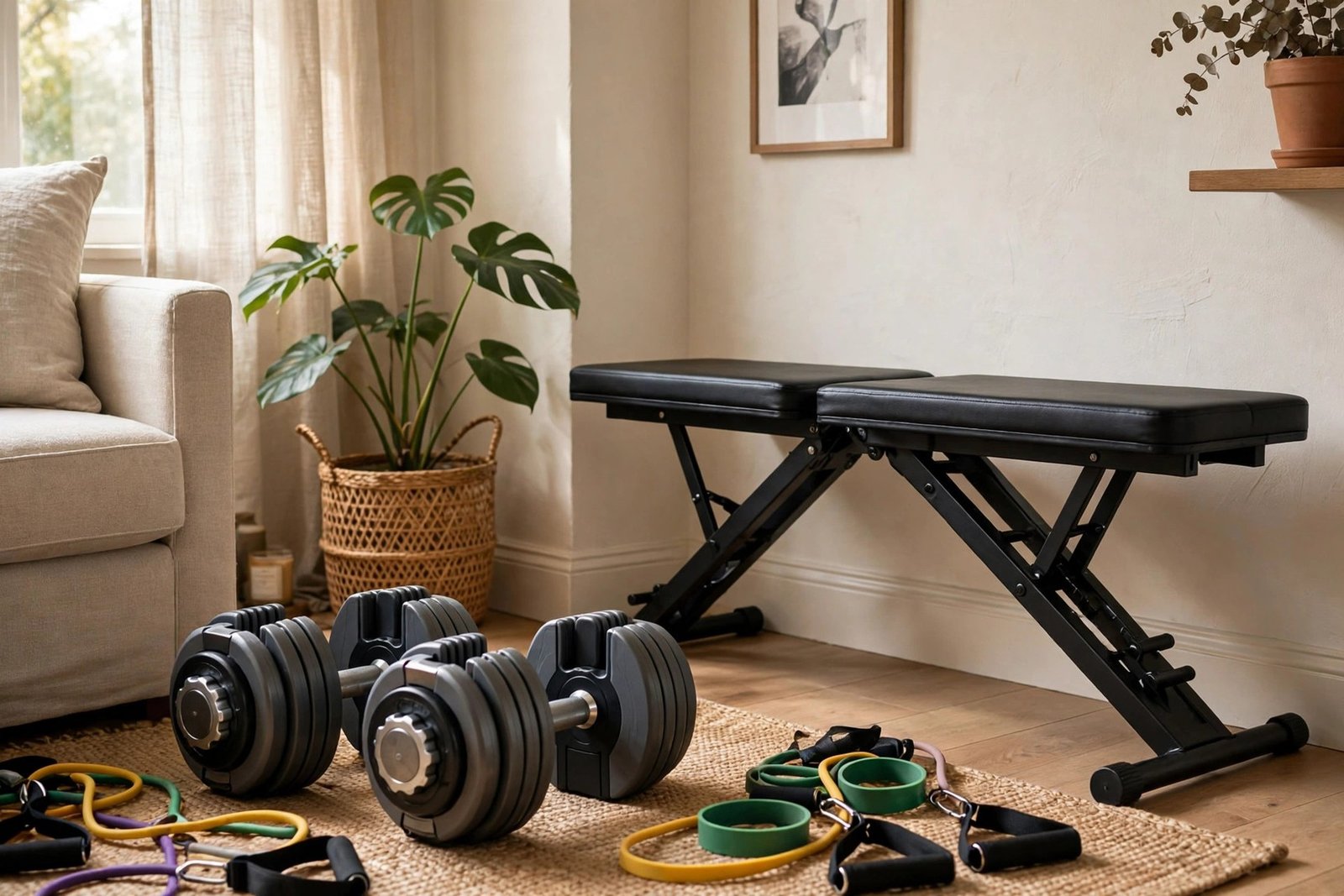
What Home Gym Gear Is Worth Buying Under £150
The home gym industry wants you to believe fitness requires a four-figure investment — the all-in-one machine, the connected bike, the monthly subscription. It does not. Some of the most effective training equipment ever made costs less than a night out, and £150 buys a genuinely complete home gym if you spend it on the right things in the right order. The trick is knowing what earns its place and what is expensive clutter.
Here is what home gym gear is actually worth buying under £150 — the priority order, the specific picks, and what to skip.
Priority One: Adjustable Dumbbells
Why adjustable dumbbells win
If you buy one thing, make it adjustable dumbbells. A pair of spin-lock adjustable dumbbells (typically 2.5-24kg per hand) replaces an entire rack of fixed weights, enabling progressive overload — the fundamental mechanism of getting stronger — across presses, rows, squats, lunges and carries. Cost: £40-70 for a decent pair, the single highest value-per-pound purchase in home fitness.
What to look for when buying
What to look for: secure spin-lock collars (test them — cheap ones loosen), knurled metal handles (plastic handles flex alarmingly), and compatibility with standard 1-inch plates for future expansion. Avoid the ultra-cheap sets with hollow handles and suspect threading. With just these, you can train every major muscle group effectively for years. Everything else on this list is optimisation; the dumbbells are the gym.
Priority Two: Bench and Pull-Up Bar
An adjustable weight bench (£40-60) multiplies what the dumbbells can do: incline presses, supported rows, Bulgarian split squats, step-ups. Choose a folding flat/incline bench rated above your bodyweight plus dumbbell weight, with stable feet — wobble is the enemy. It stores upright in a corner, essential for small London flats.
A doorway pull-up bar (£20-30) adds the pulling movement dumbbells under-serve: pull-ups, chin-ups, hanging knee raises. Check your doorframe type first — leverage bars suit standard frames; screw-mounted suits those you own. If pull-ups are currently impossible, the bar still serves for dead hangs (excellent for shoulders and grip) while you build up with dumbbell rows. Bench plus bar plus dumbbells: roughly £110-130 total, and you now own a complete strength gym.
The full background is available at the Premier League.
Priority Three: Bands, Mat and the Details
Resistance bands (£10-15 for a set) add what weights cannot: accommodating resistance for warm-ups, assisted pull-ups, and travel training. Buy a set of loop bands with varied resistance plus one heavy band for assisted pull-ups. An exercise mat (£15-20, 10mm+ thick) protects floors and knees for core work and stretching — essential on hard floors and for downstairs neighbours.
A skipping rope (£8-10) is the best cheap cardio tool ever made — ten minutes rivals running for cardiovascular stimulus in minimal space. That completes the £150 gym: dumbbells, bench, pull-up bar, bands, mat, rope. Every purchase earns its place through versatility and storage efficiency. What did not make the cut: kettlebells (lovely but redundant with dumbbells at this budget), ab wheels (a £10 luxury, not a necessity), and anything 'smart' or subscription-based.
What to Skip (and Why)
Skip the all-in-one home gym machines — bulky, expensive, limited, and resale-proof when you move. Skip connected fitness subscriptions until the habit is established; the bike becomes a clothes horse without it. Skip single-purpose gadgets (push-up handles, grip strengtheners as first buys) — versatility per pound is the budget criterion.
Skip buying everything at once: start with dumbbells, train for a month, then add the bench when you feel its absence. This sequential buying builds the habit alongside the gym and prevents the classic £150 of equipment gathering dust. And skip the idea that budget gear limits results — progressive overload with dumbbells builds real strength; the research is unambiguous that effort and consistency, not equipment cost, determine outcomes.
Programming Your First Twelve Weeks
Equipment needs programming. Weeks 1-4 (learning): full-body three times weekly, light weights, mastering form — goblet squats, dumbbell rows, floor press, overhead press, Romanian deadlifts; 2-3 sets of 10-12, resting 90 seconds. Film your form or mirror-check; the movement patterns learned now protect every later kilo. Weeks 5-8 (building): add a set, increase weights when 12 reps feel manageable — the progressive overload that drives all adaptation.
Weeks 9-11 (pushing): introduce intensity techniques — slower negatives, paused reps, supersets pairing push and pull. Week 12 (deload): halve volume, keep movement — recovery weeks consolidate gains and prevent burnout; beginners who skip deloads stall or injure. Then repeat the cycle heavier. Track every session (weight × reps × sets) — the logbook is the programme's memory and your motivation's evidence. Twelve weeks of this with the £150 kit builds visible, measurable strength; the second twelve builds on it. The programme is simple because simple works.
Worth a look: Sport England.
Programming: The Gear Is Useless Without It
Equipment without programming is furniture. The simple effective programme: three full-body sessions weekly — goblet squats, dumbbell bench press (floor press without a bench), bent-over rows, overhead press, Romanian deadlifts, plus pull-up/lat work and core. Three sets of 8-12 reps, resting 60-90 seconds, adding weight or reps when you hit 12 comfortably. That is genuinely enough for a year of progress.
Track workouts (any notebook or free app) — progression requires records. Warm up five minutes (rope, bands, bodyweight moves), cool down with stretching. Train the habit first, optimise later: the best programme is the one you do consistently. £150 of the right gear plus a simple programme plus consistency outperforms £1,500 of equipment used sporadically, every single time. The gear was never the limiting factor.
Want to go deeper? Our article on is it worth buying a ps5 in 2026 or wait and is it worth buying a refurbished iphone in the UK is worth a look next.
Under £150, buy in this order: adjustable spin-lock dumbbells (£40-70) first — the single best value in home fitness; an adjustable folding bench (£40-60) and doorway pull-up bar (£20-30) second; resistance bands, a thick mat and a skipping rope (£30 combined) third. Skip all-in-one machines, connected subscriptions and single-purpose gadgets. Pair the kit with a simple three-day full-body programme and track progression — consistency with basic gear beats expensive equipment used sporadically, conclusively.
Maintaining Your Gear on a Budget
Cheap gear that is looked after outlasts expensive gear that is not. Adjustable dumbbells are the priority: check the locking mechanisms monthly — loose collars are how plates slide mid-set, which is dangerous as well as annoying. A drop of general-purpose oil on threaded handles twice a year keeps adjustments smooth and prevents seizing. Store plates and handles off damp floors; a cheap equipment mat underneath does double duty, protecting both the weights and your floorboards.
The bench needs almost no care beyond tightening bolts every couple of months — wobble is a bolt problem before it is a build problem. Pull-up bars mounted in door frames should be re-checked for tightness regularly, and inspect any pressure-fit bar before every session rather than trusting memory. Resistance bands are the fragile item in the kit: keep them out of sunlight, away from sharp edges, and retire any band with nicks or discolouration. A snapped band under tension can genuinely hurt.
The maintenance budget is effectively zero — a spanner, a rag and some oil you already own. What it buys is longevity: cared-for budget gear lasts a decade, while neglected premium gear fails early. Build the two-minute monthly check into your routine and the £150 kit keeps paying dividends for years.
Frequently Asked Questions
What is the best home gym equipment on a budget?
Adjustable dumbbells first — they enable progressive overload across every major movement for £40-70. Add a bench and pull-up bar next; that trio is a complete strength gym.
Can you build muscle with just dumbbells?
Yes — presses, rows, squats, lunges, deadlift variations and carries with progressive overload build real muscle. Research confirms effort and consistency matter far more than equipment variety.
Are adjustable dumbbells worth it?
Absolutely — one pair replaces a full rack of fixed weights at a tenth of the cost and space. Choose spin-lock sets with knurled metal handles and secure collars.
How much should I spend on a home gym?
£150 buys a complete, effective setup if prioritised correctly. Spend sequentially — dumbbells first, add pieces as the habit establishes — rather than buying everything at once.