
Link Farming in 2026: How to Spot the Warning Signs
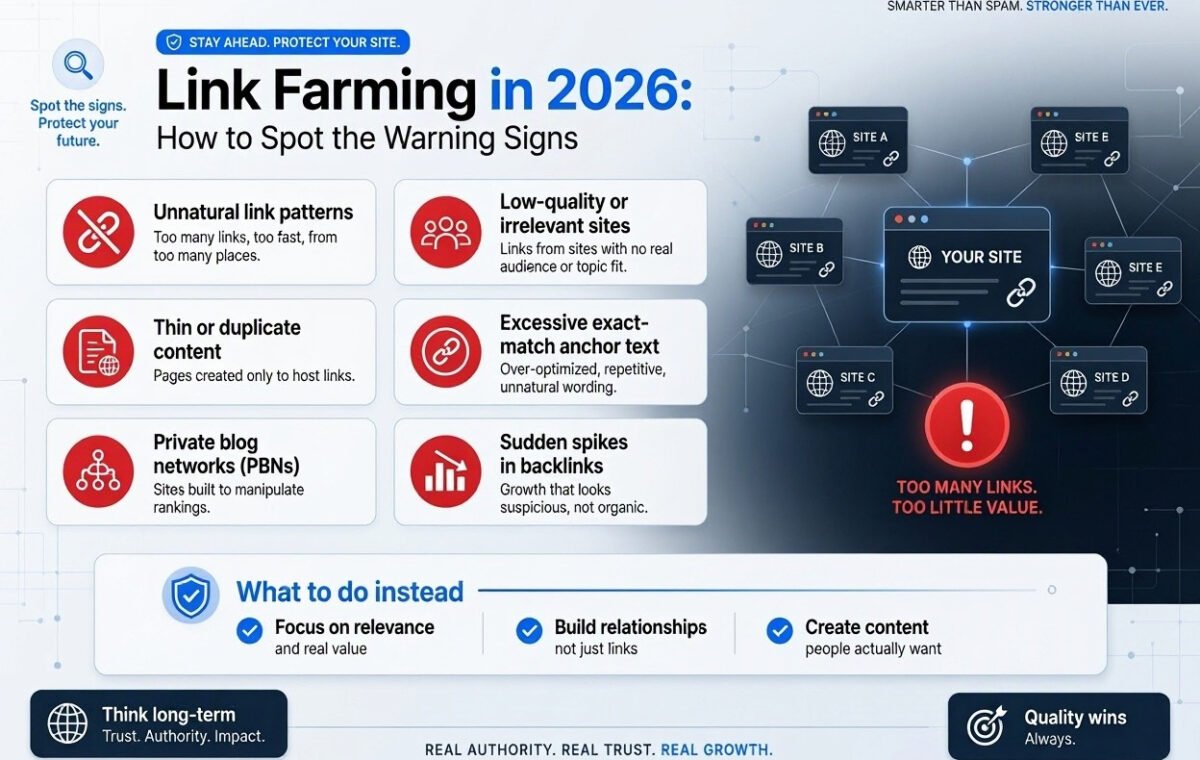
A website can look polished, publish regularly and still be a poor place to trust with your money, time or business reputation. One clue may be its links: sites built mainly to exchange or sell backlinks, rather than serve readers, can be part of a link farming scheme. The practice matters to anyone who runs a website, commissions online marketing or relies on search results to find reliable information.
Search engines use links as one signal of how pages relate to one another. That makes them attractive to people trying to manipulate rankings. But a link is only useful when it makes sense in context. A collection of unrelated sites linking to one another for the sake of improving search positions is not the same as genuine editorial recommendation. For a closer look at the definition and current warning signs, read this guide to spotting link farms.
What makes a link farm different?
A link farm is a site, or network of sites, created primarily to generate backlinks. Its pages may carry thin articles on a wide range of subjects, with links inserted to clients’ websites regardless of whether those destinations help the reader. Some networks are obvious; others imitate ordinary blogs and use polished layouts to appear credible.
That distinction matters because not every website that publishes guest articles is a link farm. A specialist publication can accept outside contributions, and a business can earn a link by producing a useful study, tool or expert explanation. The question is whether the site has an independent audience and editorial purpose, or whether publishing exists mainly to pass link value.
Warning signs to check before you buy or contribute
No single clue proves that a site is a farm. Look for a pattern, and check the site as a whole rather than judging one page in isolation.
- Unrelated subjects sit side by side. A page about London travel may be followed by articles on cryptocurrency, pet supplements and industrial machinery, with no clear editorial reason for the mix.
- Articles feel interchangeable. Look for generic introductions, repeated headings, vague advice and content that could be moved to another site without changing a word. A real publication usually has a recognisable audience and subject knowledge.
- Outbound links dominate the experience. Links appear in every paragraph, use awkward commercial wording, or lead to unrelated services. Check whether the page would still be useful if those links disappeared.
- There is little evidence of an actual publication. Missing author information, no clear contact details, an empty social presence and a lack of a consistent publishing history are reasons to investigate further.
- Promises sound too easy. Claims of guaranteed rankings, instant authority or hundreds of links for a very low fee suggest that quantity is being sold in place of editorial value.
Use these signs together. A small new blog may have limited traffic but still publish thoughtful work for a real community. Conversely, a high-volume site can look busy while offering little original reporting or reader value.
Why it matters to businesses and readers
For businesses, a paid link on a questionable site may create short-lived visibility but also bring reputational and search risks. Search engines can discount manipulative links, and a site that repeatedly participates in schemes may face ranking consequences. Even without a formal penalty, a backlink from an irrelevant page may send no meaningful visitors and add little credibility.
Readers face a different problem: the link can make a weak recommendation look like independent endorsement. That is especially concerning for health, finance and other subjects where people may act on what they read. A well-placed link should help someone verify a claim, explore a relevant service or continue their research—not simply redirect them to a paying customer.
Businesses commissioning digital work should assess the work itself before looking at promised SEO gains. For example, a company planning an app needs a realistic scope, clear ownership terms and a development budget; the cost breakdown from Osdire’s mobile app guide offers a useful comparison point for that separate decision. It is a reminder that credible online projects begin with transparent requirements, not shortcuts.
How to build links without shortcuts
Start with something worth citing: original research, a practical local guide, a useful calculator, or informed commentary on a topic your organisation understands. Then approach publications whose readers would genuinely benefit. A relevant contribution should fit the site’s normal subject matter and meet its editorial standards.
Before agreeing to publish or pay, ask who edits the article, whether links are disclosed where required, what audience the site serves and whether the content will remain available. Review recent posts and the destinations they link to. If a publisher accepts almost any subject and guarantees a followed link in return for payment, treat that as a risk rather than a bargain. For businesses exploring guest posting, the same basic test applies: prioritise relevant readers and useful articles over link counts.
Keep a record of placements and periodically review them. If a link no longer fits, is added to a page that has changed purpose, or appears alongside suspicious material, contact the publisher and consider asking for its removal. Don’t panic over every unfamiliar backlink; focus on deliberate schemes and patterns you can reasonably control.
The practical takeaway
Link farming is less about a particular website design than about intent and behaviour. If a site exists chiefly to publish thin content and sell backlinks, its links are unlikely to offer the dependable value a business wants. Check relevance, editorial quality and the site’s real audience before taking part. The strongest online reputation is built when each link earns its place by helping a reader.