
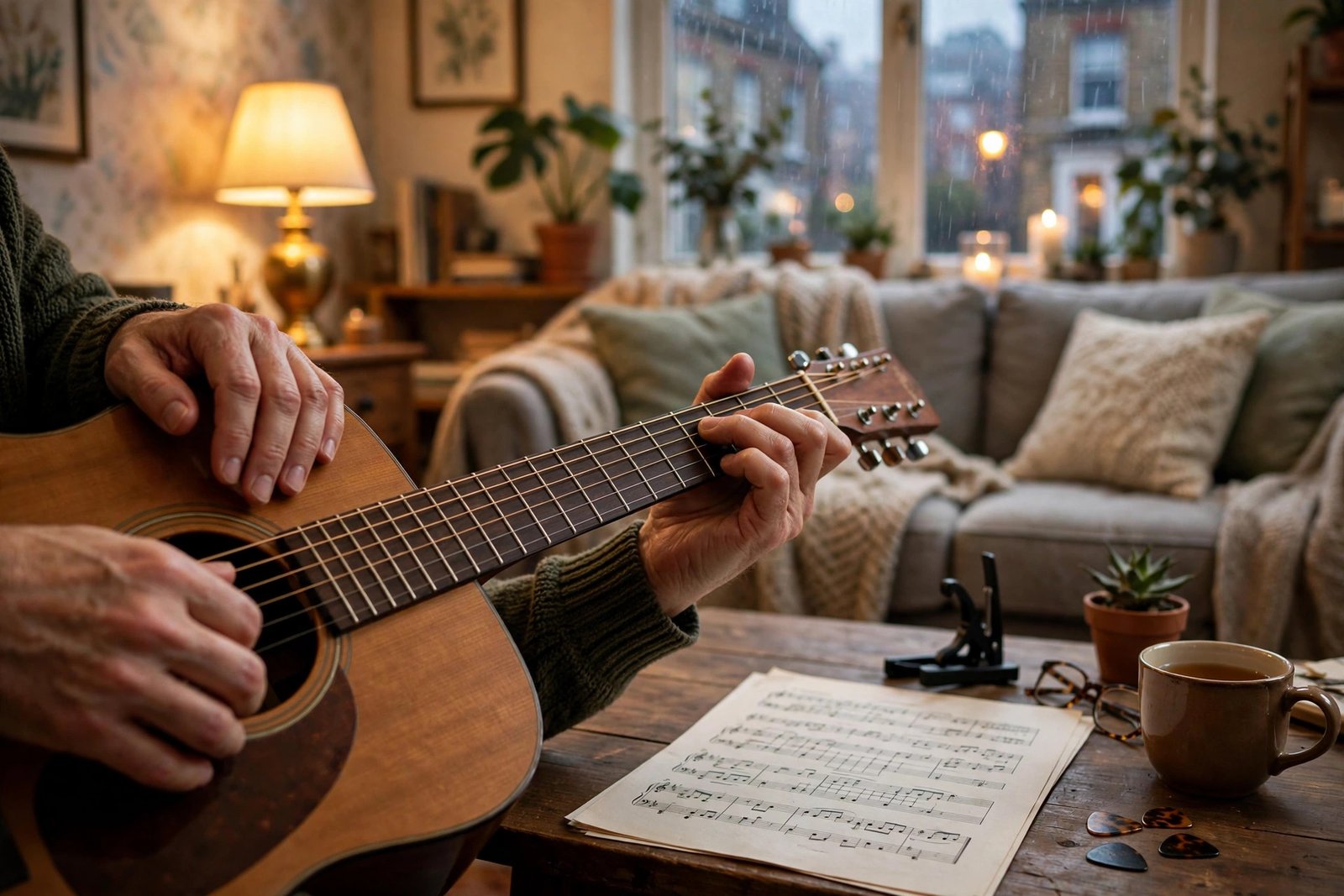
How to Teach Yourself Guitar as an Adult: The Realistic Guide
There is a particular kind of adult who buys a guitar at 34, plays it enthusiastically for eleven days, and then watches it become the most expensive coat hook in the flat. If that is you — or you are determined not to become that — this is the realistic guide. Teaching yourself guitar as an adult is absolutely possible, and adults have real advantages over kids: discipline, patience, money for decent gear, and taste. But adults also have specific failure modes, and the method that works is different from the one in most YouTube videos.
The core of it: twenty focused minutes a day beats a heroic three-hour Sunday session every time. Chords before scales. Songs before theory. A proper setup before a better guitar. Get those priorities right and you will be playing actual songs within a month.
Your unfair advantages (yes, really)
Adults learn instruments slower in one narrow sense — raw neuroplasticity peaks young — and faster in almost every sense that matters. You can structure practice, delay gratification, understand rhythm intellectually, and afford a guitar that stays in tune. Research on adult skill acquisition consistently shows that deliberate, structured practice matters far more than age of onset for reaching enjoyable competence. You are not trying to become a virtuoso; you are trying to play songs around a campfire. That is a completely achievable goal at any age.
The other advantage: you know what music you love. A kid practises what the teacher assigns; you practise the songs that made you buy the guitar. Motivation is the whole game in self-teaching, and yours is built in. If you are weighing this against other ways to spend your evenings, check out the best hobbies to start in your 30s — guitar scores unusually well on cost, space, and long-term payoff.
Gear: spend less than you think, but not nothing
The biggest gear mistake adults make is buying a £600 guitar before they can play three chords. The second biggest is buying a £60 guitar-shaped object that fights them until they quit. The sweet spot: £150–£300 for a reputable beginner acoustic (Yamaha’s FG and FS series are the perennial recommendation for good reason) or a similar electric starter pack. More important than the price tag is a professional setup — adjusting the string height (“action”), neck relief, and intonation. A £40 setup on a cheap guitar transforms it from painful to playable. Sore fingers are normal; agonising fingers usually mean the action is too high.
Consider string gauge and guitar size honestly. Light-gauge strings hurt less. A smaller-bodied or short-scale guitar suits smaller hands. If you have always wanted electric, get electric — an unplugged electric is quiet enough for flat practice, which removes the “I can’t practise after 9pm” excuse entirely. You need: the guitar, a tuner (a £10 clip-on beats any app), a capo eventually, and a comfortable strap. That is it. Practise first, upgrade later.
The 20-minute practice system
Here is the daily structure that actually works for busy adults:
- Minutes 0–3: warm up. Tune up, then play slow chord changes or a simple chromatic exercise. Cold fingers make everything feel harder than it is.
- Minutes 3–13: the hard thing. One skill only — the chord change you cannot do, the strumming pattern that falls apart. Slow it down until it is easy, then inch the speed up. This is deliberate practice, and it is where all progress lives.
- Minutes 13–20: the fun thing. Play a song you love, badly if necessary. End every session on enjoyment, not frustration. This is what brings you back tomorrow.
Consistency beats duration so completely it is almost unfair: twenty minutes daily for a month outperforms five hours every weekend. Your brain consolidates motor learning during sleep, so daily short sessions literally learn faster. Put the guitar on a stand in the room you live in, not in a case under the bed — every second of friction kills sessions.
Chords first: the fastest path to real songs
Learn in this order: Em, Am, C, G, D. Five shapes, and you can strum along to literally hundreds of songs. Add a capo and the number multiplies. Do not start with scales, do not start with theory, and absolutely do not start by trying to learn your favourite virtuoso solo. The goal of month one is to change between three chords without stopping. The goal of month three is to play five songs all the way through.
Use a metronome or drum backing from day one — timing is the skill beginners neglect and audiences notice most. Record yourself on your phone weekly. It will sound rough, and that recording is gold: it is the only objective measure of progress you have, and on the days you feel stuck, comparing week one to week eight is pure fuel. Structured free courses make this far easier than random YouTube surfing; this comparison of JustinGuitar and Fender Play for beginners is a good starting point, with JustinGuitar’s free graded course being the default recommendation of most teachers.
The finger pain timeline
Week one: fingertips ache. Week two: they ache less. Week three to four: calluses form and it mostly stops. If pain is sharp, in the joints, or in the wrist, stop — that is technique or setup, not toughness. Keep practice sessions short in the first fortnight, press just behind the fret (not on top of it), and keep your thumb low on the neck. Nylon-string classical guitars hurt less initially, but most adults do fine on steel with light strings and a good setup.
The mistakes that make adults quit
Comparing yourself to teenagers on the internet. That 14-year-old shredding on Instagram has played four hours a day for six years. You are learning to enjoy yourself, not to audition.
Practising what you can already do. Playing the intro you nailed for the twentieth time feels productive and teaches nothing. The hard, slow, ugly reps are the practice.
Skipping rhythm. Beginners obsess over which chord and ignore when to play it. A simple chord played in perfect time sounds like music; a fancy chord played out of time sounds like noise.
Theory-first learning. Theory is wonderful — later. In month one it is procrastination disguised as diligence. Learn the names of what your fingers already do, not the other way round.
Finding your people (and your stage)
Self-teaching does not mean learning alone. The JustinGuitar community’s advice on learning through songs shows how valuable other learners are — for feedback, motivation, and the realisation that everyone struggles with F major. In London specifically, you are spoiled: practice rooms like Pirate Studios let you book a room with a decent amp for a few pounds, adult learner groups meet across the city, and open mic nights in pubs from Camden to Clapham welcome nervous first-timers. Going to gigs and concerts near you is research too — watch the guitarist’s hands, not just the show.
Set a concrete milestone: one song, played all the way through, for one person, within three months. A partner, a friend, an open mic. Performing — even badly — rewires your relationship with the instrument. It stops being a private struggle and becomes something you do.
The bottom line
Teach yourself guitar as an adult by practising twenty focused minutes a day, learning chords before anything else, getting a proper setup, and playing songs you love from the start. Expect the first month to feel clumsy — that is learning, not failure. Somewhere around month three, you will play a song all the way through and realise the coat hook has become an instrument.
Frequently Asked Questions
Is 30 too old to learn guitar?
No. Adults routinely reach enjoyable playing levels starting in their 30s, 40s, 50s and beyond. You may progress differently from a child learner, but discipline, structured practice, and motivation matter far more than age.
How long does it take to learn guitar as an adult?
With 20 minutes of daily practice, most adults can strum through simple songs within 4–8 weeks and play confidently at gatherings within 6–12 months. Consistency matters more than total hours.
Should I start on acoustic or electric?
Start on whichever excites you — motivation beats theory. Acoustics are simpler (no amp needed); electrics are quieter unplugged and easier on the fingers. Either works for learning the fundamentals.
Do I need a teacher, or can I really teach myself?
Many adults succeed fully self-taught using structured free courses. A handful of lessons early on is valuable mainly to check your posture and technique before bad habits set in — consider two or three sessions, then continue solo.
Why do my fingers hurt so much?
Some fingertip soreness is normal for 2–4 weeks while calluses develop. Sharp pain, joint pain, or wrist pain is not normal — it usually means the guitar’s action is too high (get a setup) or your technique needs adjusting.