
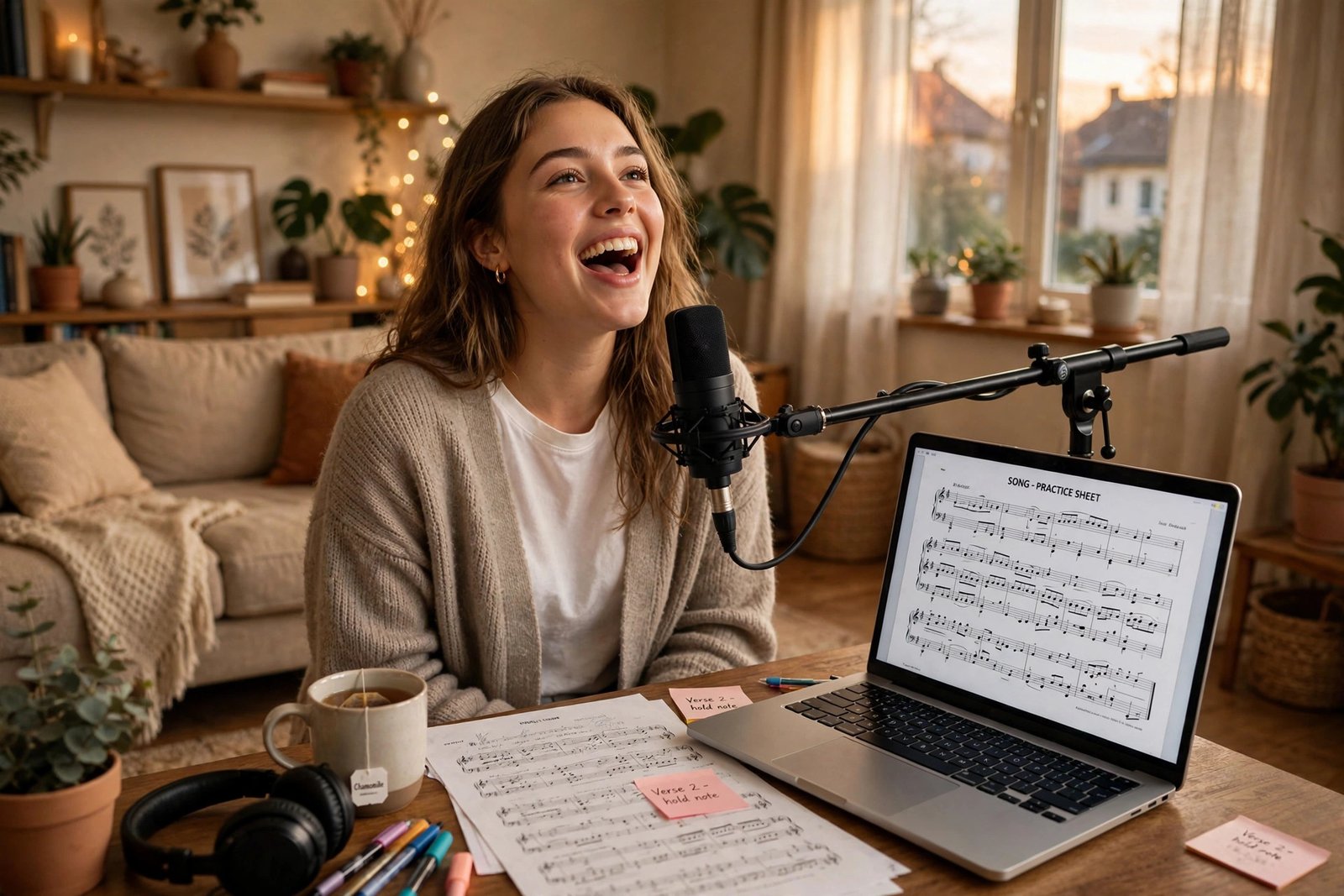
How to Sing Better Without Paying for Lessons
Singing lessons in London cost £40–£80 an hour — a serious investment, and one many aspiring singers cannot justify. But here is what the industry quietly knows: the fundamentals of good singing are physical skills, and physical skills respond to deliberate practice whether or not a teacher is in the room. You can genuinely become a markedly better singer without paying for a single lesson, provided you practise the right things in the right way.
This guide gives you the self-teaching system: the techniques that matter most, free resources that rival paid courses, how to hear your own flaws honestly, and when free learning hits its limits.
Understand what “better singing” actually means
Good singing is not a mystical gift; it is four trainable components. Pitch accuracy (hitting the right notes), breath support (the engine of the voice), tone quality (resonance, not volume), and musicality (phrasing, emotion, timing). Beginners usually blame “tone” when the real problems are breath and pitch — both highly fixable with practice.
Record yourself singing today, before you change anything. It will be uncomfortable to hear, but this baseline is your most valuable tool: in a month you will have proof of progress, and right now it reveals exactly what to work on. Most people discover their pitch is better than feared and their breath control worse.
Breath support: the foundation of everything
Singing runs on air management, not lung capacity. The key technique is diaphragmatic breathing: on inhalation, your belly and lower ribs expand while your shoulders stay still; on exhalation, you meter the air out slowly with engaged core muscles. Practise lying down with a book on your stomach — it should rise when you breathe in.
Daily exercises: hiss out on a steady “sss” for as long as possible (aim to extend your time weekly); sing scales on a lip trill (blowing raspberries through the scale), which builds breath control while relaxing the vocal cords; and practise “panting” breaths to feel the diaphragm engage. Ten minutes of breath work daily transforms your sound faster than any other single practice. The Musicians’ Union publishes vocal health guidance reminding singers that breath technique also prevents strain and injury.
Pitch: train your ear for free
If you sing out of tune, the issue is usually hearing, not voice. Ear training is free and remarkably effective: play a note on a free piano app, sing it back, and check yourself. Do this for five minutes daily across your range. Sing along with simple melodies, recording and comparing — your ear sharpens astonishingly fast with feedback.
Apps like functional ear trainers and free YouTube vocal warm-up series provide structured daily routines at zero cost. Community choirs are the secret weapon: London has dozens of no-audition choirs where you learn pitch, harmony and blend by osmosis, surrounded by encouragement. Many are free or ask small donations — and singing with others accelerates learning faster than solitary practice. To find your local scene, find gigs and concerts happening near you and look for choir showcases and open-mic nights.
Tone, resonance and the practice routine
Once breath and pitch improve, work on resonance: hum with your lips closed and feel the buzz in your face and chest — that vibration is resonance, and learning to direct sound there (rather than squeezing from the throat) creates warmth without strain. Practise sirens (sliding from low to high on “ng” as in “sing”) to smooth the break between chest and head voice.
A solid daily routine: 5 minutes breath work, 5 minutes lip trills and sirens, 10 minutes scales for pitch, 10 minutes singing real songs while recording. Thirty minutes, five days a week, beats occasional marathon sessions. Warm up always — singing cold is how voices get hurt — and stop if anything hurts. Discomfort is information; pain is a warning.
Perform before you feel ready
Singing is a performing art, and bedroom practice only goes so far. London’s open-mic nights are the free finishing school: low stakes, supportive audiences, and the irreplaceable lesson of singing while nervous. Karaoke rooms are brilliant pitch practice under pressure — see what hiring a private karaoke room in London costs for a judgement-free rehearsal space with friends.
Busking in permitted spots, singing at community events, or joining a choir’s public performances all build the stagecraft no tutorial teaches: microphone technique, managing adrenaline, recovering from mistakes gracefully. Watch great live singers too — what’s on at the O2 Arena this month might inspire, but small pub gigs teach you more about craft than arenas do.
Protect the instrument: vocal health basics
Your voice is a physical instrument with maintenance needs. Stay hydrated — vocal cords vibrate hundreds of times per second and dry cords tire faster; room-temperature water through the day beats chugging before singing. Avoid shouting over loud environments, whispering (which strains more than soft speaking), and singing through illness. Smoking and heavy drinking are the two fastest ways to damage a voice long-term.
Warm up before demanding singing and cool down after, just as athletes do. If hoarseness lasts more than two weeks, or your range suddenly shrinks, see a GP — early intervention for vocal issues is simple, late intervention is not. Self-teaching is empowering, but it never overrides medical sense: pain is always a stop signal, never something to sing through.
Know the limits of self-teaching
Honesty matters: free learning has ceilings. A teacher spots tension patterns, tongue placement and bad habits you cannot hear in yourself, and diagnoses issues in minutes that might take you months. If you plateau after 6–12 months of disciplined practice, or if you experience persistent hoarseness, vocal fatigue or pain, get professional input — a few targeted lessons or a session with a vocal health specialist is money well spent. The NHS advises seeing a GP about hoarseness lasting more than three weeks.
Conclusion
You can sing markedly better without paying for lessons: master diaphragmatic breathing, train your ear daily, practise resonance exercises, record everything, join a community choir, and perform at open mics before you feel ready. Thirty focused minutes a day, sustained for months, produces transformations that surprise everyone — including you. The voice is an instrument you already own; this is simply the owner’s manual.
Frequently Asked Questions
Can anyone learn to sing, or do you need talent?
Almost anyone with normal hearing and vocal cords can learn to sing enjoyably well. “Tone-deafness” (amusia) is genuinely rare; most poor singers have untrained ears and breath, both fixable.
How long does it take to improve singing without lessons?
Noticeable improvement in 4–8 weeks of daily practice; substantial transformation in 6–12 months. Breath control usually improves first, pitch second.
What are the best free resources for learning to sing?
YouTube vocal coaches with structured warm-up series, free ear-training apps, community choirs (often free), and recording yourself for feedback. Consistency matters more than which resource you choose.
Is it bad to sing every day?
No — daily singing is fine and beneficial, provided you warm up, stay hydrated, avoid shouting over the voice’s limits, and rest if hoarse. Think of it like athletic training with recovery built in.
When should I see a professional about my voice?
If you have hoarseness lasting more than three weeks, pain when singing, or a sudden voice change, see a GP. For technique plateaus after sustained self-practice, a few targeted lessons with a qualified teacher can unlock the next level.