
How Often Do Indoor Plants Really Need Water? The Truth
“Water once a week” — the most common houseplant advice in existence, and also the most common cause of dead houseplants. The truth about how often indoor plants really need water is that there is no calendar answer. A snake plant in a cool north-facing room might go a month; a thirsty fern above a radiator might need water every three days. The plants do not care about your schedule. They care about their roots. Here is how to actually know when to water — the method professionals use, and the per-plant rhythms that replace the guesswork.
The foundational rule, straight from the RHS: water when the compost needs it, not when the calendar says so. More houseplants are killed by well-meaning overwatering than by neglect — roots sitting in soggy compost suffocate and rot, and a rotted root system cannot be revived. Underwatering, by contrast, is usually recoverable: a wilted plant perks up within hours of a good drink. When in doubt, wait a day.
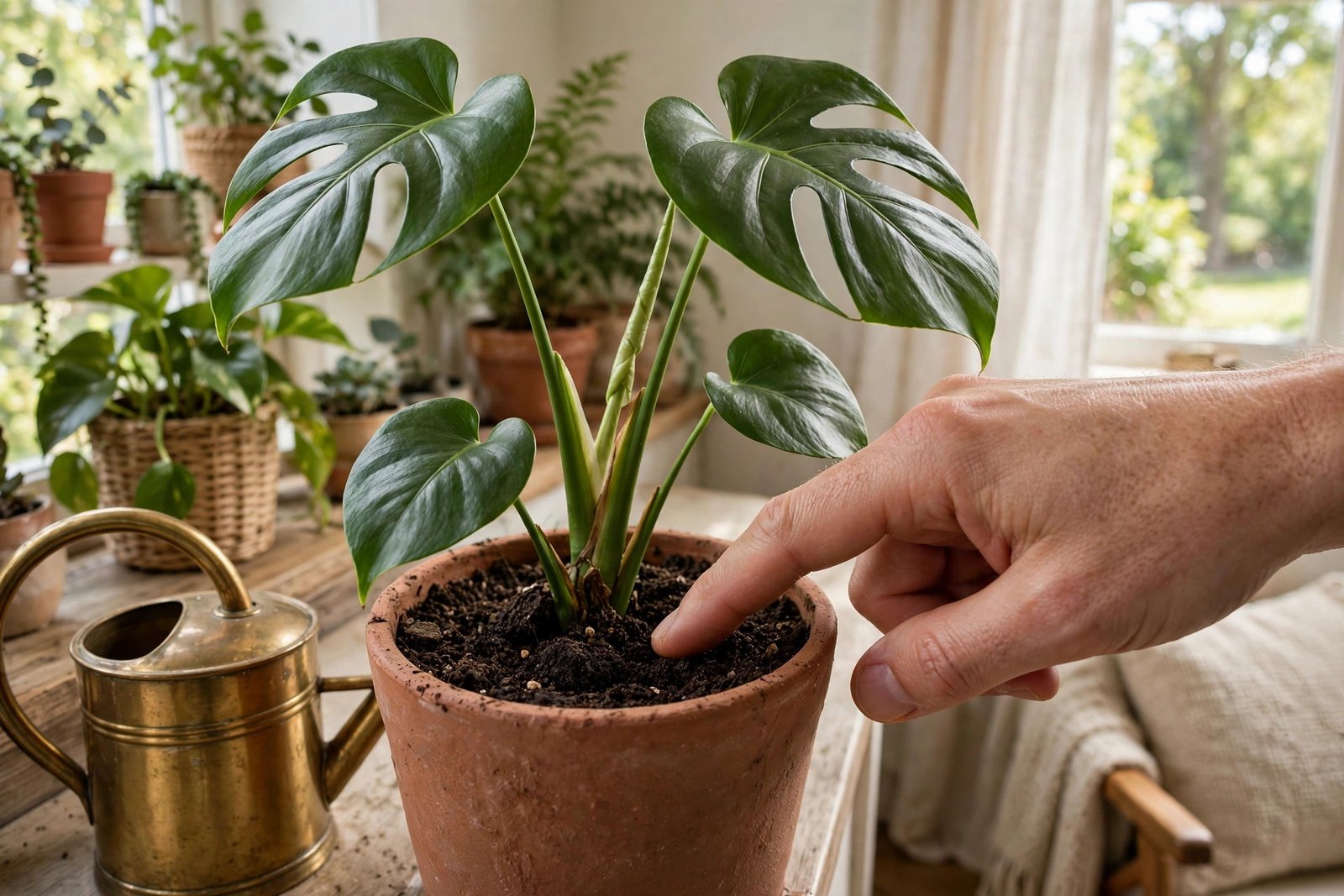
The finger test (your new religion)
Forget schedules; check the soil. Push your finger 2–5cm into the compost (deeper for bigger pots). If it feels dry at that depth, water. If it feels damp, wait. That is the entire technique, and it outperforms every app and gadget. Two refinements make it bulletproof:
- Lift the pot. A freshly watered pot is noticeably heavier than a dry one. After a few weeks you will read moisture by weight alone — the fastest check there is.
- Know your plant’s preference. “Dry at 2cm” means different things per species (see below). The finger test tells you the moisture; the plant’s profile tells you whether that moisture level is right.
When you do water, water thoroughly: drench until water flows freely from the drainage holes, let it drain completely, then empty the saucer. The worst pattern in houseplant care is the daily dribble — a splash that wets the surface while roots below stay dry, training roots upward into a shallow, fragile mat. Deep and infrequent beats shallow and often, every time. The RHS’s houseplant growing guide is the authoritative reference for these fundamentals.
The per-plant guide
As a rough framework (always confirmed by the finger test):
- Succulents and cacti: let compost dry out completely between waterings. Summer: every 2–3 weeks; winter: monthly or less. They store water in their leaves — your job is mostly to leave them alone.
- Snake plants and ZZ plants: similar to succulents; every 2–4 weeks, less in winter. The classic “unkillable” plants die almost exclusively from overwatering.
- Pothos, philodendron, monstera: water when the top 3–5cm is dry — typically every 1–2 weeks in summer, every 2–3 in winter.
- Peace lilies and ferns: the thirsty ones. Keep compost lightly moist (not soggy); often weekly in summer. Peace lilies dramatise beautifully — they droop when thirsty and recover fast, making them ideal for learning.
- Calatheas and marantas: consistently moist, high humidity, and fussy about water quality — rainwater or filtered if your tap water is hard.
- Orchids (moth orchids): water when the bark is dry, roughly weekly — the ice-cube method is marketing, not horticulture; use room-temperature water.
This practical watering-frequency guide breaks it down further by species, pot, and soil if you want the full reference.
Seasonal rhythms (the bit everyone forgets)
Your plant in December is a different creature from your plant in June. Winter means shorter days, weaker light, slower growth, and much lower water use — most houseplants need roughly half the summer frequency, and some (succulents, cacti) go nearly dormant. Central heating complicates this: it dries the air (raising humidity needs) while the plant’s roots still want less water. Mist or use pebble trays for humidity; do not compensate by watering more.
Spring is the danger season for overwaterers: growth resumes, you get enthusiastic, and the plant is not yet drinking at summer rates. Increase gradually, watching the soil. Summer is peak thirst — check twice as often. Autumn: taper off as light fades. The calendar does not tell you when to water, but it tells you when to check more often.
Reading the distress signals
Plants telegraph water problems clearly once you know the language:
- Overwatering: yellowing lower leaves, mushy stems, compost that stays damp for days, a sour smell from the pot, fungus gnats hovering. This is the emergency — let it dry out, improve drainage, and repot if roots are black and mushy.
- Underwatering: drooping, crispy leaf edges, dry leaves dropping, compost pulling away from the pot sides. Usually fixable with a thorough soak (stand the pot in water for 20 minutes).
Yellow leaves confuse everyone because both extremes cause them — which is why you check the soil, not the leaf. Damp soil + yellow leaves = too much water. Dry soil + yellow leaves = too little. The finger test resolves the ambiguity every time.
The setup factors nobody mentions
Pot and soil change everything. Terracotta breathes and dries fast (good for overwaterers, thirsty work for ferns); plastic and glazed ceramic hold moisture longer. Always use pots with drainage holes — no drainage is the slow death of most houseplants. Soil should be open and free-draining; dense multipurpose compost stays soggy. Light drives thirst: a plant in bright indirect light drinks far more than the same plant in a dim corner. Group plants by water need, not by looks — the fern and the cactus should never share a watering regime, however pretty they look together.
If your collection is growing beyond your confidence, there is no shame in calling in help occasionally — gardener hourly rates cover indoor plant care visits too. And if you grow edible plants on the sill, storing fresh herbs so they last longer pairs well with keeping the plants themselves alive.
The bottom line
Indoor plants need water when their compost needs it — check with your finger 2–5cm deep, lift the pot to learn its weight, and water thoroughly but infrequently. Learn each plant’s preference, halve frequency in winter, and remember the golden rule: more houseplants die of kindness (overwatering) than of neglect. Throw away the calendar. Trust the soil.
Frequently Asked Questions
How often should I water indoor plants in winter?
Roughly half as often as summer — growth slows and evaporation drops. Check the soil rather than following a schedule; succulents may go a month, tropicals every 2–3 weeks. Central heating dries air, not soil, so do not overcompensate.
Is it better to underwater or overwater houseplants?
Underwater, almost always. A wilted plant usually recovers within hours of watering; rotted roots from chronic overwatering usually do not. When in doubt, wait a day.
Should I water on a schedule?
No — use the schedule as a reminder to check, not to water. The finger test (dry 2–5cm down = water) and pot weight are far more reliable than any calendar.
Why are my plant’s leaves turning yellow?
Both overwatering and underwatering cause yellowing — check the soil to tell them apart. Damp soil with yellow lower leaves means too much water; dry soil with yellowing means too little. Adjust accordingly.
Do all indoor plants need drainage holes?
Yes — effectively. Pots without drainage trap water at the bottom where roots rot. If you love a hole-less decorative pot, keep the plant in a plastic nursery pot inside it and empty any collected water after watering.