
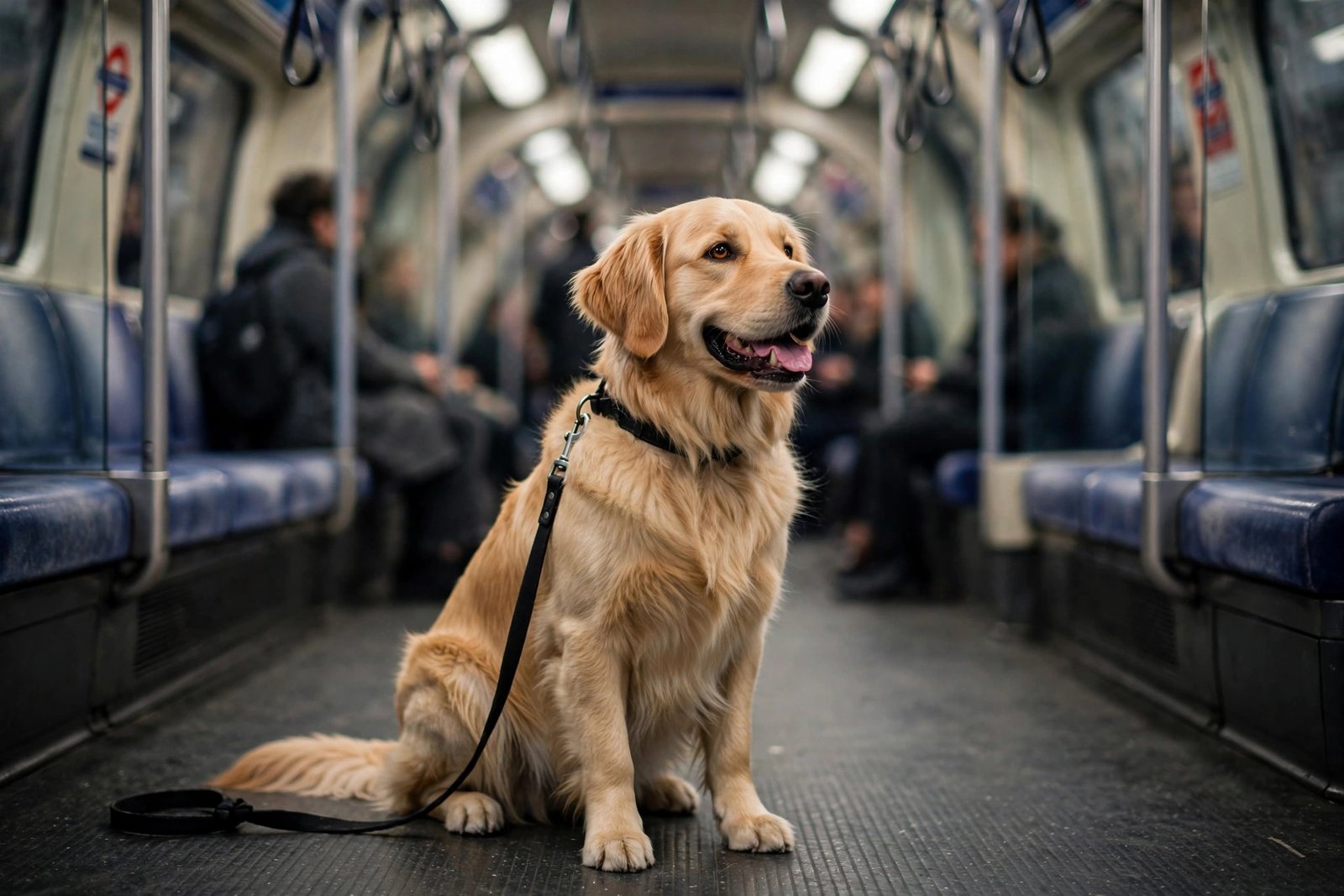
Can I Take My Dog on the Tube? Rules, Etiquette & Safety Guide
Yes — you can take your dog on the Tube, and Londoners do it every single day. From Labradors snoozing under seats on the Northern line to dachshunds in tote bags on the District line, dogs are a thoroughly normal sight on the Underground. Transport for London’s rules are refreshingly permissive compared with many European metros: dogs travel free, need no ticket, and are welcome on the Tube, buses, the Overground, the DLR, and the Elizabeth line. But “allowed” does not mean “anything goes” — there are rules, etiquette, and a few stations where you will need a plan.
Whether you are heading to Hampstead Heath for a weekend walk or commuting with a well-behaved companion, here is everything you need to know about taking your dog on the London Underground in 2026.
The official TfL rules for dogs
TfL’s conditions of carriage state that passengers may take dogs and other small animals on all TfL services, provided the animal is under control. In practice this means: your dog must be on a lead (or in a carrier) at all times, must not occupy a seat, and must not be a danger or nuisance to other passengers. Staff can ask you to remove a dog that is misbehaving, and assistance dogs have absolute priority — if your pet is unsettling a guide dog, you will be the one asked to move carriages.
Dogs travel free on every TfL service — Tube, bus, tram, DLR, London Overground, Elizabeth line, and even the IFS Cloud Cable Car. There is no dog ticket to buy and no size restriction in the written rules, though common sense and carriage space apply: a well-controlled Great Dane at off-peak is fine; the same dog wedged into a packed Central line carriage at 8:30am is asking for trouble.
Escalators: the one real hazard
The single most important safety issue with dogs on the Tube is escalators. TfL’s official guidance is that dogs should be carried on escalators, or use the stairs or lift instead. This is not bureaucratic fussiness — a dog’s claws, paws, and tails can genuinely get caught in escalator comb plates, and vets in London treat these injuries every year. Many deep-level stations (think Covent Garden, with its famously long escalators) have lifts as well, and TfL’s step-free access guides show which stations offer them.
Small dogs are easy: pick them up. For medium and large dogs that cannot be carried, plan step-free routes in advance using the TfL Go app or the TfL website‘s step-free Tube guide. Seasoned dog-owning commuters often have a mental map of lift-equipped stations on their regular routes. Muzzles are not legally required on the Tube, but many owners of nervous or reactive dogs use one as a courtesy — and it is worth remembering that under the Dangerous Dogs Act, owners are responsible for their dog’s behaviour in public at all times.
Tube etiquette for dogs (the unwritten rules)
The written rules are short; the social contract is longer. Londoners are famously tolerant of Tube dogs, but that tolerance depends on owners following a few norms. Travel off-peak when you can — a dog in a crush-loaded carriage is stressful for the dog and everyone around it. Keep your dog on the floor, ideally tucked between your feet or under the seat in front of you, never on the seats (this genuinely enrages fellow passengers and can earn you a penalty from staff).
Bring water and a collapsible bowl for longer journeys, especially in summer when deep-level platforms can be stifling — Tube temperatures have exceeded 35°C in heatwaves. Avoid the busiest interchanges at peak times if your dog is nervous, and always have an exit strategy: if your dog starts barking or lunging, get off at the next station and regroup rather than toughing it out. A calm, tired dog is a good Tube dog, so a decent walk before the journey pays dividends.
What about buses and the Overground?
Dogs are equally welcome on London buses (driver’s discretion applies, but refusals are rare for well-behaved dogs) and on the Overground and Elizabeth line, where the more spacious carriages are arguably easier than the Tube. National Rail services within London also permit dogs, though individual train companies set their own policies — most allow up to two dogs per passenger free of charge. If your adventures extend beyond the capital, our guide to taking your dog on holiday to France from the UK covers pet passports, rabies requirements, and the paperwork involved.
Training your dog for the Underground
Do not make your dog’s first Tube experience a rush-hour trip to central London. Behaviourists recommend desensitisation: start with short, quiet journeys — one stop off-peak — paired with treats and praise, and build up gradually. Practise the key skills above ground first: a solid “settle” or “down-stay” on a mat, calm behaviour around crowds and sudden noises, and tolerance of being handled in tight spaces.
Puppies under about four months are generally better kept away from the Tube until vaccinations are complete — your vet can advise on timing. Rescue dogs with unknown histories deserve extra patience; a dog that panics at the screech of brakes needs slower exposure, not forced endurance. The Dogs Trust and RSPCA both offer guidance on training for public transport, and a few sessions with a qualified behaviourist can transform a nervous traveller.
When the Tube is not the right choice
Honesty matters here: some dogs should not be on the Underground. Dogs with severe noise phobia, unmanageable reactivity, or aggression toward people or other dogs will be miserable underground and may create genuinely dangerous situations on crowded platforms. Brachycephalic breeds (pugs, French bulldogs, English bulldogs) can struggle in the heat of deep-level stations in summer — if your flat-faced dog pants heavily after ten minutes on a platform, take a taxi or wait for cooler weather.
There is also the cost of getting it wrong: a dog that causes injury or serious disruption can lead to enforcement action, and vets’ bills from an escalator accident run into hundreds of pounds. Knowing your dog’s limits is part of responsible ownership — and if you are weighing up the finances of dog ownership generally, see what documents you need to travel with a pet from the UK for the admin side, plus the real-world costs involved.
The bottom line
Taking your dog on the Tube is one of London’s small joys: the city is genuinely, unusually dog-friendly underground. The rules are simple — lead on, under control, off the seats, carried on escalators — and the etiquette is simpler still: travel off-peak, keep them settled, and know when your particular dog has had enough. Do that, and you and your dog can enjoy everything from Richmond Park to the Thames Path without ever needing a car.
Frequently Asked Questions
Do dogs need a ticket on the London Underground?
No. Dogs travel free on all TfL services, including the Tube, buses, Overground, DLR, and Elizabeth line. There is no dog fare and no ticket to buy — just keep your dog on a lead and under control.
Are dogs allowed on escalators on the Tube?
TfL advises that dogs should be carried on escalators or use stairs and lifts instead, because paws and claws can get trapped in the escalator mechanism. Plan step-free routes via the TfL Go app if your dog cannot be carried.
Can I take my dog on the bus in London?
Yes, dogs are allowed on London buses at the driver’s discretion. Well-behaved dogs on leads are routinely accepted; the driver can refuse a dog that appears dangerous or disruptive.
Are there any times dogs cannot travel on the Tube?
There is no formal ban at peak times, but TfL can ask you to remove a dog that is causing a nuisance or danger. Travelling off-peak is strongly recommended for everyone’s comfort, including the dog’s.
Do I need a muzzle for my dog on the Underground?
Muzzles are not legally required on TfL services, but owners remain fully responsible for their dog’s behaviour under the Dangerous Dogs Act. Many owners of nervous or reactive dogs choose to muzzle as a precaution and a courtesy.