
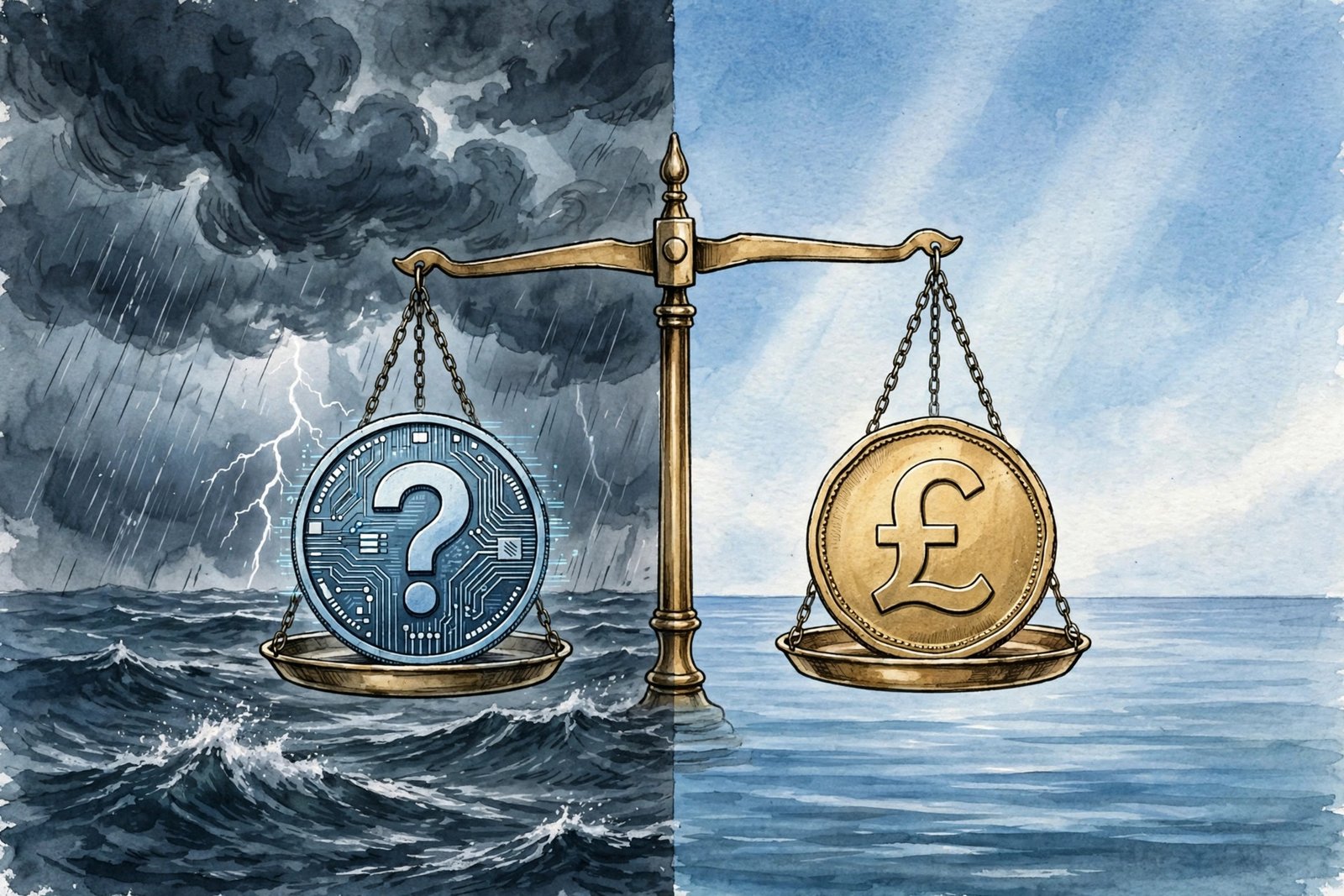
Are Stablecoins Really as Safe as Pounds? (2026 Truth)
They’re called “stablecoins”, they’re pegged to the pound or the dollar, and crypto platforms market them as the safe corner of a volatile world — digital cash you can hold, transfer and even earn interest on. It sounds like having pounds with superpowers. But are stablecoins really as safe as pounds? The honest answer is no — not even close. And the gap between perception and reality has already cost ordinary people billions. Here’s what stablecoins actually are, how the pegs work (and break), and what “safe” would really require.
What stablecoins claim to be
A stablecoin is a cryptocurrency designed to hold a steady value — usually $1 or £1 per coin. The big names (USDT/Tether, USDC) claim each coin is backed by real reserves: dollars, Treasury bills and other assets held by the issuer, redeemable on demand. In theory, you get the best of both worlds: the price stability of fiat money with the speed and global reach of crypto. Traders use them to park funds between trades, migrants use them for remittances, and DeFi platforms use them as foundational collateral.
The marketing often implies equivalence with the underlying currency — “1 USDC = $1, always”. That implication is doing a lot of heavy lifting, because the mechanisms guaranteeing it range from robust to non-existent depending on which stablecoin you’re holding.
How the peg actually works (three models)
Fiat-backed (USDT, USDC): the issuer holds reserves — cash, Treasury bills, commercial paper — and promises redemption at par. This is the strongest model, but it depends entirely on the reserves actually existing, being liquid, and the issuer honouring redemptions under stress. Tether spent years fighting scepticism about its reserves before improving disclosure; USDC is generally considered the more transparent of the two. Even here, you’re trusting a private company, not a central bank.
Crypto-backed (DAI): the coin is collateralised by other cryptoassets locked in smart contracts, typically over-collateralised (e.g. $1.50 of ETH backing $1 of DAI). No central issuer, but the system depends on code working correctly during market meltdowns — exactly when you’d most need the stability. It survived 2022’s chaos, which is genuinely impressive, but complexity is its own risk.
Algorithmic (the graveyard): no reserves at all — just code that expands and contracts supply to hold the peg. TerraUSD (UST) was the poster child: a $40 billion ecosystem that collapsed to zero in days in May 2022, vaporising life savings. The mechanism works until confidence breaks, then it death-spirals. Algorithmic stablecoins are now widely regarded as fundamentally unsound — elegant mathematics that fails contact with panicked humans.
What “as safe as pounds” would require
Let’s define the benchmark. Pounds in a UK bank account have: FSCS protection up to £85,000 per institution — if the bank fails, the government makes you whole. Central bank backing — sterling is legal tender issued by the Bank of England. Regulatory oversight — banks face capital requirements, audits and stress tests. Instant, guaranteed redemption — your pounds are pounds, always, everywhere.
Stablecoins have none of this. No FSCS protection — if Tether failed, holders would join a queue of unsecured creditors. No lender of last resort. Redemption is a promise from a private company, suspendable under stress (several issuers have paused redemptions during crises). And the Bank of England has been explicit that stablecoins used at systemic scale would need bank-like regulation precisely because they currently lack bank-like safety. The FCA’s consumer warnings treat stablecoins as cryptoassets with all the associated risks — because that’s what they are.
The depegging hall of fame (and what it teaches)
Stablecoins break more often than the marketing admits. Beyond TerraUSD’s total collapse: USDC itself depegged to $0.87 in March 2023 when Silicon Valley Bank’s failure trapped $3.3 billion of its reserves — it recovered within days, but holders who needed to sell during those hours took real losses. Smaller stablecoins have depegged dozens of times. Each episode teaches the same lesson: the peg holds until the moment you most need it to, and “temporarily” losing 13% of your “safe” money is not a rounding error.
For UK holders there’s an extra wrinkle: most stablecoins peg to the dollar, not the pound. Holding USDT means GBP/USD currency risk — your “stable” pounds wobble with the exchange rate. Pound-pegged stablecoins exist but are far smaller and less liquid, adding their own risks. If your goal is stable pounds, an FSCS-protected savings account paying 4–5% remains unbeatable — our guide to building an emergency fund explains where genuinely safe money lives.
When stablecoins do make sense
This isn’t a call to avoid them entirely — they’re genuinely useful tools. Parking trading profits between positions without converting back to fiat (and triggering constant bank transfers). Moving money internationally faster and cheaper than wire transfers. Participating in DeFi protocols that require stable collateral. For these transactional uses, the major fiat-backed stablecoins (USDC especially) are reasonable — provided you treat them as working capital, not savings.
The rules: use only large, transparent, fiat-backed stablecoins; never hold more in stablecoins than you could afford to see frozen for weeks; don’t chase the 8–12% “yields” offered for lending them (that’s credit risk wearing a savings costume); and keep your actual savings — emergency fund, house deposit, anything you need — in FSCS-protected accounts. Stablecoins are a crypto tool with a stability feature, not a bank account with a crypto feature. The distinction is everything. The MoneyHelper guide draws the same line clearly.
Conclusion
Are stablecoins really as safe as pounds? No. Pounds have FSCS protection, central-bank backing and legal-tender status; stablecoins have a private company’s promise, code of varying quality, and a history of spectacular failures — including a $40 billion collapse and depeggings of even the biggest names. The major fiat-backed stablecoins are useful tools for traders and transfers, but they’re cryptoassets with cryptoasset risk. Keep your savings in savings accounts as part of a proper monthly budget, your speculation in crypto, and never confuse a token that targets £1 with an actual pound.
Frequently Asked Questions
Is USDC safer than USDT?
Generally considered so — USDC has more transparent reserves and US regulatory oversight, while Tether has a longer history of reserve controversies. But both lack FSCS protection and both carry issuer risk. “Safer stablecoin” is still not “safe”.
Can a stablecoin go to zero?
Yes — TerraUSD did exactly that in 2022, wiping out $40 billion. Fiat-backed stablecoins are far more robust, but “backed” is a claim about reserves, not a guarantee against every failure mode.
Should I keep my emergency fund in stablecoins for the yield?
No. Emergency funds must be instantly available at full value with zero risk — stablecoins fail all three tests under stress. The extra few percent of yield isn’t compensation for risking money you need in a crisis.
Are pound-pegged stablecoins available?
A few exist but they’re much smaller and less liquid than dollar-pegged ones, which adds liquidity risk. For holding pounds, a regular savings account remains superior in every way that matters.
What happens to my stablecoins if the issuer goes bankrupt?
You’d become an unsecured creditor in bankruptcy proceedings — likely recovering cents on the pound after years, if anything. There is no deposit insurance, no bailout, no quick resolution. This is the core difference from bank deposits.