
What Is Smart Casual Dress Code for UK Offices?
What Is Smart Casual Dress Code for UK Offices?
“Smart casual” is the most confusing dress code in British professional life — deliberately vague, differently interpreted in every office, and the source of endless morning anxiety. Does it mean jeans? (Sometimes.) Trainers? (Occasionally.) A blazer? (Usually safe.) I’ve navigated smart-casual offices for years, and the code is crackable once you understand its logic. If “what is smart casual dress code for uk offices” is the question you’ve been asking, here’s the straight answer — practical, honest, and based on what actually works.
Here’s what smart casual actually means in UK offices in 2026, the formulas that always work, what to avoid, and how it varies by industry. Because “dress smart casual” shouldn’t require a decoder ring.
What smart casual actually means
The logic: “smart” modifies “casual” — start with casual, elevate it. The spectrum runs from “casual with smart elements” (dark jeans, blazer, clean trainers — creative industries) to “smart with casual elements” (chinos, shirt no tie, loafers — traditional offices relaxing slightly). Your office sits somewhere on this spectrum, and the first job is locating it.
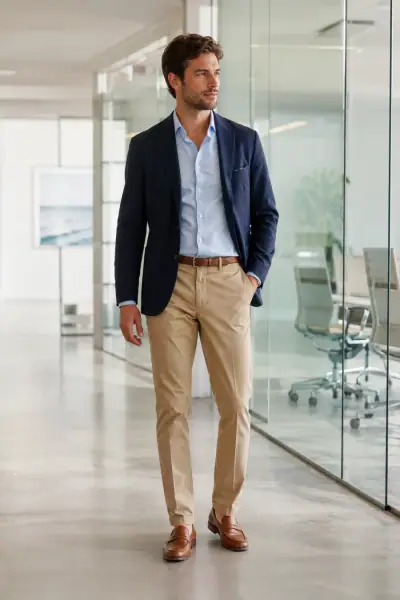
The universal safe zone — appropriate in 90% of smart-casual offices: dark jeans or chinos (no rips, no fading), a collared shirt/blouse or smart knit, and clean minimal shoes (loafers, boots, clean trainers in creative offices). Add a blazer or smart jacket and you’re covered for 99%. This formula is almost impossible to get wrong, which is why it’s the default recommendation.
What it never means: sportswear (gym kit is not smart casual, however expensive the leggings), beachwear (shorts, flip-flops — no), anything ripped or distressed, slogan t-shirts, or pyjama-adjacent loungewear. The “casual” in smart casual refers to the absence of suits and ties, not the absence of effort.
- Safe formula: dark jeans/chinos + collared shirt or smart knit + blazer + clean shoes
- Spectrum: creative = casual+elevated; traditional = smart+relaxed
- Never: gym wear, beachwear, rips, slogans, loungewear
- The blazer test: adding one should never look wrong
Women’s smart casual: formulas that work
The most versatile base: dark jeans or tailored trousers + blouse or fine knit + blazer or structured cardigan + loafers/ankle boots/ballet flats. Variations: midi dress + blazer (effortless, always appropriate), jumpsuit in a smart fabric (modern, polished), skirt + knit + boots. The common thread: one “smart” anchor piece (blazer, tailored trousers, structured dress) with relaxed companions.
Shoes make or break it: clean, in good repair, appropriate to the office’s position on the spectrum. In creative offices, minimal white trainers are fine; in traditional ones, stick to loafers, boots, or flats. Heels are optional everywhere now — no office requires them, and flats are fully accepted. Bags: structured enough to look intentional (a floppy gym bag undermines the whole outfit).
The polish is in the details: clothes clean and pressed, hair neat, minimal but intentional accessories. Smart casual fails most often not through wrong items but through scruffiness — the same outfit pressed vs unpressed reads completely differently. For the interview version (higher stakes), see interview outfits.
Men’s smart casual: formulas that work
The default: chinos or dark jeans + Oxford shirt or polo + blazer or quarter-zip knit + loafers, brogues, or clean minimal trainers. Without the blazer: shirt + chinos + loafers still reads smart casual in most offices. The shirt is the workhorse — Oxford cloth, light blue or white, sleeves that can roll. Polos divide opinion: fine in most modern offices, too casual for traditional ones.
Knitwear is the smart-casual secret weapon: a fine merino crew or v-neck over a collared shirt (collar out) looks polished with zero effort and handles office air-conditioning. Quarter-zips read modern and neat. Avoid: novelty jumpers, hoodies (the single most debated item — fine in tech, not in finance), and anything with visible gym branding.
Trouser guidance: chinos in navy, stone, olive, or charcoal; dark indigo jeans with no distressing. Shorts: no, even in heatwaves (the British office has not reached shorts acceptance, with rare creative exceptions). Socks: match or complement; the novelty sock is the one permitted flash of personality in traditional offices — use it wisely.
Reading your specific office
Week one: observe and calibrate. Note what senior people wear (they define the ceiling), what your direct team wears (your day-to-day norm), and what’s worn to client meetings (the formal end). It’s always safer to start slightly smarter and relax down than to start casual and try to smarten up — the first impression sets expectations.
Ask directly: “What’s the dress code day-to-day?” is a normal question for new starters, and most managers answer happily. Watch for unspoken rules: some “smart casual” offices mean “suits without ties,” others mean “jeans and trainers.” The phrase is a container, not a definition — the contents are local.
Special cases: client-facing days (dress to the client’s code, not yours), office parties (one level up from daily, not wedding guest), and video calls (waist-up smart casual is fine, but dress fully — the stand-up-to-close-the-door moment is real). When moving between offices or industries, recalibrate from scratch — your old normal is irrelevant. For the women’s workwear wardrobe behind all this, see affordable workwear.
Smart casual mistakes that mark you out
The most common error: confusing smart casual with casual. Gym leggings, hoodies, flip-flops, and slogan tees aren’t smart casual in any office — they’re casual, and wearing them signals you didn’t understand the brief. When in doubt, add the blazer; it’s the universal smart-casual safety net that fixes 90% of borderline outfits.
Second mistake: scruffiness. Smart casual fails more often through wrinkled shirts, scuffed shoes, and stained tops than through wrong items. The same outfit pressed and clean reads “smart casual”; unpressed it reads “couldn’t be bothered.” Polish is the cheapest upgrade — an iron and shoe polish cost less than any new clothing.
Third: dressing for the company’s marketing, not its reality. The website shows jeans and trainers; the actual office wears chinos and loafers. Trust week-one observation over branding. Fourth: never evolving — the outfit that worked at 25 may not at 45, and that’s fine; smart casual ages well when you update fits and keep it current. Finally: forgetting the client test — if clients visit, match their formality, not your office’s comfort. The dress code serves the business, not just your wardrobe.
What Is Smart Casual Dress Code for UK Offices: The Short Answer
Smart casual means casual elevated by smart anchors: dark jeans or chinos, collared shirt or smart knit, blazer, clean shoes — then calibrate to your specific office in week one. Related reading: dress codes explained.