
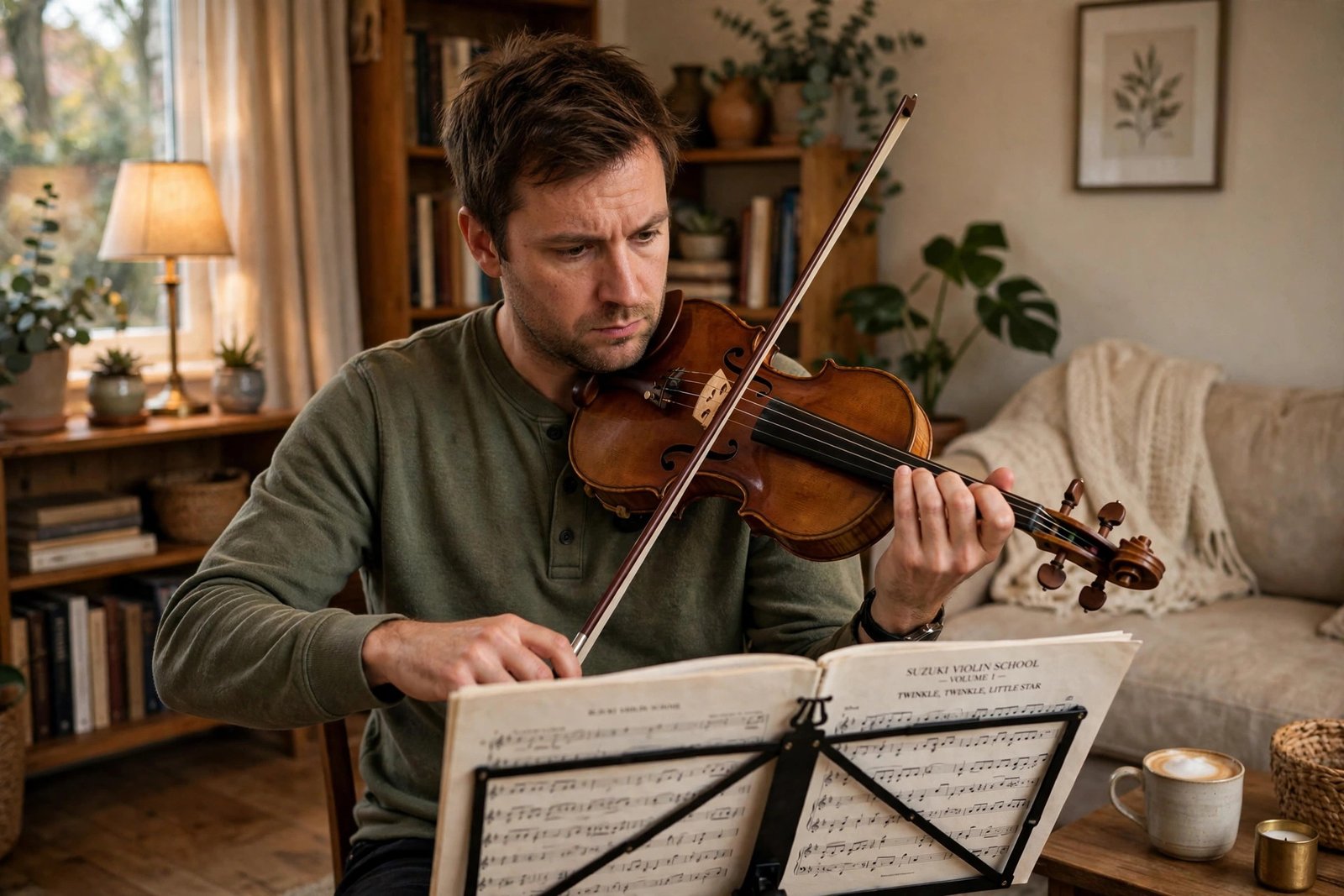
Is 30 Too Old to Start the Violin? No — Here’s Why
Is 30 too old to start the violin? No — and the question itself reveals how much mythology surrounds adult music learning. The violin has a reputation as the instrument you must begin at four or not at all, a belief sustained by conservatoires and child prodigies. But the goal for most adult beginners is not the Royal Albert Hall; it is the profound pleasure of making music, and for that, 30 is a superb age to begin.
This guide tackles the real questions: what adult beginners can realistically achieve, why 30 is actually an advantage, how to start properly in London, and what the first year honestly feels like.
The myth of “too late”
The “start at four” narrative confuses professional virtuosity with musicianship. Yes, becoming a concert soloist requires childhood immersion — but becoming a competent, joyful violinist who plays in amateur orchestras, chamber groups and folk sessions does not. Adult brains remain highly plastic for skill learning; what changes with age is not capacity but the need for smarter, more deliberate practice.
Consider the evidence around you: community orchestras across London are full of people who started as adults, playing everything from Vivaldi to film scores with evident delight. The Musicians’ Union represents players of all levels and backgrounds, and adult learners are one of the fastest-growing groups taking up instruments. Organisations like Making Music, which supports amateur music groups across the UK, report thriving adult-learner membership. “Too old” is a story, not a fact.
Why 30 is an advantage, not a handicap
Adults learn differently — and often better. At 30 you bring discipline, the ability to structure practice, financial resources for a decent instrument and lessons, and intrinsic motivation (nobody is making you do this). You understand delayed gratification, so the slow early months do not break you the way they break impatient teenagers.
You also bring musical context: decades of listening mean your ear already knows what good intonation and phrasing sound like, even if your hands cannot produce them yet. That inner reference accelerates learning enormously. And starting an absorbing new skill in your 30s is one of the best things you can do for your brain — it counts among the best hobbies to start in your 30s precisely because it is challenging, social and endlessly deep.
What the first year really looks like
Honesty first: the violin sounds bad at the beginning. The first month is screeches and sore fingers; months two to three bring recognisable tunes played unsteadily; by month six, with consistent practice, you can play simple pieces in tune; by month twelve, you can hold your own in a beginner ensemble. This timeline assumes 30–45 minutes of practice, five days a week — the single biggest predictor of progress.
The physical demands are real but manageable: building fingertip calluses takes weeks, holding the instrument correctly requires postural attention, and intonation (playing in tune without frets) is the core challenge. None of this is age-dependent. What derails adult beginners is not age but unrealistic expectations — comparing month three to a professional’s year twenty. Compare yourself only to last month’s you.
How to start properly in London
Get a teacher, at least initially. The violin’s technique is unintuitive — bow hold, posture, left-hand frame — and bad habits formed alone take months to undo. Even a term of fortnightly lessons establishes foundations that make self-practice productive. London has hundreds of violin teachers; look for experience with adult beginners specifically, since teaching a motivated 32-year-old differs from teaching a reluctant 8-year-old.
Rent before you buy. Decent student violins rent for £15–£30 a month from London shops, letting you confirm commitment before spending £300–£800 on your own instrument. Buy from a violin shop, not a generic music retailer — setup (bridge, soundpost, strings) matters enormously and only specialists do it properly. Budget for accessories: a shoulder rest, rosin, a metronome app and spare strings.
Join something as soon as you can play a scale in tune. Beginner-friendly ensembles, adult learner orchestras and folk sessions exist across London — playing with others is motivating, social and the fastest route to musicianship. Watching live players helps too; finding gigs and concerts near you might lead you to chamber concerts that show what is possible. And if reading feels solitary, joining a local book club proves the same principle applies beyond music: structured beginner groups beat going alone.
Realistic goals for an adult beginner
Set goals that inspire rather than crush. Year one: play simple pieces in tune and join a beginner group. Year two: perform for friends, tackle grade 3–4 repertoire. Year three to five: amateur orchestra, chamber music, maybe a grade 5–6 exam if that motivates you. Some adult starters reach genuinely advanced levels within a decade — not professional, but the kind of playing that moves audiences at community concerts.
The deeper goal is not grades but fluency: the ability to pick up the instrument and express something. That arrives sooner than you expect and never stops deepening.
What it costs to start at 30
Budget honestly before committing. Violin rental: £15–£30 a month from a London specialist. Fortnightly lessons with a teacher experienced in adult beginners: £25–£45 per half hour in most boroughs. Accessories (shoulder rest, rosin, spare strings, method books): around £60–£100 to start. All in, the first year typically costs £600–£1,200 including rental — comparable to a gym membership you will actually use.
Buying comes later: a decent student violin at £300–£800 once you are sure, or considerably more if you fall in love with the instrument (many do). Second-hand violins from reputable shops offer excellent value, since a well-maintained instrument holds its quality for decades. Avoid the £50 online “violin outfits” — unplayable instruments kill motivation faster than anything, and a luthier’s setup fee on a bad violin exceeds its price.
Conclusion
Thirty is not too old to start the violin — it is, in many ways, the ideal age: motivated, resourced, disciplined and playing purely for love. Expect an unglamorous first few months, invest in initial lessons and a properly set-up rental instrument, practise consistently, and join other players early. A year from now you will be making real music. Ten years from now, you will wonder why you ever asked the question.
Frequently Asked Questions
How long does it take an adult to learn violin?
With 30–45 minutes of daily practice, most adults play simple tunes in tune within 6 months and reach ensemble-ready level (around grade 3–4) in 1–2 years.
Should I rent or buy a violin as a beginner?
Rent for the first 6–12 months (£15–£30/month in London) from a specialist violin shop. Buy once you are committed — expect £300–£800 for a decent student instrument with proper setup.
Do I need lessons, or can I teach myself violin?
Initial lessons are strongly recommended: bow hold, posture and intonation technique are hard to self-correct from videos. Even a term of fortnightly lessons sets foundations for productive self-practice.
Will learning violin hurt my fingers?
Fingertips will be sore for the first few weeks until calluses form — normal and temporary. Sharp pain in wrists, neck or shoulders signals bad posture and should be addressed with your teacher.
Can adults really join orchestras?
Absolutely. London has numerous amateur and adult-learner orchestras that welcome players from beginner level upward. Ensemble playing is also the most enjoyable and motivating part of learning.