
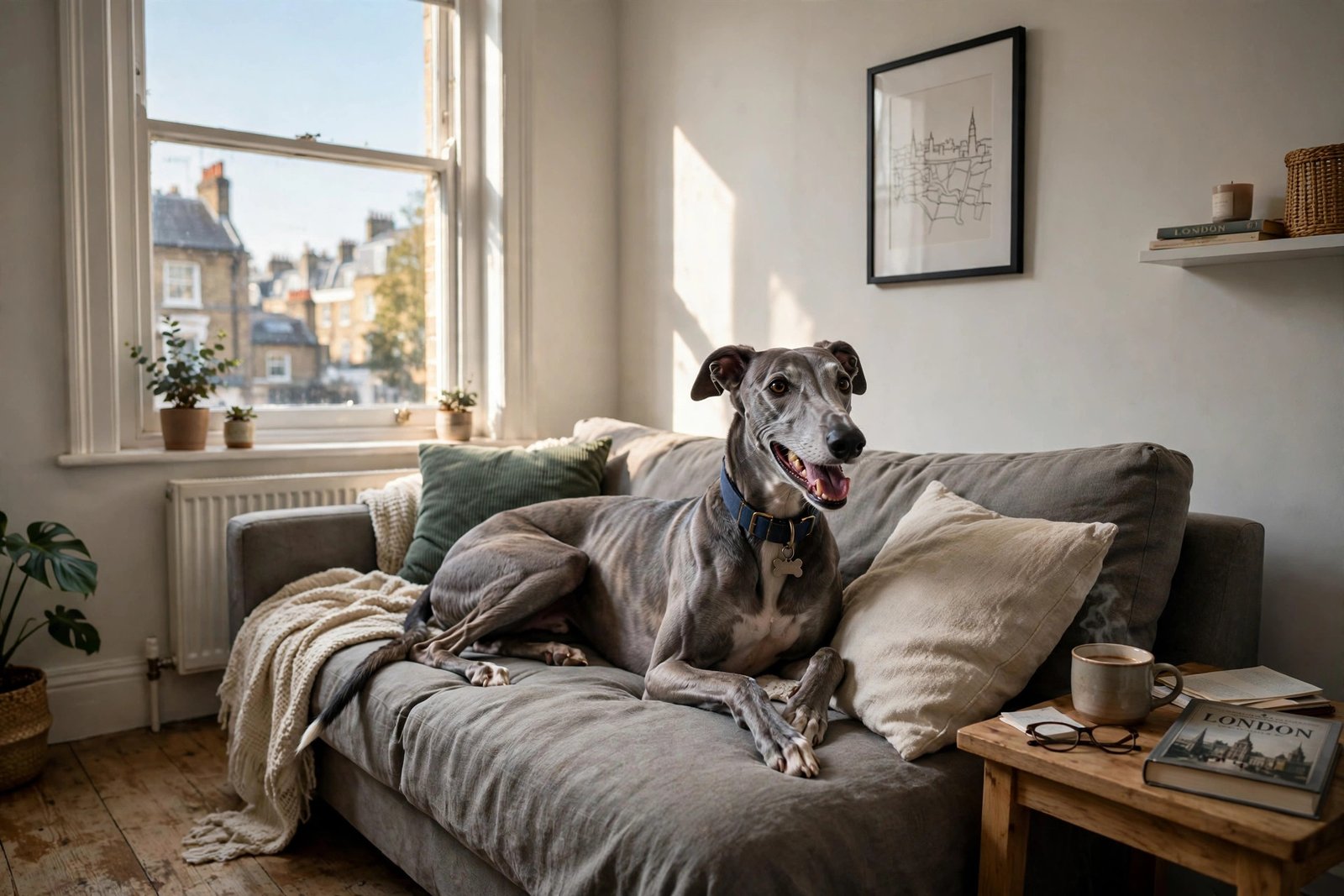
Is a Large Dog Happy in a London Flat? Honest Answer
Can a Labrador, a German shepherd or a lanky lurcher truly be happy in a London flat? It is one of the most common worries among capital-dwellers who dream of a big dog — and the answer surprises most people: yes, absolutely, provided the dog’s real needs are met. Square footage matters far less than most assume. What a large dog actually needs is exercise, mental stimulation, training and company — none of which requires a garden.
This guide looks honestly at the pros and cons, which large breeds cope best with flat life, how to make a small space work, and the London-specific challenges to plan for.
What dogs actually need (hint: it is not a garden)
Dogs do not measure happiness in square metres. Behaviourists consistently find that a dog left alone for ten hours in a house with a garden is far less happy than a dog in a one-bedroom flat whose owner provides two good walks, training games and companionship. Gardens are convenient for owners, but most dogs simply sunbathe in them — the adventure happens on walks.
The real requirements are non-negotiable whatever your home size: 1–2 hours of proper exercise daily for most large breeds, mental work (training, scent games, puzzle feeders), social contact, and a comfortable resting place. A flat can deliver all of these. What it cannot deliver is isolation tolerance — large breeds are generally social animals, so long working days away from home are the actual dealbreaker, not the floor plan.
Which large breeds suit flat life best
Energy level and temperament matter more than size. Greyhounds are famously the world’s fastest couch potatoes — 20 minutes of sprinting, then asleep for the rest of the day — making them superb flat dogs. Great Danes, despite their enormity, are calm indoors and often called “apartment horses”. Standard poodles are intelligent, trainable and lower-shedding.
Be cautious with high-drive working breeds: border collies, Belgian Malinois and young Labradors need serious daily work, and without it they will redecorate your flat out of boredom. That does not rule them out for committed, active owners — London’s parks are made for them — but be honest about your lifestyle. And whatever the breed, check the numbers first in what a dog costs per year across the UK, because large dogs eat, insure and medicate at large-dog prices.
Making a small space work
Designate a clear “dog zone” — a crate or bed in a quiet corner that is theirs alone. Dogs find small, den-like spaces reassuring, and a crate-trained dog will often choose the crate over the sofa. Protect your deposit with washable throws, a good doormat for muddy paws, and stair gates if needed.
Noise is the main flat-specific concern: a large dog’s bark carries through walls. Training a solid “quiet” cue is essential, as is managing separation anxiety before neighbours complain. Puzzle feeders, frozen Kongs and snuffle mats keep a big brain busy in a small space. Our guide to organising a small London flat with no storage has space-saving ideas that work for dog gear too — collapsible crates, wall-mounted lead hooks and under-bed toy storage.
The London advantage (yes, really)
London is arguably Britain’s best city for flat-dwelling dogs. The capital has more professional dog walkers per square mile than anywhere else, endless parks (Richmond, Hampstead Heath, Victoria Park), dog-friendly pubs on every corner, and a huge community of owners. Free outdoor time is everywhere — see the best free things to do in London at weekends for park inspiration.
The challenges are real too: lift etiquette with a nervous 40kg dog, muddy paws in a fourth-floor walk-up, and the cost of everything. Pet-friendly rentals are harder to find and often pricier. Plan for these rather than being surprised by them.
The daily routine that makes it work
Success with a large dog in a flat is 90% routine. A typical winning day looks like this: a proper morning walk of 45–60 minutes before work (not a pavement shuffle — a real walk with sniffing, training practice and ideally some off-lead time in a park), breakfast in a puzzle feeder, a midday walker visit or doggy daycare if you are office-based, an evening walk with play or training, then calm settle time. Dogs thrive on predictability; a flat dog with a rock-solid routine is a contented dog.
Weekends are your secret weapon. London offers extraordinary dog adventures within an hour: Richmond Park’s wide open spaces, the Thames Path for long riverside walks, Hampstead Heath’s swimming ponds for water-loving breeds. One big weekend adventure compensates for shorter weekday walks and gives a high-energy dog the outlet a flat cannot provide. Build your weekends around the dog, and the weekdays take care of themselves.
Training priorities for flat-dwelling big dogs
Three behaviours matter above all in a flat: a bombproof “quiet” cue, polite lead manners in stairwells and lifts, and calm greetings for visitors in a small hallway. Start these on day one — a 35kg adolescent that jumps up is charming at 8 weeks and a liability at 8 months. Enrol in a good training class early; London has excellent options in most boroughs, and the socialisation is as valuable as the obedience.
Crate training deserves special mention for flat life. A crate gives a large dog a defined personal space in a small home, prevents destructive chewing when unsupervised, and makes everything from vet stays to holidays easier. Done positively, dogs love their crates — it is their bedroom, not a cage.
When a large dog in a flat is a bad idea
Honesty matters. If you work 12-hour days with no walker budget, if your building bans dogs, if nobody in the household can manage two substantial walks daily in all weathers — wait. A large, under-exercised, lonely dog in a flat is miserable and destructive, and rehoming a big adolescent dog is heartbreaking. The Dogs Trust and RSPCA both stress lifestyle-matching over wishful thinking, and their rehoming teams will help you assess honestly.
Conclusion
A large dog can be genuinely happy in a London flat — many thousands are. Happiness comes from exercise, training, company and routine, not from a postcode with a garden. Choose a breed whose energy matches your life, budget for the real costs, train for quiet flat manners, and exploit London’s parks and dog-walking infrastructure. Do that, and your flat becomes not a compromise but simply home — for both of you.
Frequently Asked Questions
What is the best large dog breed for flat living?
Greyhounds top most behaviourists’ lists — calm indoors with modest exercise needs. Great Danes, standard poodles and older rescue Labradors also adapt well.
How much exercise does a large dog in a flat need?
Most large breeds need 1–2 hours daily, split across walks plus mental stimulation. Without it, behaviour problems follow regardless of home size.
Will my landlord allow a large dog?
Many London tenancies restrict pets or set weight limits. Always get written permission before committing, and check for pet clauses and additional cleaning requirements.
Do large dogs bark more in flats?
Not inherently, but barking carries further in flats and neighbours are closer. Training a reliable “quiet” cue and preventing separation anxiety are essential.
Is it cruel to keep a big dog without a garden?
No — cruelty is neglecting exercise, company and stimulation. A well-walked, well-trained large dog in a flat is far happier than a neglected one with a garden.