
Easy Pizza Dough from Scratch (Foolproof Recipe)
Easy Pizza Dough from Scratch (Foolproof Recipe)
Shop-bought pizza bases are fine. Homemade pizza dough is a different sport entirely — chewy, blistered, properly delicious. And it’s embarrassingly easy. Here’s how to make pizza dough from scratch easily: 5 ingredients, 10 minutes of work, and the tricks that make it great.
The recipe (makes 2 large pizzas)
- 500g “00” flour (or strong white bread flour — see flour guide; 00 gives the silkiest result)
- 325ml lukewarm water
- 7g instant yeast (1 sachet) — or 15g fresh yeast
- 10g fine sea salt (2 tsp)
- 15ml olive oil (1 tbsp) — plus extra for the bowl
That’s it. No sugar, no milk, no nonsense — Neapolitan dough is flour, water, salt, yeast. The oil is my small concession for home ovens.
The method
- Dissolve yeast in the lukewarm water (not hot — hot kills yeast; lukewarm like bathwater).
- Mix: flour and salt in a large bowl, add water/yeast and oil. Mix to a shaggy dough.
- Knead 8–10 minutes until smooth and elastic — it should stretch without tearing (the “windowpane test”). A stand mixer with dough hook: 6–7 minutes.
- Bulk prove: oil the bowl, cover, leave 1–2 hours at room temperature until doubled. Or cold prove 24–72 hours in the fridge — slower, but dramatically better flavour (the single biggest upgrade you can make).
- Divide and ball: split into 2 balls (~400g each), tucking edges underneath for a smooth top. Rest 30–60 minutes covered before shaping.
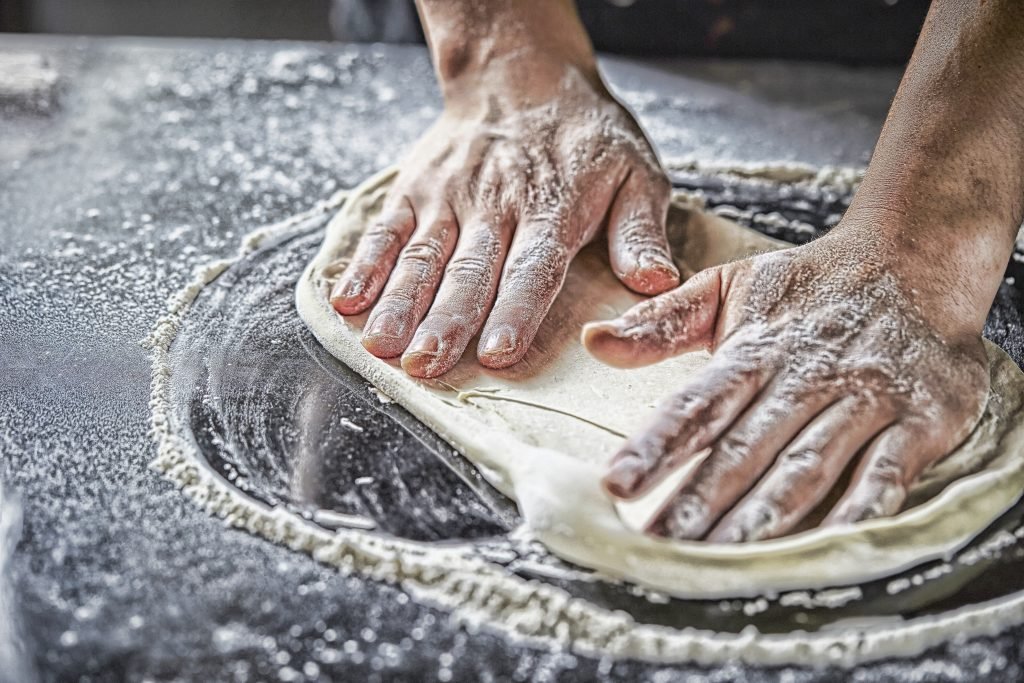
- Shape: press from the centre outward, leaving a puffy rim (the cornicione) — never roll with a rolling pin (it crushes the air bubbles). Stretch over your knuckles, letting gravity help.
Baking: heat is everything
- As hot as your oven goes — maximum, usually 250–275°C. Preheat for at least 45 minutes with a pizza stone or steel (£30–£60 — the best pizza investment after the flour) or an upturned heavy baking tray.
- Launch with a peel (or floured baking paper you slide off) — a floured worktop and confident speed.
- Bake 6–8 minutes until puffed, spotted and golden. In a proper pizza oven (Ooni etc.): 60–90 seconds.
- Don’t overload toppings — less is more; a soggy middle is always too much topping, never too little heat.
The sauce (2 minutes)
1 tin San Marzano tomatoes (or good chopped tomatoes), crushed by hand, pinch of salt, drizzle of olive oil, torn basil. Don’t cook it — it cooks on the pizza. Raw sauce = bright, fresh flavour; cooked sauce = dull. This alone lifts home pizza enormously.
Topping combinations that work
- Margherita: sauce, fior di latte mozzarella (patted dry!), basil, olive oil — the test of a good dough
- Diavola: sauce, mozzarella, spicy salami, honey drizzle after baking
- Funghi: no tomato — olive oil base, mozzarella, mushrooms, thyme, taleggio
- Bianca: ricotta, mozzarella, lemon zest, rocket after baking
Mozzarella tip: fresh mozzarella is 60% water — pat it dry or use low-moisture “pizza mozzarella” to avoid soup. Tear, don’t slice thick.
Troubleshooting
- Dough won’t stretch (springs back): gluten is tight — rest 15 minutes covered and try again.
- Sticks to the peel: more flour/semolina underneath, work faster, don’t let it sit.
- Soggy middle: oven wasn’t hot enough, too much sauce/topping, or wet mozzarella.
- Dense, bready base: under-proved — give it longer; or the yeast was dead (test in warm water with a pinch of sugar — should foam in 10 minutes).
- Burnt bottom, raw top: stone too hot relative to oven — move pizza up a shelf.
The bottom line
Flour + water + yeast + salt, kneaded well, proved slowly (24h fridge if you can), baked as hot as possible on a stone. Ten minutes of actual work, and pizza that embarrasses delivery. The cold prove is the cheat code — make dough on Thursday for Saturday pizza and taste the difference fermentation makes. Once you’ve had proper homemade pizza, the £18 delivery looks a lot less appealing. For storing leftover dough (it freezes brilliantly), see our bread storage guide.
Cold fermentation: the 24-hour upgrade
The single biggest improvement to home pizza: cold prove the dough 24–72 hours in the fridge. Why it works: cold temperatures slow yeast activity but allow enzymes to keep working — breaking down starches into sugars (better browning) and developing complex flavours (the tangy, wheaty depth that same-day dough lacks). The gluten also relaxes, making the dough easier to stretch without spring-back.
Method: make the dough as normal, but use less yeast (3–4g instead of 7g — it has 3 days to work), knead, then refrigerate immediately in an oiled, covered bowl or individual containers. Use within 72 hours (beyond that, the yeast exhausts and the dough degrades). Before baking: take out 2 hours ahead — cold dough doesn’t stretch well and bakes unevenly. The result: leopard-spotted crust, complex flavour, effortless stretching — pizzeria-quality from a home oven. Make Thursday dough for Saturday pizza — 10 minutes of Thursday effort, transformative Saturday result.
Pizza dough FAQs
Can I freeze pizza dough? Yes, brilliantly — freeze after the first prove, in individual oiled balls (wrap tightly in cling film + freezer bag). Use within 3 months. Defrost: fridge overnight, then 2 hours at room temperature before shaping. Quality: 95% as good as fresh — the yeast survives freezing well. Batch strategy: make double, freeze half — future pizza nights start with defrosting, not dough-making.
Why is my dough tough and hard to stretch? Under-proved (the #1 cause — gluten needs time to relax; if it springs back, rest 15 minutes and try again), too much flour (measure by weight, not cups — 500g is 500g), over-kneaded (rare by hand, possible with a mixer — stop at smooth and elastic, not stiff), or cold dough (room temperature for 2 hours before shaping). Never use a rolling pin — it crushes the air bubbles that make the crust airy.
How hot should my oven be? Maximum — as hot as it goes (usually 250–275°C). Preheat 45–60 minutes with the stone/steel inside — the stone needs to be saturated with heat, not just the air. Pizza steel (£50–£80) beats stone for home ovens (transfers heat faster, indestructible); stone (£25–£40) is fine and cheaper. Upturned heavy baking tray works in a pinch. Position: top third of the oven — the top element helps brown the crust.
What toppings go on first? Order: sauce (thin layer — 3–4 tbsp max), cheese (torn mozzarella, patted dry), toppings (sparingly — less is more), bake, then fresh things after (basil, rocket, parma ham, burrata, olive oil drizzle). Wet toppings (fresh mozzarella, tomatoes) — pat dry or use low-moisture versions. The rule: if you can’t see dough through the toppings, you’ve used too much. Soggy middle is always too much topping, never too little heat.
Can I make pizza dough without yeast? Yes — flatbread-style: flour + baking powder (2 tsp per 250g) + yoghurt or milk + salt + oil. Mix, rest 15 minutes, roll thin, bake hot — it’s cracker-crisp rather than chewy, ready in 30 minutes, no proving. Honest assessment: delicious in its own right, but it’s flatbread, not pizza — no chew, no leopard-spotting, no airy cornicione. For weeknight emergencies, it’s excellent; for Saturday pizza night, make the real dough (or defrost the frozen balls).
Related reading
More dough: choosing bread flour — and BBC Good Food’s pizza dough recipe.
One thought on “Easy Pizza Dough from Scratch (Foolproof Recipe)”