
Sole Trader vs Limited Company: Which Is Right for You?
Sole Trader vs Limited Company: Which Is Right for You?
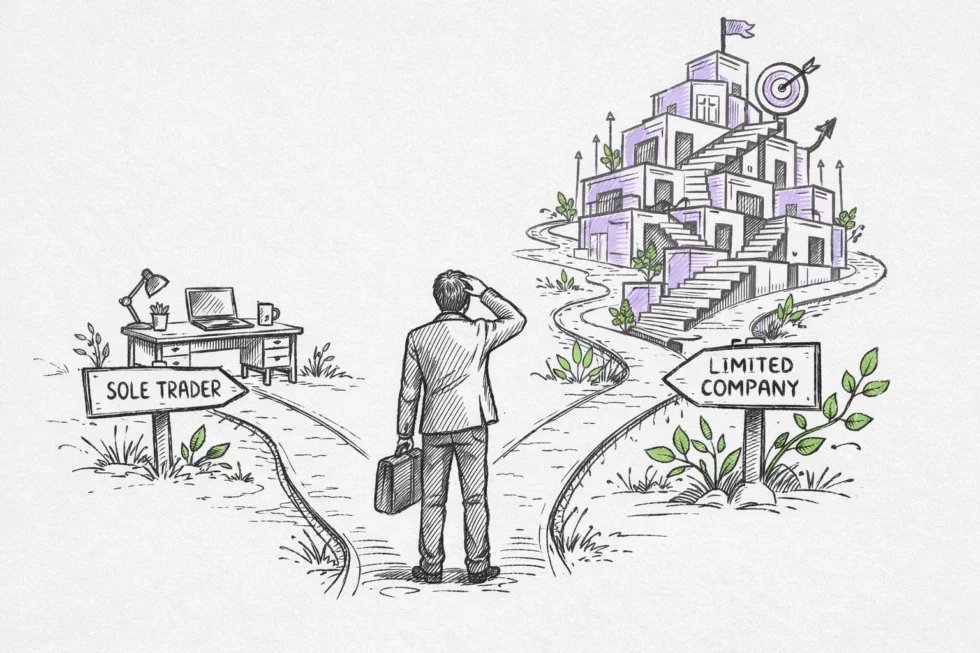
What is the difference between a sole trader and a limited company? In one sentence: a sole trader IS the business (with unlimited personal liability), while a limited company is a separate legal entity that shields your personal assets. That single distinction drives differences in tax, paperwork and risk that matter enormously as you grow.
It’s one of those questions that sounds simple until you start digging. Ask three people and you’ll get four different answers — usually because everyone’s situation is slightly different. I’ve pulled together the practical detail below so you can make a decision without spending your whole weekend on comparison sites. If that’s on your mind too, have a look at our guide to how much does it cost to start a limited company in the uk — it pairs naturally with everything below.
What is the difference between a sole trader and a limited company?
A sole trader is the simplest structure: you register as self-employed with HMRC (free), file one Self Assessment tax return a year, and keep basic records. You pay income tax (20-45%) and National Insurance on all profits. The catch: there’s no legal separation between you and the business — if the business owes money, creditors can come for your house.
A limited company is its own legal ‘person’. It pays corporation tax (19-25%) on profits, and you extract money via salary and dividends. Your liability is limited to what you’ve invested — personal assets are protected if the company fails. The price: annual accounts, confirmation statements, corporation tax returns, and more rigorous bookkeeping.
Now for the part most guides skip: the practical trade-offs. Worth a read alongside this: our guide to how do I register as self-employed with hmrc.
Side-by-side comparison
The key points, stripped of fluff:
- Setup: sole trader — free, 10 minutes with HMRC. Limited — £12-£100, more details required.
- Tax: sole trader pays income tax + NI on all profit. Limited pays 19-25% corporation tax; directors optimise via salary/dividends.
- Liability: sole trader — unlimited personal liability. Limited — liability capped at investment.
- Admin: sole trader — minimal. Limited — accounts, confirmation statement, stricter records.
- Credibility: ‘Ltd’ impresses some corporate clients; most consumers don’t care.
- Getting money out: sole trader — it’s all yours. Limited — salary/dividends with tax planning.
It’s worth pausing here to think about what you actually need versus what sounds nice on paper. Providers love selling you headroom you’ll never use.
The tax crossover point
Here’s the practical maths: below about £30,000-£40,000 profit, sole trader usually wins once you factor in accountancy costs (£600-£1,500/year for a limited company). Above that, the limited company’s lower corporation tax rate plus dividend planning typically saves £1,000s annually.
But tax isn’t everything. If your work carries liability risk (advice, construction, food, anything where a mistake could mean a lawsuit), the limited company’s protection is worth the admin from day one. And some industries and corporate clients simply prefer — or require — dealing with limited companies. Talk to an accountant before deciding; a £150 consultation can save thousands.
Can you switch later?
Yes, and it’s common: start as a sole trader, incorporate when profits or risks grow. The switch involves forming the company, transferring assets, informing HMRC, and handling the tax implications (there can be capital gains considerations on transferred assets — another reason for that accountant conversation).
What you can’t do is flip-flop casually for tax advantage — HMRC watches for ‘phoenix’ behaviour and artificial arrangements. Pick the structure that fits your genuine situation, review annually, and switch when the business genuinely outgrows the old structure. Most successful freelancers I know made the jump around year two or three.
Quick answers
What’s the biggest mistake people make with business structures?
Rushing in without comparing options. Most people grab the first business structures deal they see — usually an advert or a mate’s recommendation — and never check whether it actually fits their situation. Spend an hour comparing two or three alternatives, read the small print on the cheapest one, and you’ll dodge the regret that lands three months later when the bills arrive or the limitations start to bite.
What should I do first if I’m completely new to business structures?
Start with the free, reversible steps: research, compare, and get your facts straight before spending a penny or signing anything. Make a shortlist of two or three options, check recent reviews — and read the one-star ones, not just the average — and talk to someone who’s done it before you. Ten minutes of asking around beats ten hours of guessing, and it costs nothing.
How much should I realistically budget for business structures?
More than the headline price, less than the premium option. A sensible budget for business structures sits in the middle of the market — enough to avoid the cut corners of the cheapest tier, without paying for features you’ll never touch. Add 15-20% contingency for the extras nobody mentions upfront, and you’ll land about right. The people who blow the budget are the ones who budgeted for the advert price instead of the real one.
Pro tip: whatever you decide about business structures, set a calendar reminder to review it in a year’s time. Prices, products and your own needs all shift — the people who get the best value long-term are the ones who revisit decisions, not the ones who choose perfectly on day one.
My honest take
Sole trader for simplicity under ~£35k profit; limited company for tax efficiency above that and liability protection throughout. The £12 incorporation fee is trivial — the real question is whether the admin overhead earns its keep, and an accountant’s advice pays for itself here.
That’s the full picture as it stands. Markets move and deals change, but the principles above hold — match the choice to your real needs, read the small print, and don’t pay for things you won’t use. Final thought: the market rewards people who shop around and punishes people who don’t. You’re now in the first group. For the official word, see GOV.UK: business structures compared. HMRC: working for yourself is also worth a look for independent comparisons.
One thought on “Sole Trader vs Limited Company: Which Is Right for You?”