
Why Do Chopped Onions Sting Your Eyes? The Chemistry Behind It
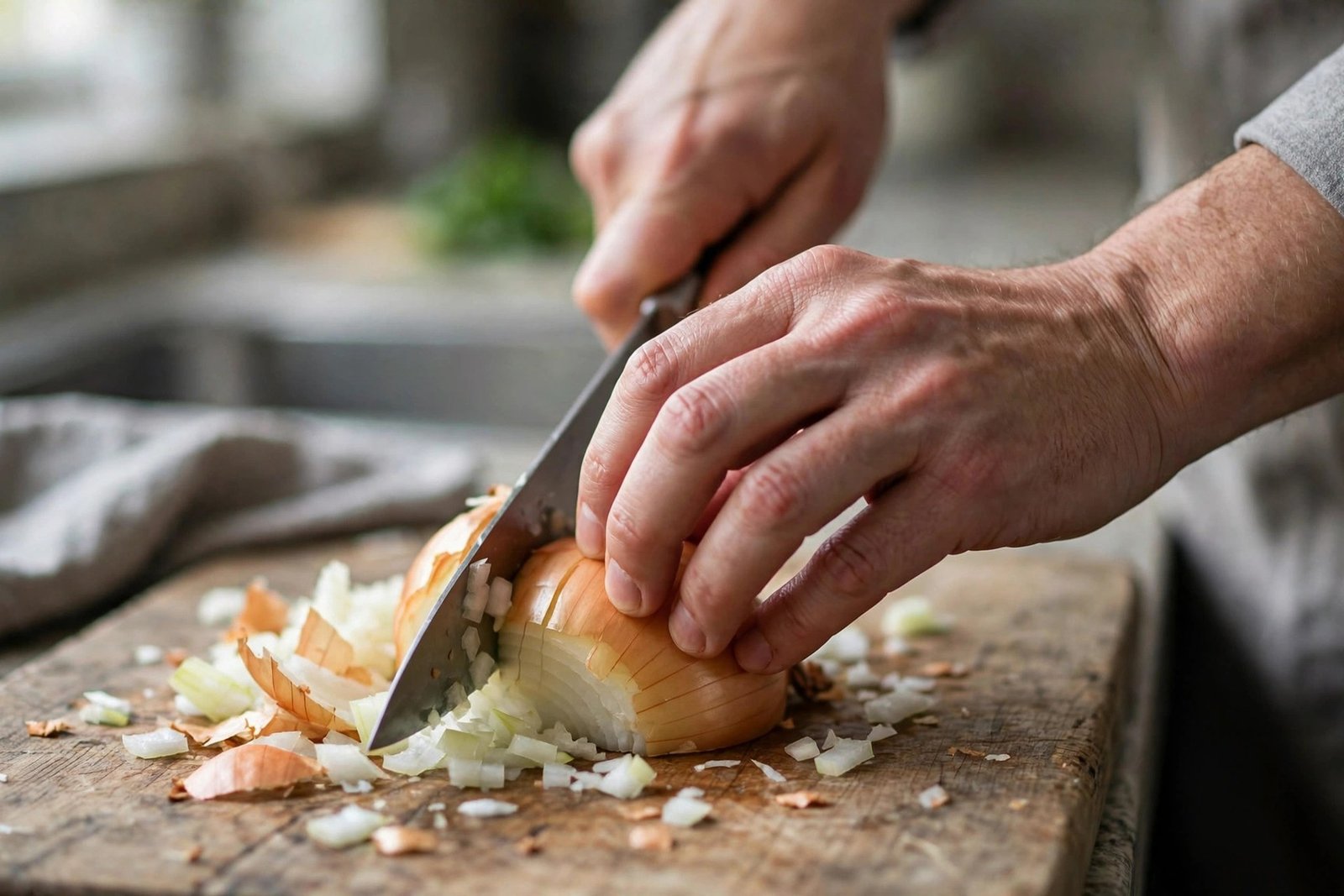
You are halfway through dicing an onion and your eyes are streaming. Not a gentle misting — full, stinging tears, as if the onion has taken personal offence at being chopped. Every cook knows the phenomenon, but few know the remarkable chemistry behind it: the onion is not passively making you cry. It is deploying a chemical weapon — an evolved defence system that converts a harmless vegetable into a tiny tear-gas factory the instant a knife breaches its cells. Here is the science of why chopped onions sting your eyes.
The Onion’s Chemical Defence System
An intact onion is perfectly innocent. Inside its cells, sulphur-containing compounds called sulfoxides sit peacefully in one compartment, while enzymes called alliinases wait in another. The knife is the trigger: slicing ruptures the cell walls, the compartments mix, and the enzymes convert sulfoxides into sulfenic acids in milliseconds. Those unstable acids are then transformed by a second enzyme — lachrymatory factor synthase — into a volatile gas: syn-propanethial-S-oxide, the lachrymatory factor (literally “tear-maker”).
This is not an accident of biochemistry; it is a defence mechanism honed by evolution. The gas deters the animals and microbes that would eat the plant — and it works on humans because our eyes are exquisitely sensitive chemical detectors. The whole cascade, from knife cut to airborne irritant, takes seconds, which is why the stinging starts almost immediately and intensifies as you keep chopping and releasing more gas.
Why Your Eyes React So Violently
When the lachrymatory factor reaches your eyes, it dissolves in the tear film and forms a mild sulphuric acid — yes, actual (very dilute) sulphuric acid, right on your eyeball. The eye’s trigeminal nerve endings detect the irritation and trigger the lacrimal glands: tears flood out to dilute and wash away the chemical. The burning, the streaming, the urge to step back — that is your eye executing an emergency decontamination protocol.
Some people suffer more than others, and contact lens wearers often report less stinging — the lenses act as a partial barrier (small mercy). The onion’s variety matters enormously: sweet onions (like Vidalias) contain fewer sulphur compounds and sting less; pungent yellow and red onions are the worst offenders. Freshness matters too — the enzymatic machinery degrades with age, so older onions are milder. And the root end concentrates the compounds, which is why chefs advise leaving it intact until last.
What Actually Helps (and What Does Not)
The folk remedies have mixed scientific support. Chilling the onion for 30 minutes before chopping genuinely helps — cold slows the enzymatic reactions that produce the gas. A very sharp knife helps more than people realise: clean cuts rupture fewer cells than crushing cuts from a blunt blade, releasing less lachrymator. Chopping near running water or a fan disperses the gas before it reaches your eyes — the classic “underwater chopping” works but is impractical and slightly hazardous.
Goggles — yes, actual onion goggles exist — are the most effective solution, creating a physical seal. Breathing through your mouth does nothing (the gas reaches the eyes through the air, not the nose). Holding bread in your mouth is pure placebo. And the microwave trick (brief heating to denature enzymes) works chemically but partially cooks the onion — fine for some dishes, ruinous for others. For the culinary aftermath, it helps to know your way around the kitchen generally — cooking tofu so it actually tastes good is another case where technique transforms the ingredient, and the difference between baking soda and baking powder is the kind of kitchen chemistry that rewards the curious cook.
Plant scientists have even bred the problem away: “sunion” onions, developed through decades of selective breeding, are engineered to produce less lachrymatory factor — proof that the sting is chemistry, and chemistry can be edited. The Royal Society of Chemistry has published accessible explainers on lachrymatory factor chemistry for the scientifically curious. The Royal Horticultural Society covers onion growing and varieties for the horticulturally inclined.
The Onion Family: A Sting Ranking
Not all alliums are created equal in the tear department, because sulphur content varies dramatically. Worst offenders: standard yellow onions and red onions — high in the sulphur compounds that feed the lachrymatory cascade, they are the ones that clear the kitchen. Moderate: white onions and shallots — still potent, but a noticeable step down, which is why shallots are favoured in fine dining where the cook’s comfort matters. Mildest: sweet onions (Vidalia, Walla Walla) and spring onions — bred or grown for low sulphur, they can often be chopped tear-free.
Garlic, leeks and chives share the same sulphur chemistry but rarely make anyone cry — the compounds are present in lower concentrations and, crucially, these are not usually chopped in the volume that onions are. It is dose that makes the poison: mince enough garlic and your eyes will notice. For the tear-averse, the strategic choice is real: sweet onions for raw applications where pungency is not needed, and accepting the sting as the price of the yellow onion’s superior flavour when cooking. The flavour and the tears come from the same chemistry — you cannot breed out one without dulling the other, which is why the mighty yellow onion remains undefeated in the pan despite its assault on the cook.
Cooking and the Tear Factor: Heat Changes Everything
The lachrymatory factor is heat-sensitive, which creates an interesting kitchen dynamic: the enzymes that produce it denature as temperature rises, so cooking destroys the tear gas even as it transforms the flavour. This is why raw onion in a salad bites (and makes you cry during prep) while long-cooked onion turns sweet and mild — the same sulphur compounds that sting become, through heat, the savoury depth of caramelised onions.
Practical applications: if a recipe needs raw onion but you are sensitive, soak sliced onion in cold water for 10–15 minutes — it leaches out some of the sulphur compounds, mellowing both bite and tears. For cooked dishes, the order matters less than people think: the crying happens during prep, not cooking, so do your chopping efficiently and get the onion into the hot pan quickly, where heat ends the chemistry. And the ultimate low-tear technique beloved of professional kitchens: prep onions first, before your eyes have had any exposure, when the cumulative effect is zero. The first onion never makes anyone cry; it is the fifth, in an unventilated kitchen, that breaks you.
Conclusion
Chopped onions sting your eyes because slicing triggers an enzymatic defence cascade that releases syn-propanethial-S-oxide — a volatile gas that forms dilute sulphuric acid on contact with your tears, prompting emergency eye-flushing. It is chemical warfare, evolved over millions of years, deployed against your dinner prep. Chill the onion, use a sharp knife, ventilate the area, or wear the goggles without shame. The tears are not weakness — they are your eyes working exactly as designed.
Frequently Asked Questions
What chemical in onions makes you cry?
Syn-propanethial-S-oxide, the lachrymatory factor — a volatile gas produced when chopping ruptures onion cells, mixing sulphur compounds with enzymes. It forms mild sulphuric acid when it contacts the moisture in your eyes.
Do sweet onions make you cry less?
Yes — sweet onion varieties contain fewer sulphur compounds, so they produce less lachrymatory factor. Pungent yellow and red onions are the worst offenders.
Does chilling an onion stop the tears?
It significantly reduces them — cold slows the enzymatic reactions that produce the tear gas. Thirty minutes in the fridge before chopping makes a noticeable difference.
Why do contact lens wearers cry less at onions?
The lenses act as a partial physical barrier between the gas and the eye’s surface, reducing irritation. It is an accidental benefit, not a recommended strategy.
Are “tearless” onions real?
Yes — sunion onions were developed through 30+ years of selective breeding to produce minimal lachrymatory factor. They are a genuine, if premium-priced, solution.