
How to Tune by Ear Without an App: Full Guide
Tuner apps are convenient — until your phone dies mid-gig, the app misreads in a noisy room, or you simply want the deeper musicianship that comes from trusting your own ears. Tuning by ear is one of the most valuable skills any musician can develop: it sharpens intonation, trains relative pitch, and connects you to centuries of musical tradition from before electronics existed. It is entirely learnable, whatever your instrument.
This guide teaches the classic methods step by step: reference pitches, beats and harmonics, instrument-specific techniques, and the practice routine that builds reliable ears within months.
Why bother when apps exist
Apps give you a number; ears give you music. Players who tune by ear develop finer intonation because they learn to hear intervals, not just match a needle. In ensembles, you tune to each other, not to twelve separate phone screens — chamber musicians and choirs constantly adjust by ear in real time. And practically, batteries die, apps glitch, and some performance settings ban phones on stage.
There is also a subtler benefit: ear tuning trains relative pitch, the skill underlying improvisation, transcription and playing by ear. Every minute spent tuning attentively is ear training in disguise. Think of it as musicianship compound interest. Making Music encourages ensemble playing as the natural home for ear-tuned musicianship.
Start with a reliable reference pitch
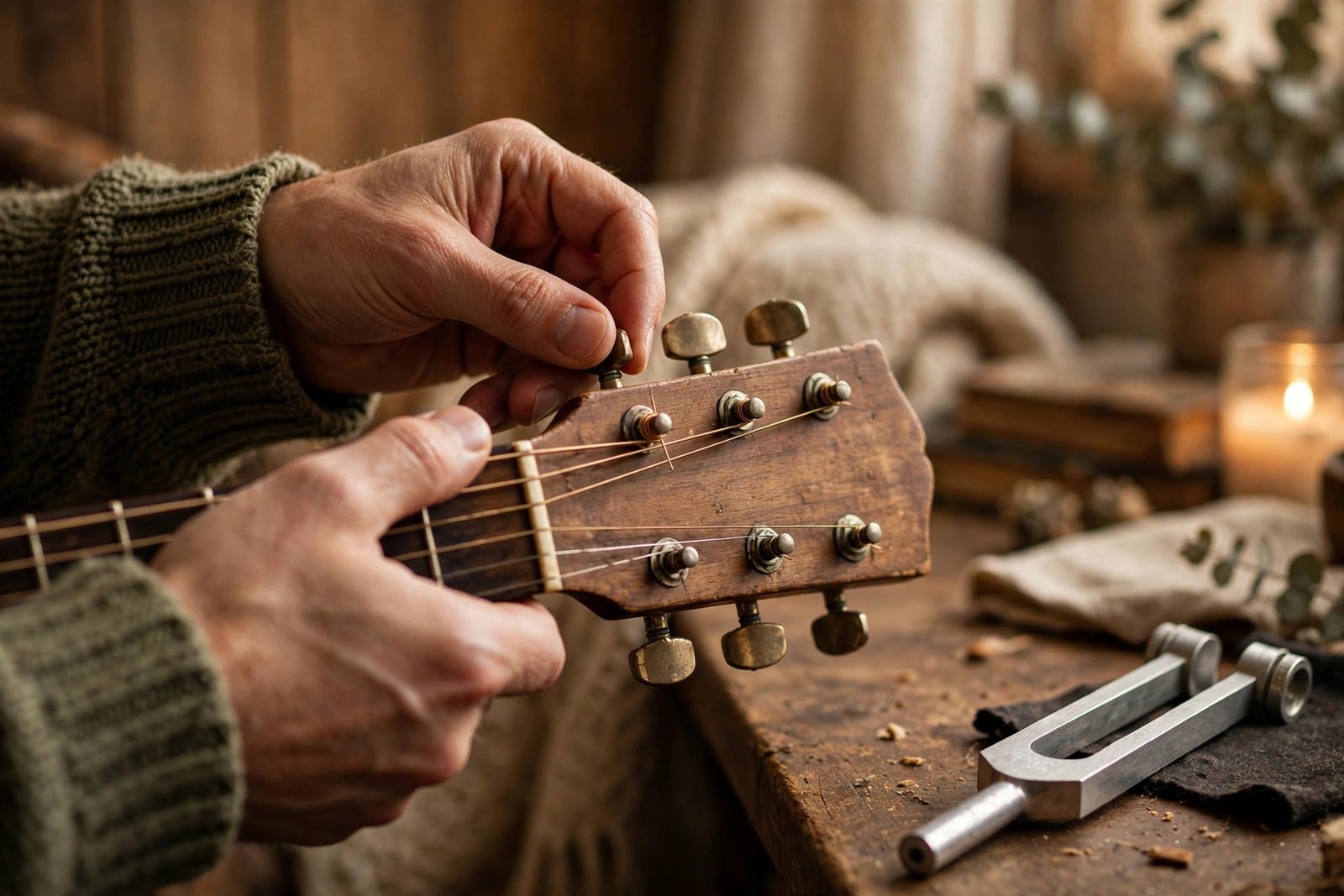
You cannot tune in a vacuum — you need one trustworthy note, then tune everything else relative to it. Traditional sources: a tuning fork (A=440Hz, the classic — strike it and hold it to the instrument or your ear), a pitch pipe, a piano or keyboard, or another musician’s tuned instrument. In orchestras, the oboe gives the A; in bands, agree on one reference instrument.
Memorise your reference pitch over time. Many experienced musicians develop a strong internal A through sheer repetition — sing it, play it, check it daily. Absolute pitch is rare and unnecessary; a well-trained pitch memory for one note is achievable and enormously useful. Until then, carry a fork: it never needs charging.
The core skill: hearing beats
When two notes are almost — but not quite — the same pitch, you hear “beats”: a pulsing wah-wah-wah whose speed reveals how far apart they are. Fast beats mean far apart; as you adjust toward unison, the beats slow, then disappear entirely into a pure, still sound. That disappearance is perfect tuning.
Practise deliberately: play your reference A, then play your instrument’s A slightly flat and slowly tune up, listening to the beats decelerate and vanish. Then try from sharp, tuning down. Do this daily for five minutes and within weeks you will hear beats clearly — the fundamental skill behind all ear tuning. This focused listening also deepens your musical attention generally; it pairs well with active listening habits like exploring the best podcasts of 2026 or studying recordings of great players.
Methods by instrument
Guitar and fretted strings
The classic 5th-fret method: tune the low E to your reference, then fret the 5th fret of the low E (which is A) and tune the open A string to match it — listening for beats. Continue: 5th fret of A tunes the D string, 5th fret of D tunes G, 4th fret of G (B) tunes the B string — note the exception — then 5th fret of B tunes high E. Check with harmonics: lightly touch the 5th fret harmonic of one string against the 7th fret harmonic of the string below; matching harmonics should ring beat-free.
Violin, viola, cello
Tune the A string to your fork first, then tune each adjacent string in perfect fifths by bowing pairs together and eliminating beats. Fifths have a distinctive open, hollow ring when pure — learn that sound and you will tune quickly. Check by playing double-stops across all four strings.
Wind and brass
Play your instrument’s standard tuning note (often B♭ or A for winds, B♭ for brass) against the reference, adjusting slides or embouchure until beats vanish. Then check octaves and fifths across your range — temperature changes affect wind tuning constantly, so recheck after warming up.
Voice and choirs
Singers tune relatively by definition: take your starting pitch from the reference, then navigate by intervals, listening for the pure ring of octaves and fifths against other parts. Choir singers who practise tuning by ear blend faster and sing more confidently in tune.
Using harmonics and sympathetic resonance
Harmonics are the precision tool of ear tuning. On strings, lightly touched harmonics produce pure, bell-like tones that make beats easy to hear. Matching the 5th-fret harmonic of a lower string to the 7th-fret harmonic of the next string up is more accurate than fretted notes because it removes finger-pressure variables.
Sympathetic resonance is the advanced check: on a well-tuned violin, bowing the A string makes the E string shimmer sympathetically. On guitar, a correctly tuned open chord rings with a chorus-like richness that slightly-off tuning lacks. Learn to feel these resonances and tuning becomes almost tactile.
The practice routine that builds ears
Ten minutes a day, structured: two minutes matching a single reference pitch by beats; three minutes tuning your full instrument by ear, then checking with an app to calibrate (use the app as teacher, not crutch — note how close you got); three minutes of interval singing or playing (fifths, octaves, fourths); two minutes of harmonic matching. Log your accuracy weekly — watching the gap close is motivating.
Play with others as soon as possible. Sessions, choirs, ensembles — finding gigs and concerts near you can lead you to folk sessions where ear tuning is the norm — force real-time listening in a way solitary practice cannot. And protect your hearing: ear training is pointless if loud gigs damage the ears, so wear protection at amplified shows. For structured audio learning, Audible’s UK pricing includes music theory audiobooks if you want deeper study.
The Musicians’ Union offers resources on musicianship development, and reminds players that hearing protection is a professional necessity, not an optional extra.
Conclusion
Tuning by ear without an app is a learnable, high-value skill: secure one reference pitch, master hearing beats, apply your instrument’s method, refine with harmonics, and practise ten focused minutes daily. Within months you will tune confidently anywhere — no battery required — and your overall musicianship will be sharper for it. The app can stay in your pocket as a backup. Your ears are the real instrument.
Frequently Asked Questions
How long does it take to learn to tune by ear?
Basic competence in 4–8 weeks of daily ten-minute practice; reliable, quick tuning within 3–6 months. Hearing beats clearly is the first milestone and usually arrives within weeks.
What is a tuning fork and do I need one?
A tuning fork produces a pure A=440Hz when struck — the traditional reference pitch. It costs under £10, never needs batteries, and is the classic tool for ear tuning. Highly recommended.
Why does my tuning drift after a few minutes?
New strings stretch, temperature changes affect all instruments (especially winds), and playing itself warms and shifts pitch. Recheck tuning after warming up and periodically during long sessions.
Can singers learn to tune by ear?
Singers do it constantly — matching pitch to accompaniment and other voices is relative tuning. Structured interval practice and choir singing develop it fastest.
Is tuning by ear more accurate than an app?
For solo practice, apps are more precise. For ensemble playing, ears win — musicians constantly adjust to each other in ways no tuner can replicate. The skills complement each other.