
Why Is My London Payslip Less Than Expected? Decoder
You expected £2,800. Your payslip says £2,147. Before you march into HR convinced of a conspiracy, know this: almost every “my payslip is wrong” panic in London has a boring, lawful explanation. Tax codes, student loans, pension auto-enrolment and National Insurance all take their cut — and London salaries cross thresholds that trigger bigger deductions. Here is how to decode your payslip line by line.
The usual suspects, in order
1. Your tax code is wrong
The single most common cause. Your tax code tells your employer how much tax-free pay you get. The standard code is 1257L (£12,570 personal allowance), but codes change constantly — a second job, untaxed benefits, or HMRC adjusting for underpaid tax can all alter it. An emergency code (like 1257L W1/M1) taxes you as if every month is month one, often overtaxing you significantly.
Check your code against your Personal Tax Account on gov.uk. If it is wrong, HMRC can fix it and your employer refunds the difference through payroll. Emergency-code overpayments routinely run to hundreds of pounds — always worth checking first.
2. Student loan deductions kicked in
Plan 2 loans (most English graduates) deduct 9% of earnings above £27,295 a year; Plan 5 (newer borrowers) deducts 9% above £25,000. On a £40,000 salary, that is roughly £95 a month you never agreed to in any meaningful sense — it just appears. Postgraduate loans add another 6% above £21,000. These deductions feel like a pay cut because, functionally, they are one.
3. Pension auto-enrolment
Most employees pay 5% of qualifying earnings into their workplace pension (employers add 3%). On a £45,000 salary, that is around £150 a month from your pay packet. It reduces your take-home but it is your money, growing with employer contributions and tax relief — the rare deduction that makes you richer. Opting out to boost take-home pay is almost always a mistake.
4. National Insurance
Employees pay 8% on earnings between £12,570 and £50,270, and 2% above that. On £45,000, NI costs about £217 a month. The thresholds and rates change — gov.uk’s National Insurance pages carry the current figures — and directors or the self-employed face different rules entirely.
The London-specific amplifiers
London salaries are higher, which means London payslips cross more thresholds. The £50,270 higher-rate threshold is the big one: earn £55,000 and every pound above £50,270 is taxed at 40% instead of 20%. Your “raise” from £50,000 to £55,000 nets far less than £5,000 — and the payslip looks disappointingly flat.
The £100,000 trap is worse: the personal allowance tapers away between £100,000 and £125,140, creating an effective 60% marginal rate in that band. London professionals crossing £100,000 for the first time often feel poorer per extra pound earned than at any other point in their careers. Pension contributions (via salary sacrifice) are the standard escape hatch — they reduce your taxable income back below the threshold. Our explainer on how much tax freelancers pay in the UK covers the self-employed side of the same thresholds.
Reading your payslip properly
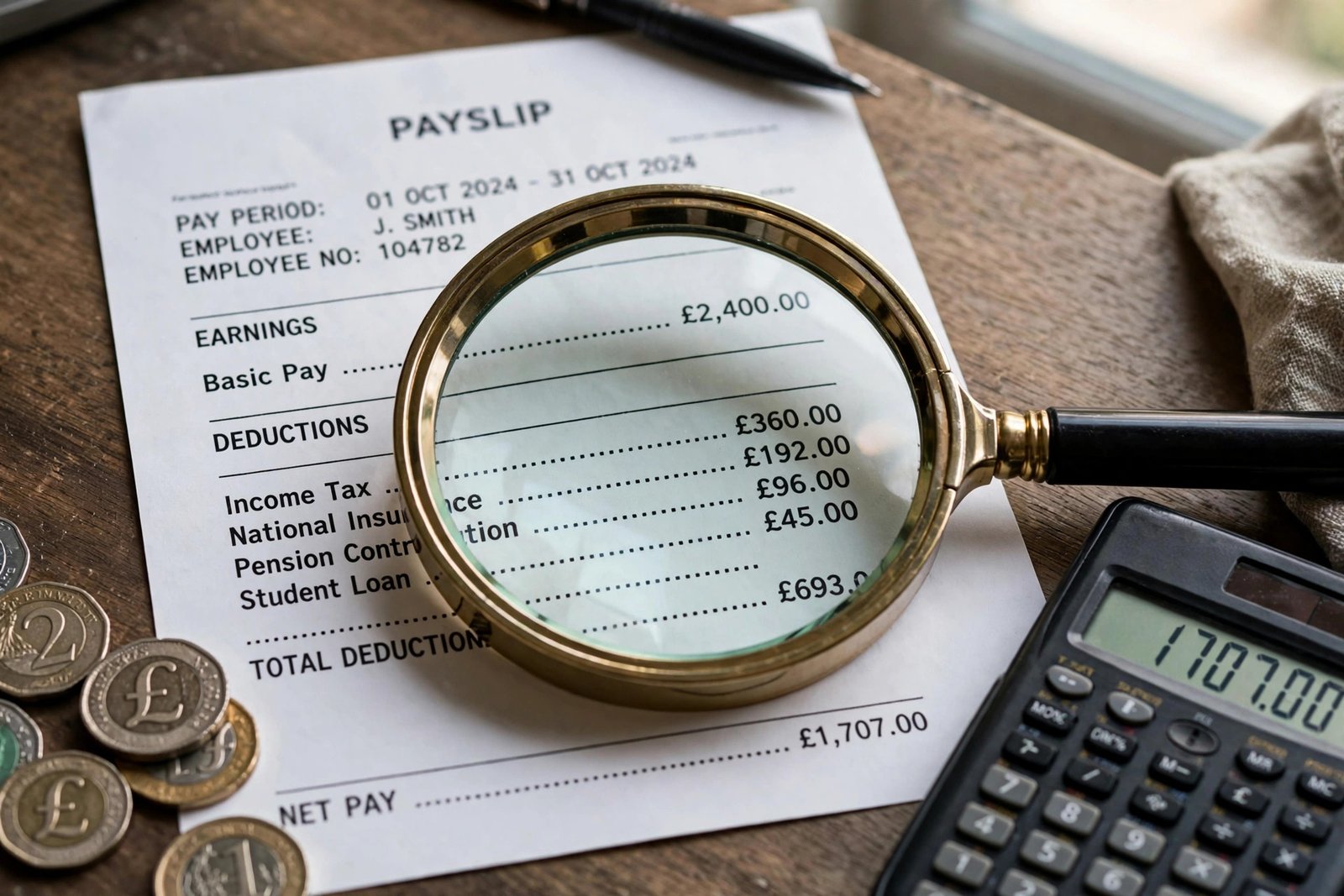
Every UK payslip must show gross pay, deductions and net pay, plus the tax code used. Work through it methodically: gross pay correct? (Check for unpaid overtime or missing London weighting.) Tax code as expected? NI at the right rate? Pension deduction matching your scheme? Student loan appearing when it should not — or missing when it should?
Common payroll errors include: benefits in kind (company car, private health insurance) taxed without you realising, salary-sacrifice schemes reducing gross pay (which is usually good — it cuts tax and NI), and payroll catching up on under-deductions from earlier months in one lump. If something looks off, ask payroll for a breakdown before assuming the worst — and keep your P60 and P45s forever.
When it actually is wrong
Genuine payroll errors happen: wrong tax code applied, double deductions, missed salary-sacrifice adjustments, incorrect student loan plan. Your first stop is always your employer’s payroll team — most errors are fixed in the next pay run. If payroll will not help, HMRC’s employer helpline can intervene on tax-code issues.
Keep records: screenshot every payslip, save every P60, and reconcile annually against your Personal Tax Account. Overpaid tax is reclaimable for up to four years, and thousands of Londoners discover each year that they have been overpaying on emergency codes or outdated benefit adjustments. The MoneyHelper tax guides walk through the reclaim process step by step.
Boosting what lands in your account
Legal ways to improve take-home: salary sacrifice for pensions (saves tax and NI for you and your employer), cycle-to-work schemes, and checking you claim everything — marriage allowance (£1,260 of personal allowance transferable to a spouse, worth £252 a year), professional subscriptions, and working-from-home tax relief where eligible. None of these are loopholes; they are the system working as designed.
And if you have side income, understand it is taxed too — the side-hustle tax rules catch many Londoners by surprise when HMRC adjusts their tax code to collect it through PAYE, shrinking the payslip overnight.
The self-employed payslip problem
If you are self-employed, there is no payslip at all — just the annual reckoning. Many newly self-employed Londoners get their first shock not from a payslip but from the January tax bill, especially the dreaded “payment on account” which effectively demands 150% of your first year’s tax upfront. The gov.uk self-assessment pages explain the system, but the practical rule is simple: put 25–30% of every invoice into a separate tax pot the day you are paid, and the January bill becomes a non-event rather than a crisis.
Conclusion
A smaller-than-expected London payslip is usually explained by four deductions — tax (check your code first), student loans, pension contributions and National Insurance — amplified by London salaries crossing the higher-rate and £100,000 thresholds. Decode the payslip line by line, verify your tax code on gov.uk, and chase genuine errors through payroll. Most of the time the money is not missing; it is just distributed to HMRC, your student loan company, and your future self.
Frequently Asked Questions
Why is my first payslip so much lower than expected?
Almost always an emergency tax code. New starters without a P45 are often put on 1257L W1/M1, which overtaxes significantly. Check your Personal Tax Account and get HMRC to issue the correct code — the overpayment comes back through payroll.
How much tax do I pay on £50,000 in London?
Roughly £7,500 income tax plus £3,000 National Insurance, plus 5% pension auto-enrolment and any student loan — leaving around £3,100–£3,200 a month before student loans. Use gov.uk’s calculators for exact figures.
Why did my take-home pay drop when I got a pay rise?
Crossing the £50,270 higher-rate threshold means earnings above it are taxed at 40%; crossing £100,000 triggers the personal allowance taper (60% effective rate). HMRC may also adjust your tax code to collect underpaid tax or side-hustle income.
Can I get overpaid tax back?
Yes — overpaid PAYE tax is reclaimable for up to four years via your Personal Tax Account or a call to HMRC. Emergency-code overpayments are the most common reclaim, and the process is straightforward once your code is corrected. Keep every payslip and P60 as evidence.