
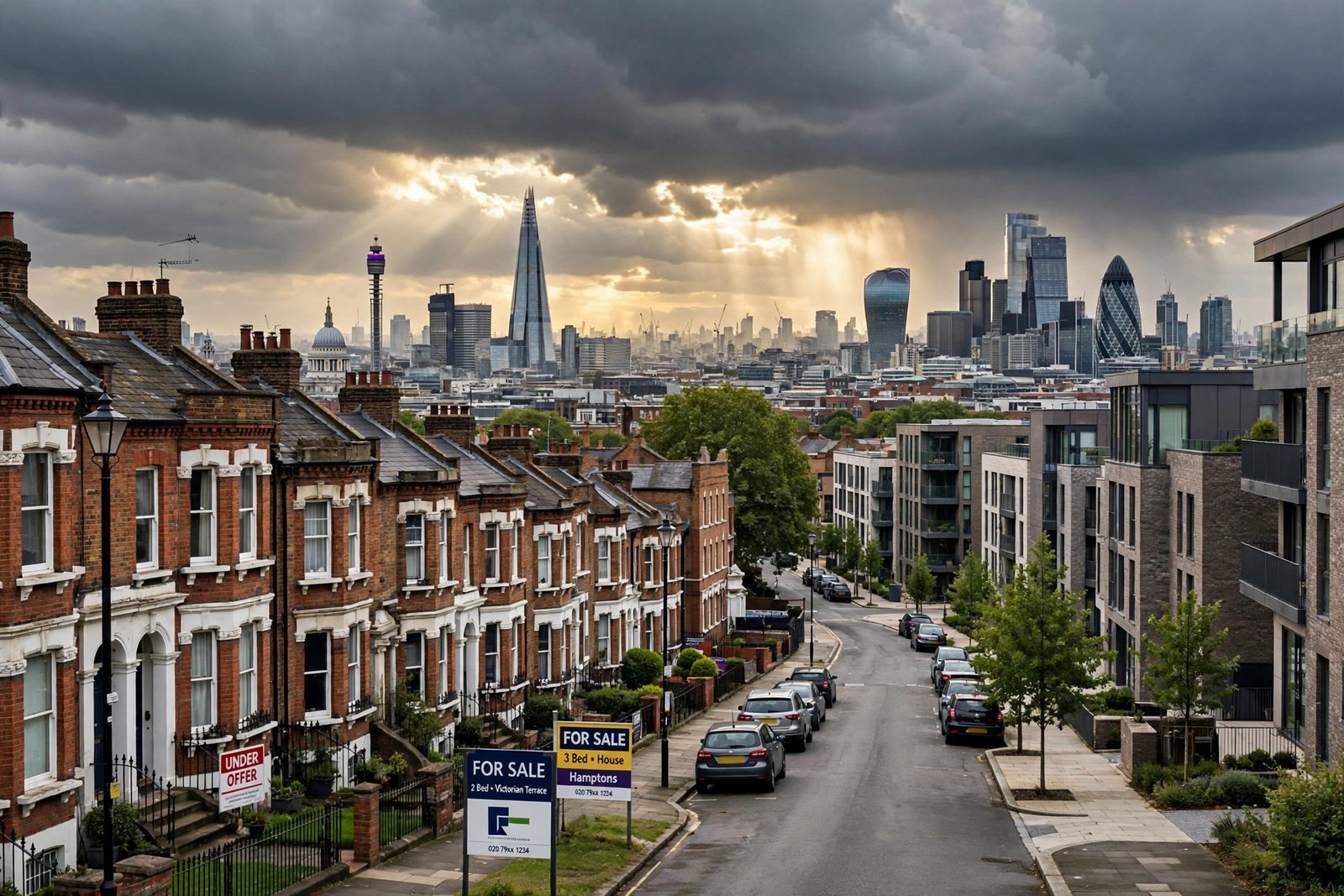
Why Is London Property So Expensive in 2026? The Real Reasons
Every few months someone declares that London property prices must surely fall — and every few months the capital politely ignores them. In 2026, the average London home still costs north of £540,000, roughly eleven times the average London salary. A one-bedroom flat in Zone 2 can swallow a salary that would buy a detached house with a garden in the North. So why does the world’s most expensive property market refuse to budge? The answer is not one villain but a pile of structural, financial and cultural forces that keep colliding in the capital.
The shortage no one has fixed
The single biggest driver is simple supply and demand. London has built too few homes for decades. Successive governments have promised 300,000 new homes a year across England; delivery has repeatedly fallen short, and London’s share has been particularly grim. Green belt restrictions, slow planning decisions, and high construction costs mean completions lag far behind household formation.
The capital’s population keeps growing even as building stalls. International students, migrant workers and young professionals all need somewhere to live, and new-build completions in outer boroughs rarely make up the shortfall. When ten buyers chase every decent property, prices do not need much encouragement to stay high. Anyone renting will feel the same pressure — see our guide on how much deposit you need to rent a flat in London to understand what tenants face in the same squeezed market.
Land costs more than the building
Here is the part most people miss: in London, you are barely buying a house — you are buying land. Construction costs for a typical home might be £150,000 to £250,000, but the plot underneath can be worth two or three times that. Land values are a function of planning permission and scarcity, and London has the most constrained land supply of any major world city.
Every change of use, from office to residential or commercial to mixed-use, carries enormous value uplift. That uplift gets priced into every deal, every development appraisal and ultimately every asking price. High building costs since the pandemic — materials inflation, labour shortages, stricter building safety rules after the Grenfell-era reforms — have only added to the bill.
Cheap money’s long shadow
Even though mortgage rates are higher than the rock-bottom era of 2020–2021, London prices were set during that era of near-free money. Rates under 2% let buyers borrow far more, and sellers anchored their expectations to those valuations. The market has not yet fully reset to today’s 4–5% rates because many owners simply refuse to sell at a loss — and can afford to wait.
According to the Bank of England, rate cuts in 2025 and 2026 have gently revived demand rather than crashed prices. Each quarter-point cut brings a wave of pent-up buyers back to viewings, supporting prices in popular boroughs. London’s market behaves less like a national housing market and more like a financial asset that gets repriced slowly.
The global money factor
London is not priced for Londoners alone. It is a global reserve asset for international buyers — from the Gulf, South Asia, Hong Kong and beyond — who park wealth in prime and super-prime property. Sterling’s relative weakness has periodically made this even more attractive, with foreign buyers effectively getting a currency discount on already-premium homes.
This matters even if you never look at a Kensington townhouse. Wealth at the top ripples downward: sellers in prime zones move to Zone 2, pushing up prices there; Zone 2 sellers move to Zone 3, and so on. The pressure cascades all the way out to places like Croydon and Barking. The HM Land Registry’s price paid data shows this ripple clearly across borough boundaries.
The rental squeeze props up prices
Paradoxically, unaffordable rents keep house prices high. When the average two-bed flat rents for £2,000+ a month, buying starts to look rational even at inflated prices — especially once you factor in paying off your own mortgage rather than a landlord’s. Investors see the same maths: strong rental yields in outer London keep buy-to-let demand alive.
The tenant-fee ban, stricter EPC requirements and tax changes have pushed some landlords out, reducing rental stock and pushing rents higher still — which again reinforces buying demand. It is a feedback loop with no obvious exit. If you are weighing the maths, our breakdown of the cost of living in London in 2026 puts renting and buying in full monthly context.
Planning, NIMBYism and the politics of height
London could build upwards — many argue it should — but planning politics resist it. Conservation areas, protected views of St Paul’s, height restrictions near airports and endless local objections slow or shrink developments. A scheme approved for 200 homes often emerges as 120, with years of delay baked in.
Compare that with cities like Tokyo, where liberal zoning keeps homes relatively affordable despite huge demand. London has chosen character and constraint over volume, and the price of that choice is paid by every first-time buyer. The National Planning Policy Framework has tried to push councils toward higher targets, but delivery remains the weak link.
What could actually bring prices down
Honest answer: probably not much in the short term. Three things could change the picture — a large-scale building programme sustained over a decade, a serious recession that forces distressed sales, or major tax reform targeting property wealth. None looks likely in 2026.
What buyers can do instead is play the long game: look at areas with confirmed transport upgrades, consider ex-council and new-build resales, and get realistic about deposit timelines. London rewards patience and punishes panic-buying. The price you pay matters less than whether you can comfortably sustain it through rate cycles.
The leasehold trap inflating London prices
One London-specific factor deserves its own mention: leasehold. Hundreds of thousands of London flats are leasehold, and in recent years ground rents, service charges and cladding remediation costs have added thousands a year to ownership costs. Buildings caught in the post-Grenfell safety crisis saw values collapse while owners paid five-figure bills — a scandal that is still unwinding.
Reforms have capped some ground rents and lease extension costs, and savvy buyers now scrutinise service charge accounts before offering. But the legacy of the leasehold system means two identical-looking flats can have wildly different true costs — another reason headline prices only tell half the story.
Conclusion
London property is expensive in 2026 because a growing population chases a chronically underbuilt housing stock on some of the world’s most valuable land, funded by global capital and propped up by a rental market that makes buying look like the least bad option. None of these forces is reversing soon, so affordability will stay brutal — but understanding the machinery helps you make smarter decisions within it, whether that means buying strategically, renting well, or relocating with your eyes open.
Frequently Asked Questions
Will London house prices fall in 2026?
Most forecasters expect modest growth or a flat market in 2026 rather than a crash. Chronic undersupply and renewed buyer demand after rate cuts continue to support prices, though overpriced stock can sit for months.
Which London boroughs are cheapest to buy in?
Barking and Dagenham, Bexley and Havering typically have the lowest average prices, though “cheap” still means £350,000–£400,000 for a typical home. Commuter towns just outside London can offer better value.
Is London property a good investment in 2026?
Capital growth has slowed compared with the 2010s, but rental demand remains fierce. Returns now depend more on yield and long holding periods than on rapid price appreciation — do the maths carefully before buying as an investment.
How much deposit do I need for a London home?
Most first-time buyers put down 10–15%. On a £450,000 flat that means £45,000–£67,500 plus stamp duty, fees and moving costs. Some lenders offer 5% deposit products but rates are higher.